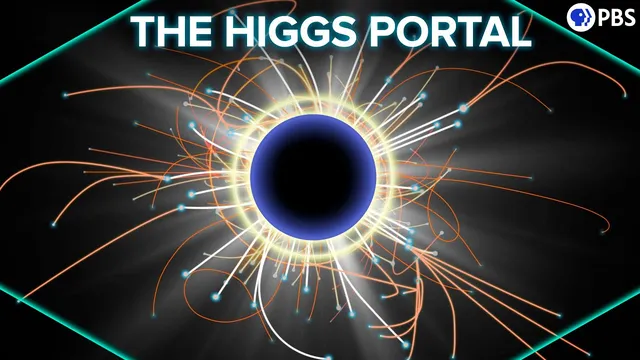
Could the Higgs Boson Lead Us to Dark Matter?
Based on PBS Space Time's video on YouTube. If you like this content, support the original creators by watching, liking and subscribing to their content.
Dark matter is inferred from gravitational effects on galaxies and cosmic structure, yet it doesn’t interact with ordinary matter strongly enough to be directly observed.
Briefing
The strongest thread tying the Higgs boson to dark matter is the possibility that the Higgs acts as a “portal” between ordinary matter and an unseen dark sector—meaning Higgs decays could produce invisible particles that escape detectors. Dark matter is inferred from gravity’s fingerprints on galaxies and the universe’s large-scale structure, yet it doesn’t show up in standard particle interactions. That mismatch with the Standard Model has pushed physicists toward theories where dark matter has mass and interacts with the Higgs field, even if it interacts only extremely weakly with known particles.
Dark matter searches generally fall into three strategies. Direct detection looks for rare collisions between dark matter and detector material, using massive underground liquid or crystal targets to block cosmic rays; no confirmed signal has emerged. Indirect detection searches for products of dark matter annihilation—such as gamma rays from regions with high dark-matter density—but astrophysical sources like pulsars, supernova remnants, and black-hole-related processes can mimic the signal. The third approach uses colliders: if dark matter particles are produced in high-energy collisions, they would be inferred indirectly from missing energy and momentum.
The Higgs enters this collider strategy because it is one of the few Standard Model particles plausibly connected to dark matter’s mass. Charged or color-charged particles (including electrons, muons, tau leptons, quarks, the W boson, and gluons) cannot decay into Higgs bosons, and photons are also excluded since dark matter is defined by not interacting with light. That leaves neutral candidates—especially the Z boson and the Higgs. The Z has been studied extensively at the Large Electron-Position Collider without evidence for interactions with dark matter, making it a less promising route. The Higgs, by contrast, could couple to dark matter through “Higgs portal models,” a family of theories where the Higgs field provides the doorway between the visible sector and a dark sector.
At the Large Hadron Collider, the key experimental trick is a momentum audit. In proton collisions, the transverse momentum (sideways relative to the beam) should sum to zero. If visible particles’ transverse momenta don’t balance, conservation laws imply something invisible carried away the missing momentum. Neutrinos can also be invisible, but they come with detectable charged-lepton partners, allowing experiments to account for that background in many cases.
One especially promising Higgs production mode is vector boson fusion, where quarks exchange W or Z bosons that fuse into a Higgs. The Higgs then decays quickly, and the analysis focuses on events consistent with “invisible” Higgs decays. The ATLAS experiment has aggregated results across Higgs production channels into a branching fraction for decays into undetectable particles. The Standard Model predicts up to about 17% of Higgs decays into invisible neutrinos, so 0.17 is the null expectation. ATLAS reports that the true branching fraction could be as high as 26%, with sizable uncertainties—meaning the result is tantalizing but not yet decisive. With the LHC restarting after a major upgrade and additional Higgs-focused collider plans on the horizon, the next step is simply more data to tighten the invisible-decay measurement and test whether the Higgs is indeed feeding a dark sector.
Cornell Notes
Dark matter leaves gravitational evidence but doesn’t show up in direct interactions with known particles, pushing searches toward “dark sector” ideas. Higgs portal models propose that the Higgs can connect ordinary matter to an unseen dark sector, so Higgs decays might produce invisible particles. Collider experiments infer such decays using missing transverse momentum: transverse momentum should balance to zero, so an imbalance suggests undetected products. The ATLAS experiment has measured an “invisible” Higgs branching fraction that could be up to 26%, compared with a Standard Model expectation of about 17% from neutrinos. Large uncertainties remain, so improved LHC data after upgrades is crucial to confirm or rule out new invisible decays.
Why does the Higgs boson get special attention in dark matter searches compared with other Standard Model particles?
What are the three main experimental approaches to finding dark matter, and what limits each one?
How does conservation of momentum help experiments detect “invisible” Higgs decays?
Why can’t the missing momentum always be blamed on neutrinos?
What did ATLAS measure regarding invisible Higgs decays, and how does it compare to the Standard Model?
Review Questions
- What does “invisible” mean in the context of Higgs decays, and how is it inferred experimentally?
- Explain how transverse momentum conservation is used to identify missing particles in collider events.
- Why are Higgs portal models considered a plausible bridge between the Standard Model and a dark sector?
Key Points
- 1
Dark matter is inferred from gravitational effects on galaxies and cosmic structure, yet it doesn’t interact with ordinary matter strongly enough to be directly observed.
- 2
Direct detection experiments use large underground detectors to search for rare dark matter scattering events, but no confirmed signals have been found.
- 3
Indirect detection searches for annihilation products such as gamma rays, yet astrophysical sources can produce similar signals.
- 4
Collider searches can infer dark matter production through missing transverse momentum, using momentum conservation to reveal invisible particles.
- 5
Higgs portal models propose that the Higgs field can connect the visible sector to a dark sector, making Higgs decays a promising route to dark matter.
- 6
ATLAS has measured an invisible Higgs branching fraction that could reach 26%, compared with a Standard Model expectation of about 17% from neutrinos, though uncertainties remain large.