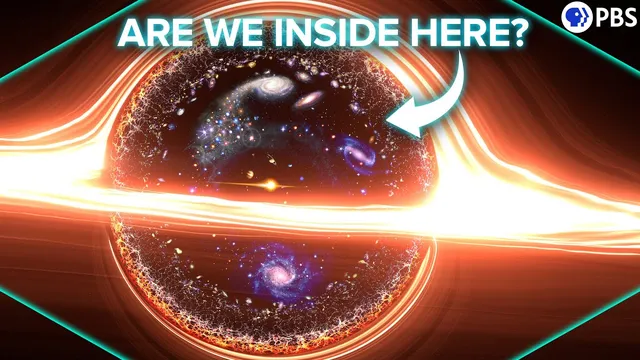
Could The Universe Be Inside A Black Hole?
Based on PBS Space Time's video on YouTube. If you like this content, support the original creators by watching, liking and subscribing to their content.
General relativity treats both the Big Bang and black holes as singularities where geodesics end, differing mainly in whether they occur in the past or future.
Briefing
The most striking claim in the discussion is that the observable universe could, in principle, be the interior of a black hole—specifically, that the Big Bang singularity might correspond to the “future singularity” inside a black hole, with the universe’s expansion playing the role of an event horizon. The idea matters because it would turn two of general relativity’s biggest trouble spots—the Big Bang and black hole interiors—into the same mathematical structure, potentially reframing what “inside” and “outside” even mean in cosmology.
General relativity predicts that collapsing matter can form an event horizon: a boundary where space itself flows inward at the speed of light, preventing anything from escaping once it crosses. Outside such a black hole, the region appears dark because light cannot return from below the horizon. Inside, geodesics—“straightest possible” paths through curved spacetime—terminate at singularities, where the theory’s mathematics breaks down. The Big Bang is also treated as a singularity, but as a past, space-like one: all geodesics in the universe converge to it in the past. A black hole contains a future, space-like singularity: geodesics within the horizon end at the singularity in the future. That past-versus-future distinction is the key similarity that makes the black-hole-universe analogy feel less like science fiction and more like a symmetry in the equations.
To make the interior of a black hole look like a universe to someone living there, the discussion leans on a time-reversal trick. A “white hole” is the time-reversed counterpart of a black hole and is a valid solution to Einstein’s equations. Its event horizon behaves oppositely: it can be crossed only from the inside to the outside. At first glance, white-hole interiors look nothing like the smooth, nearly homogeneous cosmos—curvature can change violently near the singularity, and some idealized solutions contain pure spacetime without matter. But there’s a route to disguise the difference: the Oppenheimer–Snyder model of black hole formation (from 1939, developed by Robert Oppenheimer and Hartland Snyder) treats a collapsing star as a spherical cloud with homogeneous density and zero pressure. Under that approximation, the interior remains flat and homogeneous until a singularity forms. Because the same homogeneity assumption underlies the Friedmann–Lemaître–Robertson–Walker (FLRW) metric used for cosmology, the interior of a collapsing star can be described by patching an FLRW-like region inside a Schwarzschild exterior—even after an event horizon forms.
If that construction works for a black hole, time reversal suggests it can work for a white hole too: a white hole could contain an expanding “bubble” that resembles our universe. The discussion points to Raj Pathria’s 1972 “Black Hole Cosmology” hypothesis as a concrete version of this proposal, and notes related ideas such as Lee Smolin’s “Cosmological Natural Selection,” where universes might emerge from bounces rather than singularities.
The final ingredient is Hawking’s 1999 argument: if a black hole is in equilibrium with Hawking radiation—absorbing radiation like the cosmic microwave background while emitting Hawking radiation—then the distinction between black holes and white holes becomes less clear. That doesn’t prove the universe is inside a black hole, but it removes an easy objection. The conclusion is cautious: there’s no compelling reason to believe the hypothesis is true, yet the mathematical parallels are strong enough that it remains an open “maybe.” If it were correct, black hole interiors would be more than doom; they could be structured like a cosmos, potentially leading to nested, self-similar universes beyond the horizon.
Cornell Notes
The discussion links black hole interiors and the Big Bang by focusing on how general relativity treats singularities and geodesics. Both the Big Bang and black holes are singularities where geodesics end, differing mainly in whether they occur in the past (Big Bang) or future (black hole interior). To make a black/white-hole interior resemble our universe, the argument uses time reversal (white holes) and the idea that an FLRW-like, homogeneous interior can be patched inside a Schwarzschild exterior, drawing on the Oppenheimer–Snyder collapse model. Raj Pathria’s 1972 hypothesis and related “natural selection” ideas propose that such interiors could look like expanding universes. Hawking’s equilibrium reasoning (1999) further blurs the black-hole/white-hole distinction, leaving the claim as speculative but not easily dismissed.
Why does the analogy between the Big Bang and black holes start with geodesics and singularities?
What role does the event horizon play in making a black hole look different from the outside?
How can a black hole interior be made to resemble a homogeneous expanding universe?
Why does the discussion introduce white holes instead of only black holes?
What does Hawking’s 1999 equilibrium argument change about the black-hole-versus-white-hole distinction?
What is the overall stance on whether the universe is actually inside a black hole?
Review Questions
- What is the difference between a past, space-like singularity and a future, space-like singularity, and how does that map onto the Big Bang versus black hole interiors?
- How does the Oppenheimer–Snyder model help connect black hole interiors to the FLRW description used in cosmology?
- What conditions does Hawking’s equilibrium argument require, and why does it make black holes and white holes harder to distinguish?
Key Points
- 1
General relativity treats both the Big Bang and black holes as singularities where geodesics end, differing mainly in whether they occur in the past or future.
- 2
An event horizon prevents escape from a black hole because space flows inward at the speed of light at the boundary.
- 3
A time-reversed black hole (a white hole) offers a way to align a singularity’s time direction with the Big Bang’s past singularity.
- 4
The Oppenheimer–Snyder collapse model uses homogeneous, zero-pressure matter to keep an interior region flat and homogeneous, enabling an FLRW-like patch inside a Schwarzschild exterior.
- 5
If an FLRW-like interior can be hidden inside a black hole, time reversal suggests a white hole could contain an expanding bubble resembling our universe.
- 6
Hawking’s equilibrium reasoning (1999) can blur the distinction between black holes and white holes, making the hypothesis harder to dismiss outright.