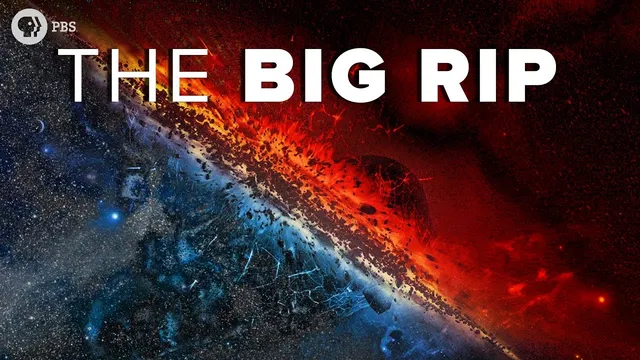
Could the Universe End by Tearing Apart Every Atom?
Based on PBS Space Time's video on YouTube. If you like this content, support the original creators by watching, liking and subscribing to their content.
A big rip requires dark energy to strengthen over time, which corresponds to an equation-of-state parameter w < −1 (phantom energy).
Briefing
The universe could end in a “big rip” if dark energy isn’t constant but instead grows stronger over time. In that scenario, the accelerated expansion would eventually tear apart every bound structure—from galaxy clusters down to atoms—because the outward push from dark energy would outpace gravity at progressively smaller scales. The key trigger is an equation-of-state parameter for dark energy, w, less than −1, a regime often labeled “phantom energy.”
Under Einstein’s general relativity, the expansion rate depends not only on energy density but also on pressure. Normal matter and radiation effectively slow expansion, while a cosmological constant (the usual model for dark energy) produces acceleration because its pressure is negative and tightly linked to its density. For a constant dark energy density, the acceleration stays steady and the universe trends toward a “heat death,” where galaxies drift apart but remain intact within their gravitationally bound regions.
The big rip changes the rules by letting dark energy density increase as space expands. When w drops below −1, the density grows instead of staying fixed, so the acceleration itself accelerates. Space between distant regions can then separate faster than light, creating a shrinking “cosmic event horizon”—the boundary beyond which signals can never reach us. If that horizon contracts past the size of the smallest bound structures, interactions can no longer occur anywhere, and matter is progressively dismantled.
The transcript lays out a timeline using a representative phantom-energy value, w = −1.5. In that estimate, the big rip arrives about 22 billion years from now. Roughly a billion years before the end, galaxy clusters are pulled apart; about 60 million years before, the Milky Way would be shredded. Even then, the cosmic event horizon is still far enough away that some galaxies remain visible for a while, allowing a final period of astronomical “disassembly” before the last bound systems fail. The final stage is described as extremely rapid: in the last 30 minutes, phantom energy overwhelms Earth’s gravitational binding, and within about 10^-19 of a second it would defeat chemical bonds, then nuclear forces, leaving only isolated elementary particles separated by ever-expanding space.
Confidence that this won’t happen comes from measurements of dark energy’s equation of state. Observations combining the Cosmic Microwave Background, baryon acoustic oscillations, and supernovae place w very close to −1. A Planck-based estimate quoted in the transcript gives w = −1.028 ± 0.032, leaving phantom energy as a faint possibility but pushing the big rip far out—on the order of tens of billions of years even under extreme assumptions. The stronger case for w = −1 rests on the apparent fine-tuning of being so close to −1, a physical motivation for a constant vacuum energy density, and theoretical objections: phantom energy violates energy conservation more severely and runs into problematic energy conditions in general relativity.
Still, there’s a lingering hint from distant quasars suggesting w might be slightly less than −1, though not with enough statistical weight to overturn the broader dataset. Even if dark energy changes in the future, the transcript notes that many alternatives still lead to no recollapse because the universe is already expanding too fast. The result is a universe that most likely ends quietly—but with a nonzero chance of a spectacular, scale-by-scale disintegration.
Cornell Notes
Dark energy drives the universe’s accelerated expansion. If it behaves like a true cosmological constant (w = −1), acceleration stays steady and the universe heads toward heat death. But if dark energy is “phantom energy” with an equation-of-state parameter w < −1, its density increases as space expands, making the acceleration grow without bound. That runaway expansion shrinks the cosmic event horizon until it becomes smaller than bound structures, eventually preventing particles from interacting. Current observations put w very close to −1, making a big rip unlikely, though a small quasar-based hint keeps the possibility alive.
What does the equation-of-state parameter w tell cosmologists about dark energy’s behavior?
Why does w < −1 lead to a “big rip” rather than just faster expansion?
How does the cosmic event horizon connect to the fate of galaxies and atoms?
What timeline is given for the big rip using w = −1.5?
What observations constrain w, and what do they imply about the big rip’s likelihood?
What evidence suggests w might be slightly less than −1, and how strong is it?
Review Questions
- How do pressure and energy density enter the cosmological acceleration equation, and why does negative pressure matter for dark energy?
- Explain the chain of causation from w < −1 to increasing dark energy density, then to a shrinking cosmic event horizon, then to the breakup of bound structures.
- What specific observational datasets are used to constrain w, and what numerical range for w is quoted from Planck?
Key Points
- 1
A big rip requires dark energy to strengthen over time, which corresponds to an equation-of-state parameter w < −1 (phantom energy).
- 2
For w = −1 (cosmological constant), dark energy density stays constant and acceleration remains steady, making heat death the expected end state.
- 3
If w < −1, the acceleration grows, recession speeds exceed light speed on larger scales, and the cosmic event horizon shrinks.
- 4
The shrinking horizon can eventually become smaller than bound structures, preventing particles from interacting and leading to disintegration from galaxies down to atoms.
- 5
Current constraints from Cosmic Microwave Background, baryon acoustic oscillations, and supernovae place w very close to −1 (quoted: w = −1.028 ± 0.032), making a big rip unlikely.
- 6
A quasar-based hint may allow w slightly below −1, but it lacks enough significance to override the dominant evidence.
- 7
Even if dark energy changes but does not become strongly phantom, the universe likely still won’t recollapse because expansion is already too fast.