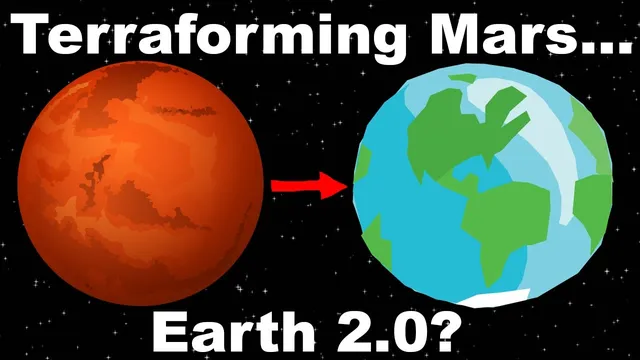
Could We Have a Second Home on Mars?
Based on Second Thought's video on YouTube. If you like this content, support the original creators by watching, liking and subscribing to their content.
Terraforming Mars is presented as a survival and continuity strategy driven by extinction risk and uncertainty about Earth’s long-term carrying capacity.
Briefing
Terraforming Mars is framed as a long-horizon survival strategy: Earth’s population is rising fast, extinction events remain a constant threat, and Mars is the closest candidate for a “backup” world. The case for Mars rests on feasibility relative to other targets like Venus, Europa, and Titan, plus the scientific payoff of building the technologies needed for sustained life off-planet. The core question becomes practical: what would it take to turn a cold, thin-atmosphere, radiation-exposed planet into one that can support humans?
Mars starts with four major barriers. Its average temperature is far too low for long-term human exposure. Its atmospheric pressure is too thin to sustain liquid water, and without water the planet can’t become truly habitable. The atmosphere is mostly carbon dioxide, which would be toxic for humans to breathe. Finally, Mars lacks a global magnetic field, leaving it exposed to solar wind and charged particles that both strip away atmosphere and deliver harmful radiation.
The proposed solutions largely move in a coordinated chain. The first and biggest lever is warming the planet. Mars likely once had oceans and a thicker atmosphere, but over time the atmosphere was stripped away, leaving polar ice caps and subsurface ice. The main strategy is to trigger a greenhouse-gas “domino effect”: release large quantities of greenhouse gases to warm the surface, melt CO2-rich ice, and then let the released CO2 generate additional warming until polar ice caps melt into oceans. Kickstarting that process is where the ideas range from industrial to extreme. One early concept—factories on Mars producing greenhouse gases—runs into prohibitive logistics and cost. More dramatic proposals include redirecting or impacting Mars with ammonia-rich asteroids, using the ammonia as a warming agent to initiate runaway global warming. Another option is detonating thermonuclear warheads over the poles, a suggestion associated with Elon Musk, aimed at rapidly boosting temperatures and melting polar ice. A less destructive alternative involves placing giant mirrors in orbit to concentrate sunlight on the poles, trading speed for environmental restraint.
Once temperatures rise, the next hurdle is breathable air. Shipping oxygen canisters is described as too expensive, so attention shifts to biology. Researchers are working on sending bacteria or algae to Mars that can use Martian soil as “fuel” to produce oxygen. Depending on efficiency, these organisms could be spread across the surface or confined to smaller biospheres where colonists could also farm and support oxygen production. Over time—potentially aided by future improvements—Mars air could become breathable enough to reduce reliance on enclosed habitats.
The final challenge is radiation protection. Without a magnetosphere, Mars would need an artificial magnetic field to shield the surface and help restore atmospheric conditions. NASA scientist Jim Green proposed in late February 2017 that deploying a magnetic dipole field between Mars and the sun could help the planet recover from solar bombardment. The plan calls for a super-powerful magnet (1–2 Tesla) placed in L1 orbit; Green’s paper suggests that if deployed, Mars could reach about half Earth’s atmospheric pressure within years. With a thicker atmosphere, frozen CO2 at the poles would sublimate, further warming the climate and accelerating ice melt—potentially making a habitable Mars achievable on a relatively near timescale, though still not within human lifetimes. The overall message is that terraforming is not a single invention but a sequence of interlocking engineering breakthroughs, aimed at reducing extinction risk and preserving humanity’s long-term future beyond Earth.
Cornell Notes
Mars is presented as the most feasible “backup home” because it’s the closest candidate among several options, even though it is currently too cold, too airless, too CO2-heavy, and too exposed to radiation. Making it habitable requires solving four linked problems: raising temperature, increasing atmospheric pressure to enable liquid water, changing the atmosphere so humans can breathe, and protecting the surface from solar wind. Warming is targeted first through greenhouse-gas feedback, potentially triggered by ammonia-rich asteroid impacts, thermonuclear heating of the poles, or orbital mirrors. Oxygen could come from engineered bacteria or algae that produce O2 using Martian soil, while radiation protection may require an artificial magnetic field—such as Jim Green’s proposed dipole field in L1 orbit using a 1–2 Tesla magnet.
Why is Mars considered a practical target for a second habitable world compared with other candidates?
What are the four core barriers to human habitability on Mars?
How does the greenhouse-gas plan for warming Mars work, and why is it described as a feedback loop?
What are the proposed ways to kickstart Mars warming, and what tradeoffs do they imply?
How would oxygen and radiation protection be handled after warming and atmospheric changes begin?
Review Questions
- Which of the four Mars barriers is targeted first, and how does solving it help with the others?
- Compare the three warming kickstart methods (ammonia-rich asteroids, thermonuclear heating, orbital mirrors): what differs most is speed, cost, and environmental impact—how does that shape feasibility?
- What conditions would need to be met for Jim Green’s magnetic dipole concept to meaningfully increase Mars’s atmospheric pressure?
Key Points
- 1
Terraforming Mars is presented as a survival and continuity strategy driven by extinction risk and uncertainty about Earth’s long-term carrying capacity.
- 2
Mars habitability hinges on four linked fixes: higher temperature, higher atmospheric pressure for liquid water, a breathable atmosphere (less CO2, more oxygen), and radiation protection without a natural magnetosphere.
- 3
Warming is expected to follow a greenhouse feedback loop: greenhouse-gas release melts CO2-rich ice, which releases more CO2 and accelerates warming.
- 4
Ammonia-rich asteroid impacts, polar thermonuclear detonations, and orbital mirrors are offered as different ways to trigger the greenhouse “domino effect,” each with different tradeoffs.
- 5
Oxygen production is framed as more feasible through bacteria or algae that can generate O2 using Martian soil than through shipping oxygen canisters.
- 6
Radiation shielding may require an artificial magnetic field; Jim Green’s 2017 proposal uses a 1–2 Tesla magnet in L1 orbit to create a dipole field between Mars and the sun.
- 7
Even with today’s start, terraforming is portrayed as a multi-year to multi-decade process, not something that becomes livable quickly.