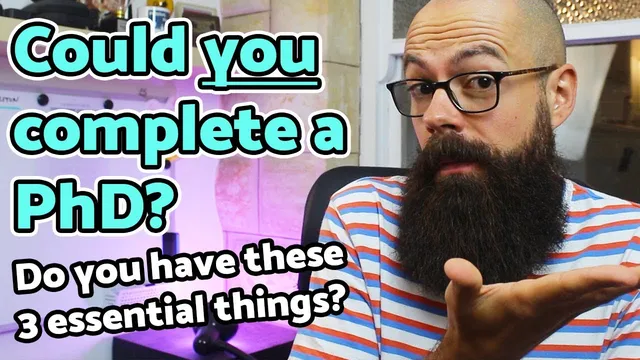
Could you complete a PhD? The 3 attributes you need!
Based on Andy Stapleton's video on YouTube. If you like this content, support the original creators by watching, liking and subscribing to their content.
PhD completion depends more on resilience, enjoyment, and execution than on undergraduate grades or exam cleverness.
Briefing
Completing a PhD depends less on being “clever” and far more on three practical attributes: resilience through the messy reality of research, genuine enjoyment of the work, and the ability to execute—turning theory into repeated, imperfect action. Grades and undergraduate credentials matter only indirectly; a PhD demands a different skill set than exam performance and coursework completion.
Undergraduate success often rewards linear progress: study, sit exams, earn grades. Research training breaks that pattern. PhD work throws students into uncertainty where experiments fail, opportunities vanish, and feedback can be harsh—sometimes repeatedly. The core determinant becomes how well someone can “weather” the ups and downs. That resilience includes accepting that emotional reactions to failure are normal, taking time to process setbacks (even crying if needed), and then switching back into problem-solving mode. Failure is treated as information rather than a verdict: a step backward can reveal another method that doesn’t work, which then guides the next attempt. The long-term plan still matters, but progress rarely moves in a straight line; it advances through persistence while staying “in the game.”
The second attribute is enjoyment. The most effective PhD students tend to be genuinely interested in the questions they’re pursuing and the scientific process itself—whether that means lab work, literature research, or discipline-specific methods. Undergraduate programs only offer a limited taste of research, so many students arrive expecting a familiar academic routine and instead feel disoriented. That reaction is not a moral failing; if someone truly hates the work, the advice is to leave rather than cling to a sunk-cost belief (“I’m here, so I must continue”). Enjoyment doesn’t mean constant happiness—grant writing, experiments, and revisions can be draining—but it does mean being excited by generating ideas, testing hypotheses, and learning from what doesn’t pan out.
The third attribute is execution, framed as bridging the “learning doing gap.” Knowing theory is not the same as applying it in practice. Research requires organizing real-world constraints—supplies, procedures, experimental design—and overcoming self-limiting beliefs. Execution also means accepting that failure will happen more often than success, then continuing until results emerge. The thesis is built “brick by brick,” often through daily writing and repeated experimentation. Thinking matters, but thinking alone won’t finish a PhD; the work is completed by repeatedly turning ideas into action, even when the experiments are imperfect.
Taken together, these three factors—resilience, enjoyment, and execution—explain why some students with average grades thrive in PhD environments while others with strong academic records struggle. The practical takeaway is straightforward: if someone can handle emotional setbacks, actually wants the work, and can consistently apply theory to messy experiments and writing, finishing becomes far more achievable than raw academic cleverness alone.
Cornell Notes
A PhD is not primarily a test of cleverness or top grades; it’s a long process shaped by resilience, enjoyment, and execution. Success depends on weathering the unpredictable cycle of failed experiments, delayed progress, and difficult feedback—treating setbacks as information and continuing anyway. Enjoyment matters because research is different from undergraduate coursework and can feel alien at first; genuinely interested students are more likely to persist through the ups and downs. Execution is the “learning doing gap”: turning theory into real lab or research practice through organized, repeated, imperfect action and daily writing. Together, these traits determine whether someone can build a thesis over years.
Why do undergraduate grades often fail to predict PhD completion?
What does “weathering success” mean in the context of PhD research?
How should a student respond if they discover they don’t enjoy research?
What is the “learning doing gap,” and why is it central to executing a PhD?
What does execution look like day-to-day in building a PhD thesis?
Review Questions
- Which of the three attributes—resilience, enjoyment, execution—feels most missing in your current PhD experience, and what evidence supports that?
- Describe a time you treated failure as information rather than a final verdict. How did that change the next attempt?
- What specific actions would help you close the “learning doing gap” in your own research (e.g., experimental planning, daily writing, iterative testing)?
Key Points
- 1
PhD completion depends more on resilience, enjoyment, and execution than on undergraduate grades or exam cleverness.
- 2
Research progress is inherently non-linear; setbacks, emotional dips, and backward steps are normal parts of the path.
- 3
Resilience means processing the emotional impact of failure and then switching back to analytical problem-solving and iteration.
- 4
Enjoyment increases the odds of finishing because research requires sustained interest through grant writing, experiments, and revisions.
- 5
If someone discovers they truly hate research, the transcript frames leaving as a valid choice rather than clinging to sunk-cost thinking.
- 6
Execution bridges the “learning doing gap” by turning theory into real-world practice through organized, repeated, imperfect action.
- 7
A PhD thesis is built through daily experimentation and writing; thinking alone won’t complete it.