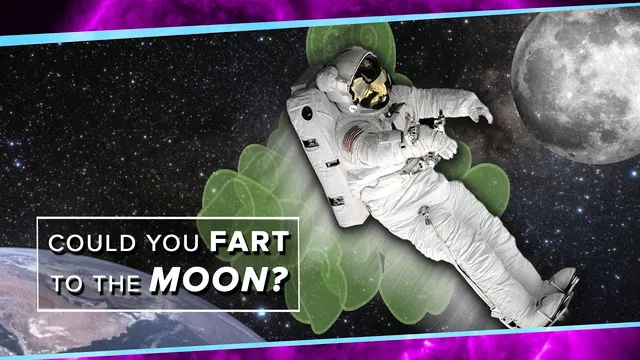
Could You Fart Your Way to the Moon?
Based on PBS Space Time's video on YouTube. If you like this content, support the original creators by watching, liking and subscribing to their content.
Rocket propulsion can be understood as momentum conservation from expelling mass, not as a requirement to ignite fuel.
Briefing
Fart-powered space travel fails for a simple reason: there isn’t enough expelled mass to generate meaningful momentum in the long run. Rockets work by throwing mass one way so the rest of the system moves the other way, and the same momentum-conservation rule applies to any “gas rocket,” including flatulence. In space, where there’s no air to push against, the only way to move is to eject something—so the question becomes whether a human can eject enough gas fast enough to matter.
The analysis starts by clearing up a common misconception: rockets don’t need to “burn” to accelerate. Any mechanism that ejects mass at high enough speed produces thrust, because the ejected material carries away momentum and the rocket must recoil to keep total momentum balanced. Chemical rockets achieve that by heating propellant until it expands into fast-moving gas particles that escape the nozzle; the same thrust could be produced in principle by non-burning “throwing” systems, as long as enough mass is expelled sufficiently fast.
Turning to farts, the episode treats flatulence as “throwing gas” and estimates the recoil from typical human output. Using an exhaust speed estimate of about 3 meters per second and an estimated total mass of roughly one gram of flatus produced over 24 hours, the recoil speed comes out to only about 43 microns per second. That translates to roughly 1.3 kilometers per year—so slow that even in a vacuum it would take hundreds of thousands of years to cover the Earth–Moon distance, and the situation is even worse once gravity is included. The core bottleneck is mass: even if the gas exits, the amount of gas is too small to build up useful momentum.
The discussion then shifts from “moon travel” to a more realistic emergency scenario. If someone were stranded 10 meters from an airlock on the ISS, farting could, in principle, get them there—over about two and a half days if they build up and release gas in bursts (or about three and a half days if they take a full 24 hours to accumulate the roughly one gram). Sneezing is suggested to be similar in effect because its mass and exit speed are comparable to farts.
Peeing, however, changes the math dramatically. Urine streams are estimated to exit at roughly 3–4 meters per second, and a full bladder holds about half a liter—around 0.5 kilograms. That’s roughly 500 times the mass of a day’s worth of gas, so momentum conservation implies a recoil velocity about 500–700 times larger. The result: a recoil speed on the order of tens of meters per hour, enough to return to the ISS in under eight minutes.
The episode closes with a blunt comparison: to match urine’s effect with farting, the required exhaust velocity would need to exceed Mach 4 (over 3,000 miles per hour), far beyond anything achievable by “nozzle engineering.” The practical takeaway is that sideways farting is technically possible but wildly inefficient, while peeing—or simply throwing something heavier—would produce far more recoil.
Cornell Notes
Momentum conservation governs any “body-function rocket”: ejecting gas pushes the body in the opposite direction. Using typical estimates for fart exhaust speed (~3 m/s) and total daily gas mass (~1 gram), the recoil speed is only ~43 microns per second, yielding about 1.3 km per year—far too slow for Earth–Moon travel. In a short-range ISS emergency (10 meters), farting could theoretically work over days by accumulating and releasing gas in bursts. Sneezing is suggested to be similar. Peeing is vastly more effective because a full bladder (~0.5 kg) is ~500 times the mass of daily flatus, producing recoil sufficient to return to the ISS in under eight minutes.
Why doesn’t a “fart rocket” work for long-distance space travel even in a vacuum?
What misconception about rockets does the episode correct?
Could farting help in a real ISS-style emergency?
How does peeing compare to farting, quantitatively?
What would it take for farting to match peeing’s effectiveness?
Review Questions
- What physical law ties the body’s motion to the speed and mass of expelled gas?
- Using the episode’s assumptions, why does increasing time (accumulating more gas) help farting but still not make it viable for Earth–Moon travel?
- Why does peeing produce a much larger recoil than farting even if both have similar exhaust speeds?
Key Points
- 1
Rocket propulsion can be understood as momentum conservation from expelling mass, not as a requirement to ignite fuel.
- 2
A typical daily output of flatus is about 1 gram, which severely limits the total momentum available for recoil.
- 3
With an assumed fart exhaust speed near 3 m/s, the resulting recoil speed is only about 43 microns per second—around 1.3 km per year.
- 4
In a short-range ISS scenario (10 meters), farting could theoretically work but would take days due to the small total gas mass.
- 5
Peeing is far more effective because a full bladder holds about 0.5 kg, roughly 500 times the mass of daily flatus.
- 6
Matching urine’s effect with farting would require exhaust speeds above Mach 4, which is beyond practical human capability.