CPU vs GPU vs TPU vs DPU vs QPU
Based on Fireship's video on YouTube. If you like this content, support the original creators by watching, liking and subscribing to their content.
CPUs are optimized for sequential, branching-heavy logic and general-purpose tasks like running operating systems and managing hardware.
Briefing
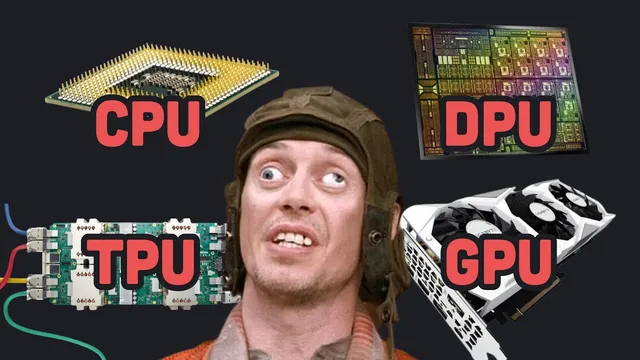
The core takeaway is that modern chips aren’t interchangeable “brains”—CPU, GPU, TPU, and DPU each specialize in different kinds of computation, and that specialization is why they outperform one another on the tasks they’re built for. CPUs handle general-purpose, logic-heavy work with strong support for sequential execution and branching. GPUs accelerate massively parallel math, especially graphics and deep learning. TPUs push that parallelism further for tensor operations used in neural networks. DPUs offload data-heavy networking and security workloads from CPUs, letting general-purpose cores focus on application logic.
The CPU story starts with how computers evolved from early mechanical and transistor-based designs into today’s programmable processors. The transcript traces milestones from the Z1 (a 1936 programmable machine later destroyed in 1943) to the Von Neumann architecture, where instructions and data share memory, and then to the transistor and integrated circuit that made high-speed computing practical. The CPU’s job description is then made concrete: it runs the operating system, executes programs, manages hardware, and pulls data from RAM using cache hierarchies for speed. CPUs are optimized for sequential computation with extensive branching—think conditional logic like “if/else” in routing algorithms. They also scale via multiple cores, enabling parallelism across applications through multi-threading. But scaling cores has limits: power draw and heat rise quickly, leading to diminishing returns. The transcript cites typical high-end limits around 24 cores for consumer systems, while data centers can use far larger multi-core chips such as a 128-core AMD EPYC.
From there, the GPU becomes the “parallel math” engine. GPUs were built for graphics, but their thousands of simpler cores excel at the linear algebra and matrix operations behind rendering and deep learning. The transcript contrasts CPU and GPU design: a CPU core is faster and better at complex branching, while a GPU core is optimized for simpler operations that can run in parallel. That’s why GPUs dominate workloads like rendering frames and training neural networks, where the same mathematical operations repeat across huge datasets.
TPUs (Tensor Processing Units) are presented as a further specialization for neural-network tensor workloads. Similar in spirit to GPUs, TPUs are engineered for tensor operations such as matrix multiplication. Developed by Google in 2016 and integrated with TensorFlow, they use thousands of multiply-accumulators to perform matrix math efficiently without the same reliance on registers or shared memory typical of GPU approaches—positioned as a way to cut training time and cost.
DPUs (Data Processing Units) shift the focus from compute to data movement. Designed mainly for big data centers, they’re often based on ARM and optimized for tasks like packet processing, routing, security, compression, and encryption. The goal is to relieve CPUs from data plumbing so general-purpose cores can spend more cycles on application logic.
Finally, the transcript adds a wildcard: the QPU, or Quantum Processing Unit. Instead of bits (0/1), quantum computers use qubits that can exist in superposition and become entangled across distance. Quantum gates manipulate qubits in ways classical logic can’t replicate. The major implication highlighted is cryptography: quantum algorithms such as Shor’s algorithm could factor numbers exponentially faster than classical brute force, threatening RSA-style security—though no quantum system today is described as capable of running that attack at scale.
Cornell Notes
CPUs, GPUs, TPUs, and DPUs are specialized processors built for different bottlenecks: logic and branching (CPU), massive parallel math (GPU), tensor-heavy neural network operations (TPU), and data-heavy networking/security tasks (DPU). CPUs run operating systems and general programs, using caches and multi-core parallelism, but scaling cores hits power and heat limits. GPUs trade per-core complexity for thousands of parallel cores, making them ideal for graphics rendering and deep learning matrix operations. TPUs are purpose-built for tensor operations like matrix multiplication and were developed by Google for TensorFlow workflows. DPUs offload packet processing, routing, security, compression, and encryption from CPUs in data centers. A QPU is mentioned as a future wildcard that could disrupt encryption via quantum algorithms.
Why do CPUs struggle to “just do everything” that GPUs do?
What architectural idea makes the Von Neumann model central to how modern computers run programs?
How do GPUs and TPUs differ in what they accelerate?
What does a DPU offload, and why does that matter for data centers?
What makes quantum computing fundamentally different from classical computing in this explanation?
Why is RSA highlighted as vulnerable in a quantum future?
Review Questions
- Which chip type is best aligned with sequential branching-heavy workloads, and what CPU feature supports that?
- What specific mathematical operation is repeatedly emphasized as a strength of GPUs and TPUs?
- How do DPUs change the division of labor between compute and data movement in data centers?
Key Points
- 1
CPUs are optimized for sequential, branching-heavy logic and general-purpose tasks like running operating systems and managing hardware.
- 2
Multi-core CPUs enable parallelism across applications, but power and heat make large core counts expensive and inefficient beyond certain limits.
- 3
GPUs accelerate workloads that can be expressed as large-scale parallel math, which is why they dominate graphics rendering and deep learning training.
- 4
TPUs are specialized for tensor operations—especially matrix multiplication—built to work efficiently with TensorFlow-style neural network workloads.
- 5
DPUs focus on offloading data-center networking and security tasks (packet processing, routing, encryption, compression) so CPUs can concentrate on application logic.
- 6
Quantum processing uses qubits with superposition and entanglement, and quantum algorithms such as Shor’s algorithm could threaten RSA-style encryption if quantum hardware becomes capable at scale.