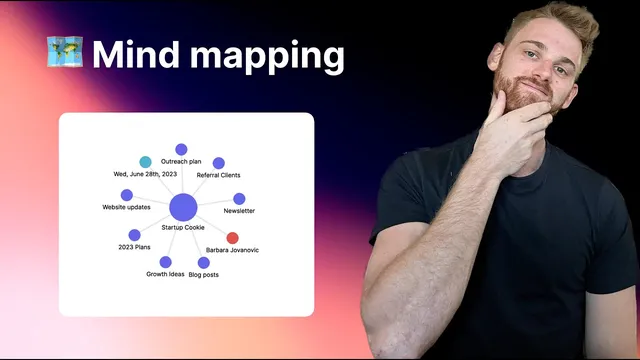
Create a mind map out of your notes
Based on Reflect Notes's video on YouTube. If you like this content, support the original creators by watching, liking and subscribing to their content.
Use bidirectional backlinks so relationships between notes appear as connected nodes in the graph.
Briefing
A network-style mind map can grow from a handful of linked notes into a sprawling web of ideas—by using bidirectional backlinks between daily notes and every “entity” worth tracking. After months of use, the map shows colored nodes representing different note types (companies, people, daily notes, and other entries) connected through two-way links, so related items automatically surface as part of a connected graph rather than staying isolated.
Getting started is intentionally simple: begin with a mostly blank graph, then create a new note and link it back to existing notes. In the example, the map initially contains only two nodes—Reflect B company note and Alex McCaw’s personnel note—while a daily note sits unconnected because no content has been written into it yet. Once a user creates a new “to do” note and backlinks it from the daily note, and also backlinks Alex McCaw’s note from that same daily note, the graph immediately gains new connections. The result is a small cluster where Reflect B connects to Alex McCaw, and both connect to the daily note via the backlinks.
That small cluster is the template for expansion. Each new daily note created over time becomes a hub that links to newly mentioned companies, people, projects, and task lists. As the user continues backlinking, the mind map spreads outward—new nodes appear and connect, turning a starting point into an interconnected knowledge network. The practical takeaway is that the daily workflow drives the structure: capture what happens, then backlink everything relevant.
A simple rule of thumb guides what to link: if a term begins with a capital letter, it deserves a backlink. That convention helps ensure the map consistently captures named entities—people, organizations, projects, and other proper nouns—without requiring complex categorization up front.
For organization, the map includes filters that can hide “unlinked” notes (nodes that still appear in the graph but aren’t connected to anything). In the more complex example, some nodes resemble “satellites” orbiting a central area; these are unlinked notes that clutter the view. By toggling filters—such as removing unlinked or blank nodes—the graph becomes cleaner and easier to interpret. Users can also temporarily remove daily nodes to focus on project nodes and the work they’re driving.
In short: build the mind map by backlinking from daily notes to capitalized entities, then use filters to keep the graph readable as it grows from a few nodes into a full network of relationships.
Cornell Notes
A network mind map grows automatically when daily notes backlink to named entities—people, companies, projects, and task lists—using bidirectional links. Starting from a nearly blank graph, adding a to-do note and backlinking it (along with a person’s note) from a daily note immediately creates visible connections between nodes. As new daily notes are created over time, each one becomes a hub that links newly mentioned entities, turning a small cluster into a large web. Capitalization provides a practical rule: if it starts with a capital letter, it should get a backlink. Filters can hide unlinked or blank nodes to reduce clutter and let users focus on projects or other subsets.
How does a mind map turn from a blank graph into a connected network?
Why do bidirectional backlinks matter for how the map behaves?
What’s the simplest rule for deciding what to backlink?
How do filters help when the map gets cluttered?
How can users focus on different parts of their knowledge network?
Review Questions
- When you create a new daily note, what specific action makes it start connecting to other nodes in the mind map?
- What does the “capital letter” rule help you capture, and why is it useful for building a network over time?
- How would hiding unlinked notes change what you can infer from the mind map?
Key Points
- 1
Use bidirectional backlinks so relationships between notes appear as connected nodes in the graph.
- 2
Start with a blank or nearly blank map, then create a new note and backlink it from an existing daily note to generate connections immediately.
- 3
Treat daily notes as hubs: each day’s entries should backlink to people, companies, projects, and task lists mentioned that day.
- 4
Adopt the capitalization rule—if it begins with a capital letter, backlink it—to consistently capture named entities.
- 5
Expect the map to expand organically as new daily notes are created and linked to newly mentioned items.
- 6
Use filters to hide unlinked or blank nodes to keep the graph readable as it grows.
- 7
Switch views by filtering out daily nodes when you want to focus on projects rather than day-by-day activity.