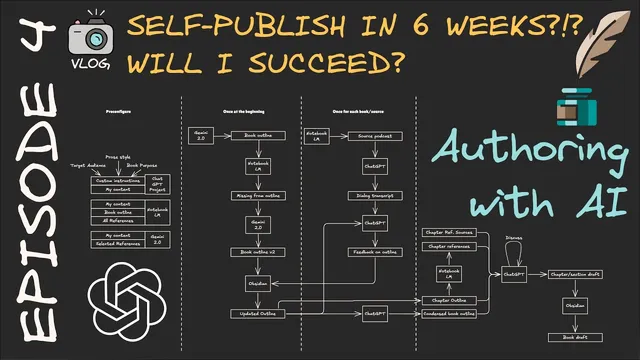
Creating an Outline and Authoring Chapters - Self-Publishing 4D PKM in 6 Weeks - VLOG Episode 4
Based on Zsolt's Visual Personal Knowledge Management's video on YouTube. If you like this content, support the original creators by watching, liking and subscribing to their content.
The book’s structure follows a four-part arc: diagnosing the reader’s situation with cognitive science and learning history, then moving into a solution.
Briefing
A self-publishing author is turning a 15-chapter, ~9,000-character book outline into a full draft by running an iterative, tool-assisted workflow—using Gemini, NotebookLM, and a paid ChatGPT setup—to repeatedly refine structure, then generate chapters quickly enough to target a March 15 launch.
The project’s backbone is a four-part arc that starts with explaining why the reader is “in the situation” they’re in, backed by cognitive science and learning history, before moving into a solution. The outline is already assembled and deeply detailed—so detailed that it can’t be treated as a simple plan. Instead, it becomes a living knowledge base that gets condensed, reworked, and fed back into the writing system as the author cycles through feedback and reference material.
Early attempts at writing through a visual workflow proved too slow and too hard to reuse. Card-based thinking helped generate ideas, but it didn’t “place icons, connect them in a story, and bang the book is there” in a way that produces the required text output. That pushed the author toward a text-first pipeline.
The current stack is three tools. Gemini 2.0 (an experimental, free model) is used for large-context tasks; it can accept up to 2 million tokens in theory, though the author hit an internal server error above 1.4 million tokens. NotebookLM is used after the outline is drafted, drawing on previously filed content to identify missing elements and provide feedback grounded in reference materials. ChatGPT (paid, $20/month) is added to overcome free-tier rate limits and to take advantage of “projects,” which allow grouped project chats, document attachments for context, and custom instructions (target audience, intended style, and book purpose) to keep outputs consistent.
The refinement loop runs about five cycles. First, Gemini generates a rough outline from the author’s accumulated materials (transcripts, blog posts, and notes about visual PKM, plus selected books and articles). Then NotebookLM recommends what’s missing and where the outline needs strengthening. The updated outline goes back into Gemini for a second version. After that, the author tightens the structure by selecting reference books and using NotebookLM to generate a separate 20–30 minute “podcast” summary for each book. While listening, the author uses ChatGPT to produce dialogue-style transcripts that connect each source back to the outline and the author’s own experience. Those transcripts and the outline feed back into ChatGPT for targeted feedback, and the outline is edited in Obsidian. The result is an outline that’s not just derived from sources, but shaped by personal anecdotes and reflections.
Once the outline is robust, the chapter-writing phase begins. The author condenses the long outline so it fits into context limits and then generates chapters iteratively: NotebookLM supplies chapter-specific references, and ChatGPT is prompted to ask clarification questions first, then draft the section. The author reviews and edits the output in ChatGPT and saves each chapter into Obsidian. With the outline already refined through multiple cycles, the author expects that—if time allows—an entire rough draft could be ready by the end of Saturday, followed by fact-checking, reference verification, and adding illustrations.
Beyond the mechanics, the author is also soliciting feedback on cover designs and titles. The working title direction centers on “visual thinking for the digital mind,” with a related concept of an “ambidextrous digital mind,” and the author plans to choose a cover based on audience votes while keeping the March 15 launch goal in view.
Cornell Notes
A visual PKM author is building a book draft by turning a detailed 15-chapter outline into text through an iterative workflow across Gemini, NotebookLM, and a paid ChatGPT “project” setup. Gemini is used to generate an initial rough outline from a large personal corpus (transcripts, blog posts, notes) plus selected references; NotebookLM then flags missing elements using stored materials. The outline is refined through about five cycles that include creating NotebookLM “podcasts” for reference books and using ChatGPT to write dialogue transcripts connecting each source to the outline and personal experience. After the structure is solid, ChatGPT generates each chapter section-by-section using condensed outline context plus chapter-specific references, with clarification questions before drafting. The approach matters because it compresses months of outlining and drafting into a repeatable pipeline aimed at a March 15 launch.
Why did the author abandon a card-based visual workflow for writing chapters?
How do Gemini, NotebookLM, and ChatGPT divide responsibilities in the workflow?
What is the core outline-refinement loop, and why does it run multiple times?
How does the author turn a long outline into chapters without exceeding context limits?
What practical constraints shaped tool choices and prompts?
What does “done” mean in the author’s timeline?
Review Questions
- What specific role does NotebookLM play in both the outline phase and the chapter phase?
- How does the author use dialogue transcripts to personalize an outline derived from external references?
- Why does the author condense the outline before generating chapters, and how is the condensed version used during drafting?
Key Points
- 1
The book’s structure follows a four-part arc: diagnosing the reader’s situation with cognitive science and learning history, then moving into a solution.
- 2
A card-based visual workflow generated ideas but didn’t reliably produce publishable text quickly, so the author switched to a text-first drafting pipeline.
- 3
Gemini 2.0 is used for large-context outline generation and revision, but input size must stay below a practical threshold due to internal server errors above ~1.4 million tokens.
- 4
NotebookLM functions as a reference-grounded feedback engine—first to identify missing outline elements, later to supply chapter-specific references.
- 5
Paid ChatGPT is used for faster iteration and for “projects,” which support grouped chats, attached documents, and custom instructions for consistent writing style and audience targeting.
- 6
The outline is refined through about five cycles combining NotebookLM “podcast” summaries of reference books with ChatGPT dialogue transcripts that connect sources to personal experience.
- 7
Chapter drafting is iterative and modular: extract the next section, gather references, run clarification questions, draft, edit, and save each chapter in Obsidian.