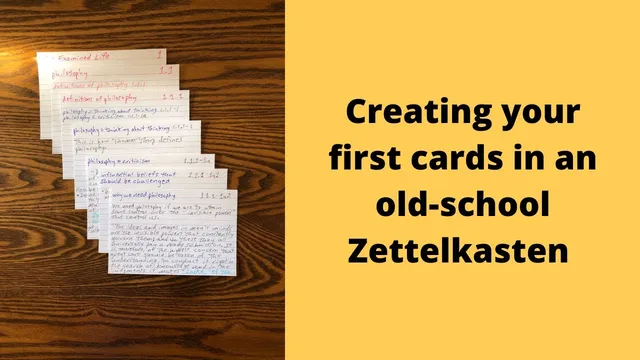
Creating the first cards in your old-school Zettelkasten
Based on FP's video on YouTube. If you like this content, support the original creators by watching, liking and subscribing to their content.
Start with a small hierarchy of pink folder/category cards before writing any idea cards, so every new note has a clear place.
Briefing
Analog Zettelkasten building starts with a small set of “folder” (category) cards that organize the system, followed by “idea” cards that contain actual sentences and quotations. In this walkthrough, the course-specific structure for an analog philosophy Zettelkasten called “Examine Life” begins with a top-level folder card, then a second folder card for the topic “philosophy,” and a third folder card for “definitions of philosophy.” The creator uses color as a practical signal: category cards are placed in pink, while idea cards—where the content is written as sentences rather than just references—are typically distinguished in another color (blue in the examples).
Once the category scaffolding is in place, the first idea cards are created from a shortened philosophy syllabus. The earliest idea card is titled “philosophy equals thinking about thinking,” and it is built around a quotation from American philosopher John Dewey. That card is treated as the start of a sequence: the next idea card, “philosophy equals criticism,” continues the Dewey theme by focusing on the need to call influential beliefs into question. To make the sequence legible inside the address system, the notes use an address format at the top-right of each card; a hyphen in the address usually signals an idea card rather than a folder card, though the method allows for exceptions.
The workflow then shifts from quoting to prompting. Students create a card titled “influential beliefs that should be challenged,” where they list two or three dominant beliefs they think deserve scrutiny. This card includes a reference to another folder card—also color-coded in pink—that holds material about the relationship between money and happiness, reflecting how the Zettelkasten links ideas across categories.
The final example card, “why we need philosophy,” is again quotation-based, this time drawing on John Locke. It follows the Dewey card by arguing that people need philosophy to gain some control over “invisible powers” that govern them. Those invisible powers are interpreted as the beliefs people subscribe to—especially beliefs formed through upbringing and habit rather than beliefs that have been reflectively endorsed. The address on this card ends with “1a2,” reinforcing the idea that card numbering and addressing can encode relationships and ordering within the system.
A key takeaway is that early cards may be imperfect, and messiness is expected. The method is framed as “chaos and order” at once: mistakes in card quality or organization matter less than following basic ground rules and building a network of linked, addressable notes that can grow over time.
Cornell Notes
The analog Zettelkasten workflow shown here builds structure first, then content. Students create pink “folder/category” cards for the system’s hierarchy (e.g., a top-level course folder, then “philosophy,” then “definitions of philosophy”). They then add blue “idea” cards with written sentences or quotations, using an address system where a hyphen in the address usually indicates an idea card. Early idea cards are sequenced from syllabus readings—starting with John Dewey on “thinking about thinking,” then moving to Dewey’s emphasis on challenging influential beliefs, and finally using John Locke to argue that philosophy helps people gain control over beliefs that govern them. The result is a linked set of notes that can expand even when early cards are rough.
How does the method distinguish “folder/category” cards from “idea” cards in practice?
What is the purpose of creating a hierarchy of folder cards before writing idea cards?
How are John Dewey and John Locke used to generate the first idea cards?
Why does the system include a card that lists beliefs “that should be challenged”?
What does the address system (including hyphens and numbering) do for readers?
Review Questions
- What are the practical differences between folder/category cards and idea cards, and how do color and address conventions reinforce those differences?
- How do the Dewey-based cards (“thinking about thinking” and “criticism”) relate to each other, and how does the Locke-based card (“why we need philosophy”) extend that line of thought?
- What role does linking (e.g., referencing the money-and-happiness folder) play in turning a set of cards into a Zettelkasten network?
Key Points
- 1
Start with a small hierarchy of pink folder/category cards before writing any idea cards, so every new note has a clear place.
- 2
Use idea cards for written sentences and quotations; use category cards mainly to organize and reference other cards.
- 3
Rely on the address system to distinguish card types and relationships—hyphens usually indicate idea cards, while their absence usually indicates folder/category cards.
- 4
Sequence related ideas by using consistent address patterns (such as “1a” and “1a2”) to show continuations and connections.
- 5
Convert syllabus readings into linked cards: quotations can become idea cards, while prompts can generate personal “challenge beliefs” cards.
- 6
Expect early cards to be imperfect; messiness is acceptable as long as basic ground rules are followed and the system grows over time.
- 7
Link across categories by referencing relevant folder cards (e.g., money and happiness) so the note network becomes navigable.