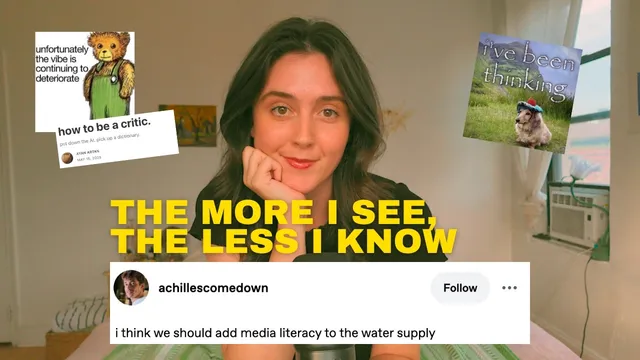
Critical Thinking, Media Literacy, and The Surveillance State
Based on Anna Howard's video on YouTube. If you like this content, support the original creators by watching, liking and subscribing to their content.
Moral policing emerges when “good vs. bad” judgments replace context-based evaluation, often leading to harassment or suppression rather than dialogue.
Briefing
Critical thinking isn’t dying online—it’s getting confused with moral policing, and that mix is reshaping how people judge media, creators, and one another. The core problem is binary thinking dressed up as “discernment”: when a comment or piece of content triggers a sense of “good vs. bad,” some users shift from evaluating context to enforcing punishment. That enforcement can look like harassment, profile-blocking cycles, tone policing, and micro-scrutiny of personal behavior—often with the unspoken assumption that the commenter has jurisdiction over the creator’s choices.
The argument centers on how suspicion—made more plausible by deepfakes, Sora-like synthetic media, and fast-moving misinformation—can slide into a “crime investigation” mindset. Once someone labels a creator as morally wrong, nothing else can correct the record. The transcript describes this as an extension of the surveillance state: not only cameras and facial recognition, but individuals monitoring strangers and acting like enforcers. Even when the intent is framed as activism, the effect is a purity contest that drains energy from actual dialogue and liberation.
A second thread targets the conflation of critical thinking with moral certainty. Critical thinking, as framed here, means understanding deeper themes, implications, and broader context—without demanding that every creator meet a personal standard of purity before being allowed to exist. The transcript draws a sharp line between critique and censorship: critique asks what a work means and how it’s constructed; censorship decides what should be suppressed. It also warns against treating ignorance as evil. Knowledge and ignorance are intertwined—ignorance shapes what people can learn next—so equating “not knowing” with moral failure creates a trap where everyone is perpetually “wrong” about something.
To replace hot-take culture, the transcript argues for a more disciplined model of media literacy and criticism. It leans on media-literacy questions associated with the National Association for Media Literacy Education: who made the message, who paid for it, what’s left out, what techniques are used, how credibility is established, and how emotions shape interpretation. It also emphasizes that trust should be contextual, not cult-like—especially for independent creators who don’t have institutional fact-checking teams. Including a source doesn’t require ideological agreement; it requires engaging the work and its context.
The transcript then elevates criticism as an art rather than an enemy of creation, citing the idea that criticism can extend the creative act by pinning a work to the “firmament” of culture. It contrasts thoughtful critique with the “hot take” format that collapses conversation into cannibalistic takes designed to reduce nuance. The practical takeaway is to seek critics who demonstrate integrity—who critique without character assassination—and to practice due diligence: revisiting a work, drafting, waiting, and re-checking observations.
Finally, the message ties media literacy to a broader “curiosity crisis.” Binary thinking shuts down curiosity; layered learning and repeated engagement reopen it. The closing sentiment frames understanding as an attempt—imperfect but necessary—where the magic lies in trying to understand someone else’s sharing, even when success is unlikely.
Cornell Notes
The transcript argues that online “critical thinking” is often replaced by moral policing: binary judgments that treat creators as inherently good or bad and then justify harassment or suppression. It distinguishes critique from censorship by focusing on context—deeper themes, implications, and how media is constructed—rather than demanding purity. It also warns against equating ignorance with evil, noting that ignorance is part of how knowledge develops. Media literacy is presented as a set of practical questions (who made it, who paid for it, what’s left out, credibility, emotional influence), and criticism is framed as an ethical craft that requires due diligence and revisiting a work. The stakes are cultural: when condemnation replaces exploration, fewer people share, and curiosity shrinks.
How does the transcript define the difference between critical thinking and moral policing?
Why does suspicion (deepfakes, misinformation) sometimes lead to binary thinking rather than better evaluation?
What does the transcript say about treating ignorance as evil?
What media-literacy questions are used to ground evaluation of sources?
How does the transcript handle trust in independent creators versus institutional journalism?
What does “due diligence” look like in criticism, according to the transcript?
Review Questions
- Where does the transcript place the boundary between critique and censorship, and what behaviors cross that line?
- What media-literacy questions would you ask to evaluate a source you distrust, and how would you separate credibility from ideological alignment?
- How does the transcript argue that binary thinking undermines curiosity, and what practices are offered to counter it?
Key Points
- 1
Moral policing emerges when “good vs. bad” judgments replace context-based evaluation, often leading to harassment or suppression rather than dialogue.
- 2
Reasonable suspicion about deepfakes and misinformation can turn into a pre-labeled verdict that no new information can overturn.
- 3
Equating ignorance with evil is portrayed as a trap: ignorance is part of how knowledge forms, and everyone lacks information somewhere.
- 4
Media literacy is framed as a repeatable checklist: maker, timing, funding, sources, omissions, techniques, credibility, emotional influence, and potential harms.
- 5
Independent creators can’t offer institutional “purity,” so trust should be contextual and paired with reader investigation rather than blind certainty.
- 6
Thoughtful criticism is treated as an ethical craft requiring due diligence—revisiting works, drafting, and checking observations—rather than one-shot hot takes.
- 7
Curiosity is presented as the antidote to binary thinking: layered learning and repeated engagement keep interpretation open.