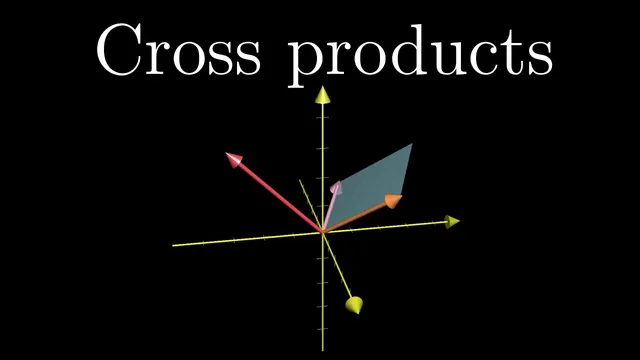
Cross products | Chapter 10, Essence of linear algebra
Based on 3Blue1Brown's video on YouTube. If you like this content, support the original creators by watching, liking and subscribing to their content.
In 2D, v × w equals the signed area of the parallelogram spanned by v and w, with sign determined by orientation (order matters).
Briefing
Cross products turn the geometry of a parallelogram into an algebraic object: in 2D, they produce a signed area, and in 3D, they produce a perpendicular vector whose length equals that same area. Start with two vectors v and w in the plane. They span a parallelogram, and the cross product v × w is tied to the parallelogram’s area—except the sign depends on orientation. When v sits to the right of w, v × w is positive; when v sits to the left of w, the result is negative. Swapping the order flips the sign, so w × v = −(v × w). This ordering rule can be anchored to the standard basis: i-hat × j-hat is positive, and the basis order fixes what “positive orientation” means.
To compute the 2D cross product without eyeballing areas, the determinant provides the shortcut. Put the coordinates of v as the first column of a matrix and the coordinates of w as the second column, then take the determinant. The determinant measures how a linear transformation scales area, including whether it flips orientation. Conceptually, the unit square spanned by i-hat and j-hat has area 1; after the transformation that sends i-hat → v and j-hat → w, that square becomes the parallelogram defined by v and w. The determinant gives the scaling factor for area, so it becomes exactly the signed area of the parallelogram. A concrete example uses v = (−3, 1) and w = (2, 1). The determinant of the matrix with these as columns is (−3)(1) − (2)(1) = −5, matching the idea that the parallelogram’s area is 5 but the orientation is reversed, producing a negative sign.
Two quick geometric checks reinforce the intuition. If v and w are perpendicular (or nearly so), the parallelogram’s area is large, so the cross product magnitude grows. If one vector is scaled—say 3v—the parallelogram’s area scales by the same factor, so (3v) × w = 3(v × w). These properties are consistent with the determinant’s role as an area-scaling quantity.
The “true” cross product, however, is a 3D operation that outputs a vector, not just a number. The length of v × w equals the area of the parallelogram spanned by v and w, while the direction is perpendicular to the plane of the parallelogram. The right-hand rule resolves the direction ambiguity: point the forefinger along v and the middle finger along w; the thumb points in the direction of v × w. In a simple case where v points in the +z direction with length 2 and w points in the +y direction with length 2, the parallelogram is a 2-by-2 square with area 4, and the right-hand rule gives v × w = −4 i-hat.
For actual computation in 3D, the determinant reappears in a “strange” form: a 3×3 determinant with i-hat, j-hat, k-hat in the first row and the coordinates of v and w in the remaining rows. Treating the basis vectors like symbolic entries yields a linear combination of i-hat, j-hat, and k-hat that produces the unique perpendicular vector with the correct magnitude and right-hand-rule direction. The deeper reason for why this determinant structure works is linked to a duality idea introduced earlier, with more geometric motivation reserved for a follow-on discussion.
Cornell Notes
The cross product converts the geometry of two vectors into algebra. In 2D, v × w equals the signed area of the parallelogram spanned by v and w: the sign is positive when v is to the right of w and negative when it’s to the left, so swapping order flips the sign. The determinant computes this signed area by measuring how a linear transformation scales area and whether it flips orientation. In 3D, v × w becomes a vector perpendicular to the plane of v and w, with magnitude equal to the parallelogram’s area; the right-hand rule picks the direction. A 3×3 determinant with i-hat, j-hat, k-hat entries provides a practical computation method tied to the same underlying area-and-orientation geometry.
How does the 2D cross product relate to area, and why does it have a sign?
Why does the determinant compute the 2D cross product?
What do scaling and near-perpendicularity do to v × w in 2D?
What changes when moving from the 2D cross product to the 3D cross product?
How does the right-hand rule determine the direction of v × w?
What is the purpose of the 3×3 determinant with i-hat, j-hat, k-hat entries?
Review Questions
- In 2D, how do you determine whether v × w should be positive or negative without computing a determinant?
- Given v = (−3, 1) and w = (2, 1), what determinant setup produces v × w, and what sign should the result have?
- In 3D, what two geometric facts determine the cross product vector’s magnitude and direction?
Key Points
- 1
In 2D, v × w equals the signed area of the parallelogram spanned by v and w, with sign determined by orientation (order matters).
- 2
Swapping the order flips the sign: w × v = −(v × w).
- 3
The 2D cross product can be computed as the determinant of the matrix whose columns are the coordinates of v and w.
- 4
The determinant’s sign captures whether the associated linear transformation preserves or flips orientation.
- 5
Scaling one vector scales the cross product magnitude by the same factor (e.g., (3v) × w = 3(v × w)).
- 6
In 3D, v × w is a vector perpendicular to the plane of v and w, with length equal to the parallelogram’s area.
- 7
The right-hand rule fixes the direction of v × w, and a 3×3 determinant provides a practical computation method.