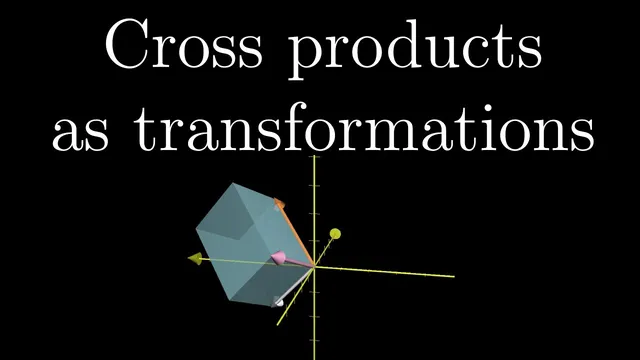
Cross products in the light of linear transformations | Chapter 11, Essence of linear algebra
Based on 3Blue1Brown's video on YouTube. If you like this content, support the original creators by watching, liking and subscribing to their content.
Define a linear functional f(x) = det([x v w]) by fixing v and w and letting x vary.
Briefing
The 3D cross product isn’t just a memorized formula—it’s the dual vector of a specific linear transformation built from two vectors v and w. Once that connection is made, the usual geometric claims about v × w (perpendicular direction, right-hand rule, and magnitude equal to parallelogram area) stop feeling like “just believe it” facts and instead follow from how determinants encode signed volume.
The starting point is the familiar determinant trick used to compute v × w: form a 3×3 matrix whose second and third columns are the coordinates of v and w, while the first column is the symbolic basis placeholders i-hat, j-hat, and k-hat. Expanding the determinant yields three coefficients, which are interpreted as the coordinates of the resulting vector. Rather than treating this as a purely computational stunt, the reasoning reframes it as follows: fix v and w, and let the first column be an arbitrary vector x = (x, y, z). Then the determinant becomes a function f(x) that maps 3D vectors to a single number—specifically, the signed volume of the parallelepiped spanned by x, v, and w.
Because determinants are linear in their columns, this function f(x) is linear in x. Linear maps from 3D to the number line have a special representation via duality: there exists a vector p such that f(x) equals the dot product p · x for every x. So the cross product emerges as the identity of that dual vector. In other words, v × w is the unique vector p satisfying p · x = det([x v w]) for all x.
The geometry then locks in the same conclusion. A dot product p · x can be read as the length of x projected onto the direction of p, multiplied by the length of p. Meanwhile, the determinant det([x v w]) is the signed volume, which can be decomposed into “base area times height”: the base is the area of the parallelogram spanned by v and w, and the height is the component of x perpendicular to that parallelogram. That means the determinant equals (area of v–w parallelogram) × (signed perpendicular component of x). The only vector p that reproduces this dot product for every x must be perpendicular to both v and w, with magnitude equal to the parallelogram’s area. The sign matches the orientation encoded by the right-hand rule.
So the determinant computation and the geometric properties are two descriptions of the same dual vector. The cross product’s direction, magnitude, and orientation aren’t separate facts—they’re the inevitable consequence of representing a determinant-based linear functional as a dot product with a perpendicular vector. The payoff is a cleaner mental model for cross products that sets up the next major linear algebra idea: change of basis.
Cornell Notes
Fix v and w in 3D and define a linear function f(x) = det([x v w]), where x is variable. Determinant linearity makes f a linear map from 3D to the number line, so duality guarantees a vector p such that f(x) = p · x for every x. The determinant det([x v w]) is the signed volume of the parallelepiped spanned by x, v, and w, which equals (area of the v–w parallelogram) times the signed perpendicular component of x. Therefore p must be perpendicular to both v and w, have length equal to that parallelogram area, and carry the right-hand-rule sign. That p is exactly v × w.
Why does defining f(x) = det([x v w]) lead toward the cross product?
How does duality connect a determinant to a dot product?
What geometric meaning does det([x v w]) have, and how does it determine p?
How does the right-hand rule show up in this framework?
What role does the “i-hat, j-hat, k-hat in the first column” trick play?
Review Questions
- Given fixed vectors v and w, define f(x) = det([x v w]). What property of determinants ensures f is linear in x?
- Why must the vector p satisfying f(x) = p · x be perpendicular to v and w?
- How does the magnitude of v × w relate to the area of the parallelogram spanned by v and w in this duality-based explanation?
Key Points
- 1
Define a linear functional f(x) = det([x v w]) by fixing v and w and letting x vary.
- 2
Determinant linearity in columns makes f a linear map from 3D to the number line.
- 3
Duality guarantees a unique vector p such that f(x) = p · x for all x.
- 4
Interpreting det([x v w]) as signed volume shows it equals (area of v–w parallelogram) times the signed perpendicular component of x.
- 5
Matching the dot-product geometry forces p to be perpendicular to both v and w and to have magnitude equal to that parallelogram area.
- 6
Orientation (sign) in the determinant corresponds to the right-hand rule for the cross product direction.