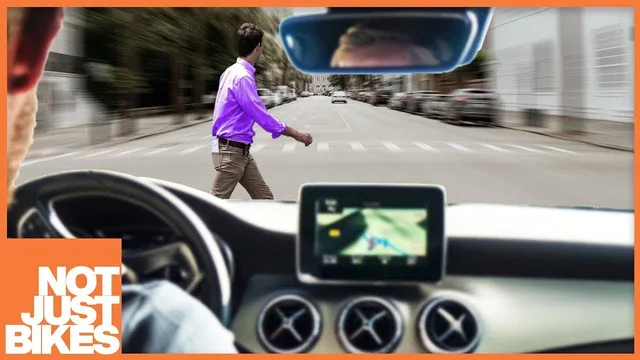
Crossing the Street Shouldn't Be Deadly (but it is)
Based on Not Just Bikes's video on YouTube. If you like this content, support the original creators by watching, liking and subscribing to their content.
North American intersections are frequently engineered for vehicle throughput, using signal timing, pedestrian button systems, and short walk phases that can leave walkers exposed.
Briefing
Crossing the street is dramatically safer in the Netherlands than in much of North America because Dutch road design forces drivers to slow down and makes pedestrian priority “built in,” not “requested.” In North America, intersections and crossings are engineered mainly to keep cars moving—through synchronized signals, long crossing distances, right turns on red, and timing rules that can cut pedestrians off mid-crossing—leaving walkers to navigate multiple lanes of fast traffic with limited protection.
North American intersections often run on a car-first logic: traffic lights switch directions so vehicles get green in one direction, then the other, while pedestrian detection is frequently indirect (button presses) and timed for vehicle flow. Walk signals can appear only briefly, then switch to a flashing hand with countdown timers, and in some places pedestrians are not allowed to start crossing once the countdown begins. That design creates “missed your chance” moments and keeps pedestrians exposed longer—especially where crossings are spaced far apart or where slip lanes allow right turns without slowing down. Right turns on red are singled out as a major danger because drivers may not stop and their attention is focused on traffic coming from the left, increasing the risk of crashes. A cited study links right-on-red permissions to a 69% increase in crashes involving pedestrians.
Even when signals exist, their sequencing can disadvantage walkers. In many North American setups, the walk signal and the green light trigger at the same time, meaning pedestrians must watch for vehicles turning right. The Netherlands uses leading pedestrian indicators that give pedestrians a head start before cars get green, reducing conflict points. Dutch designs also rely on refuge islands—middle areas where pedestrians can wait safely while traffic in other lanes clears—so crossings can be completed in stages without being exposed to all directions at once.
Dutch traffic control is described as “independent by direction,” allowing signals to adapt to detected conditions. In a busy Amsterdam example, pedestrians receive a walk signal immediately and can reach a refuge island while cars still move in a separate lane. As the system detects that no further vehicle traffic is coming in the next lane, the walk phase continues, letting pedestrians finish while the perpendicular direction remains safe. The result is less waiting, fewer things to monitor, and shorter periods of vulnerability.
Beyond signal timing, the transcript argues that physical street geometry does much of the safety work. Dutch lane widths are narrower, crossings are often raised or include speed-calming elements, and continuous sidewalks through minor junctions keep the pedestrian route uninterrupted—unlike designs that drop curb ramps and signal “this is a car space.” Roundabouts and raised intersections are presented as additional tools that increase driver visibility and reduce speed.
The transcript also critiques “solutions” that shift risk onto pedestrians, such as pedestrian bridges that keep walkers away from ground-level crossings so cars can flow, and “crossing flags” that require people to wave for safety rather than slowing vehicles. It contrasts these with modern road-safety research emphasizing speed reduction and infrastructure changes. The speaker closes with casualty comparisons: the Netherlands reports far fewer pedestrian deaths than Ontario and points to Phoenix, Arizona, as an extreme example of car-dominated design. The central takeaway is that safer streets feel safer—lower stress, fewer conflicts, and better quality of life—because the environment, not the pedestrian, is engineered to prevent tragedy.
Cornell Notes
The transcript argues that pedestrian safety hinges on infrastructure that slows cars and reduces conflict, rather than on education or devices that depend on driver compliance. North American intersections are described as car-optimized: synchronized signals, right turns on red, long multi-lane crossings, short walk phases with countdown rules, and designs that keep pedestrians exposed. The Netherlands is presented as a contrasting model, using leading pedestrian indicators, refuge islands, adaptive signal timing by direction, narrower lanes, raised crossings, and continuous sidewalks through minor junctions to keep walkers protected at ground level. The practical payoff is both statistical and emotional: fewer pedestrian deaths and noticeably lower stress for people walking with children or family.
Why are right turns on red portrayed as especially dangerous for pedestrians?
What is a leading pedestrian indicator, and how does it change pedestrian safety at signals?
How do Dutch refuge islands and adaptive signals reduce exposure during a crossing?
What design differences make Dutch crossings feel safer than North American ones?
Why does the transcript criticize pedestrian bridges and “crossing flags”?
What historical and policy argument is used to explain why jaywalking became stigmatized in the U.S.?
Review Questions
- Which specific North American intersection features increase pedestrian vulnerability during crossings, and how do they interact (timing, distance, turning rules)?
- Explain how refuge islands and leading pedestrian indicators work together to reduce conflict points.
- What infrastructure changes does the transcript claim are more effective than education campaigns or visibility-based devices?
Key Points
- 1
North American intersections are frequently engineered for vehicle throughput, using signal timing, pedestrian button systems, and short walk phases that can leave walkers exposed.
- 2
Right turns on red are highlighted as a major pedestrian risk because drivers may not stop and often focus on left-side traffic rather than scanning for pedestrians.
- 3
Long crossing distances, multiple lanes, and slip lanes increase the time pedestrians spend in conflict zones and the number of vehicles they must monitor.
- 4
The Netherlands improves safety through leading pedestrian indicators, refuge islands, and signal systems that operate independently by direction and adapt to detected traffic.
- 5
Dutch street geometry—narrower lanes, raised crossings, speed-calming elements, and continuous sidewalks through minor junctions—reduces vehicle speed and clarifies pedestrian priority.
- 6
The transcript argues that “solutions” like pedestrian bridges and crossing flags often shift risk or inconvenience onto pedestrians instead of slowing cars and reducing conflicts.
- 7
Infrastructure-focused road safety is presented as both statistically safer and emotionally less stressful, with casualty comparisons used to support the claim.