Curvature Demonstrated + Comments | Space Time | PBS Digital Studios
Based on PBS Space Time's video on YouTube. If you like this content, support the original creators by watching, liking and subscribing to their content.
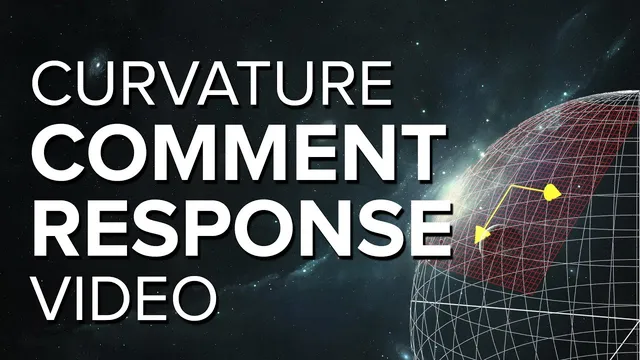
Geodesics on a sphere are defined by parallel transport: a tangent vector carried along the curve stays tangent to the curve.
Briefing
The core takeaway is that “geodesic” on a curved surface isn’t a definition-by-handwaving—it’s the specific curve that preserves a tangent direction under parallel transport. On a sphere, a great circle has this property: if a tangent vector is carried along the curve using the sphere’s intrinsic “slide-and-project” rule, the vector remains tangent to the curve. That behavior is what makes a great circle the sphere’s analogue of a straight line, and it matters because it gives a concrete, testable way to distinguish curved geometry from flat geometry without relying on any outside embedding.
The explanation starts by untangling two meanings of tangency. A vector can be tangent to the sphere at a point while still making an angle with a particular black curve drawn on the sphere. Only a vector that points along the curve at that point is tangent to the curve itself. Geodesics are then defined operationally: they are curves that take tangent vectors and, under parallel transport along the curve, keep those vectors tangent to the curve.
A hands-on construction demonstrates the logic. Imagine an ant on a basketball (a sphere). To parallel transport a vector, the ant repeatedly zooms into tiny patches where the sphere looks nearly flat, treats each patch as a tangent plane, transports the vector within that plane, then projects back onto the sphere. As the patch size shrinks and the number of steps grows, the transported direction converges to a result that stays aligned with the curve’s tangent direction—specifically for a great circle. In the limit, the curve generated by this procedure is the geodesic.
The contrast is equally important: take a curve that is not an arc of a great circle. If the ant performs the same patch-by-patch parallel transport procedure while trying to carry the vector along, the transported vector no longer stays tangent to the curve. Even if the ant chooses a great circle that matches the curve’s tangent direction at a point, the curve still “peels away” from that tangent geodesic in nearby patches. The sphere’s curvature shows up locally: compared to a truly straight line on a plane, the transported direction reveals that the arc is not geodesic.
The comments then broaden the point beyond the basketball. Curvature is intrinsic: it can be detected using only the surface itself. Following the same parallel-transport procedure on Earth—laying down a local grid patch by patch—reveals that transporting a vector from New York to Los Angeles and back along a different path returns a different direction, signaling curved geometry on the surface.
The discussion also clarifies the role of the 3D ambient space. The embedding in three dimensions is mostly a visual aid. If one asks whether the space around Earth is curved, the test changes: parallel transport must be done using Euclidean 3D rules around the orbit. If the vector returns unchanged, the surrounding 3D space is flat; if not, it’s curved.
Finally, the apparent paradox of geodesics “converging” is resolved: initially parallel geodesics on a sphere can meet because the space is curved. Two north-pointing geodesics along the equator lie on meridians; they start parallel and then converge at the North Pole without any “turning” along the geodesics. That convergence is another geometric fingerprint of curvature, setting up the next step: combining curvature with spacetime to reinterpret gravity in geometric terms.
Cornell Notes
Geodesics on a sphere are the curves that preserve tangent directions under parallel transport. Tangency must be distinguished: a vector can be tangent to the sphere at a point yet not tangent to a specific curve there. Parallel transport is demonstrated by repeatedly zooming into tiny patches where the sphere is approximated by a tangent plane, transporting the vector in that plane, and projecting back; in the limit, great circles keep the vector tangent and thus are geodesics. Curves that are not great-circle arcs fail this test: the transported vector stops being tangent, revealing curvature locally. The same intrinsic method applies to Earth’s surface, and “converging” geodesics (e.g., meridians meeting at the North Pole) further signals curved geometry.
Why does the transcript insist on separating “tangent to the sphere” from “tangent to the curve”?
How does the “ant” perform parallel transport on a curved surface in a way that avoids circular definitions?
What is the concrete test that distinguishes a great circle geodesic from a non-geodesic arc?
Why doesn’t the ambient 3D space (the fact that the sphere sits in 3D) determine the curvature story?
How can geodesics “converge” if they are straightest possible paths?
Review Questions
- In the patch-and-project construction, what happens to the transported vector as the patch size shrinks, and why does that matter for defining geodesics?
- What specific parallel-transport outcome would convince someone that Earth’s surface is curved, even without referencing the 3D space around it?
- How does the North Pole convergence example resolve the idea that geodesics should never meet?
Key Points
- 1
Geodesics on a sphere are defined by parallel transport: a tangent vector carried along the curve stays tangent to the curve.
- 2
Tangency has two layers—being tangent to the sphere at a point is not the same as being tangent to a particular curve there.
- 3
Parallel transport on a curved surface can be constructed intrinsically by transporting in tiny tangent-plane patches and projecting back, then taking the limit.
- 4
Great circles pass the parallel-transport test and behave like “straight lines” on the sphere; non-great-circle arcs fail because transported directions drift off the curve’s tangent.
- 5
Curvature is intrinsic to the surface: transporting vectors along different paths on Earth’s surface can return different directions.
- 6
The 3D embedding is not required to detect surface curvature; it matters only if asking whether the surrounding 3D space itself is curved.
- 7
Initially parallel geodesics on a sphere can converge (e.g., meridians meeting at the North Pole), which is a direct consequence of curvature.