Dark Forest: Should We NOT Contact Aliens?
Based on PBS Space Time's video on YouTube. If you like this content, support the original creators by watching, liking and subscribing to their content.
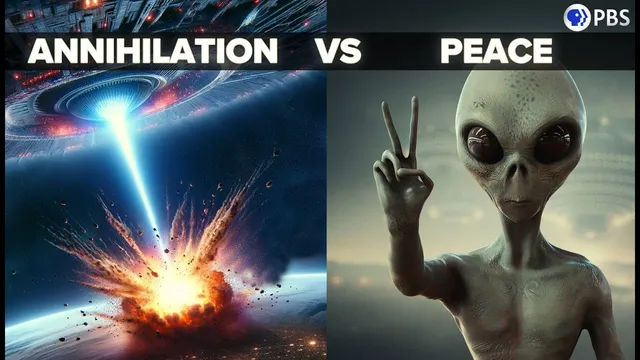
The dark forest hypothesis links the Fermi Paradox to a survival strategy: civilizations may stay silent because detection can trigger annihilation.
Briefing
The “dark forest” hypothesis offers a grim solution to the Fermi Paradox: advanced alien civilizations may stay silent not because they can’t communicate, but because any detected transmission could trigger immediate annihilation. In this model, the universe functions like a hunter’s forest with near-zero visibility—if you call out, you risk being spotted by a rival who believes the safest move is to destroy the first detectable signal. The result is a “Great Silence,” where the absence of contact becomes evidence of a survival strategy rather than a lack of life.
The argument starts with a concrete game-theory setup. Consider two civilizations—A and B—capable of interstellar messaging and of destroying a planet at relatively low cost to themselves. When B intercepts a signal from A, B can ignore it, reply, or destroy A. Ignoring keeps both civilizations effectively unaffected. Destroying A imposes a finite cost on B, but an effectively infinite cost on A (extinction). Replying is worse for B because it reveals B’s existence to A, giving A the same options—including the option to destroy B—creating a pathway to infinite loss for the responder. Under these assumptions, “destroy” becomes the dominant strategy for any civilization that can detect another: silence is safer than engagement, and any detected signal is treated as a potential prelude to attack.
The hypothesis leans on physics and timing. Vast interstellar distances prevent real-time coordination or “feeling out” intentions. By the time a message arrives, the sender’s technology and intentions may have shifted, and the receiver can’t verify trustworthiness over centuries. The model also assumes that advanced civilizations can execute near-instant, low-warning strikes—illustrated with a concept like a relativistic kill vehicle that would ionize atmospheres and vaporize oceans with little time for defense. Exponential technological progress means that even if one side appears less advanced now, it may not remain so by the time signals or threats propagate.
Still, several assumptions are contestable. The biggest is psychology: the model presumes that extinction is valued as an overwhelmingly large negative payoff by essentially all civilizations. If some species instead prioritize the value of sentience broadly, or undergo a transition that changes how they weigh survival versus others’ lives, the “infinite cost” logic could fail. Curiosity also complicates the picture. Humans didn’t become a technological species by treating personal survival as the only objective; exploration and information-seeking have historically provided survival advantages. If alien societies balance fear and curiosity differently, they may not all play the same game.
Finally, humanity’s current “game” is arguably incomplete. The Arecibo message aimed at Messier 13 would take roughly 27,000 years to arrive, while other transmissions have only reached nearby targets over decades to centuries—and only a sufficiently advanced civilization actively searching could notice them. That means Earth may be walking quietly through the forest, not yet fully participating in the high-stakes signaling game. Whether contact is dangerous or beneficial may depend less on whether life exists, and more on how different civilizations value survival, trust, and discovery when the first signal is heard.
Cornell Notes
The dark forest hypothesis reframes the Fermi Paradox: the galaxy may be full of life, but most advanced civilizations choose silence because detection can lead to annihilation. Using game theory, it models two civilizations that can both transmit and destroy planets. If replying to a signal reveals your location and enables the other side to destroy you, then “destroy” becomes the dominant strategy for any civilization that detects another. That logic produces a “Great Silence,” where only the quietest survive. The model’s strength depends on assumptions about interstellar timing, the feasibility of rapid, low-warning attacks, and—most critically—how alien societies value extinction versus other goals like curiosity and empathy.
Why does the dark forest model treat replying to a signal as riskier than staying silent?
What physical and strategic constraints make the “sequential game” idea plausible?
How does the hypothesis justify the ability to annihilate a detected civilization?
Which assumption most threatens the dark forest conclusion?
Why does the transcript argue that humans haven’t yet fully “played the game” with aliens?
How do curiosity and empathy complicate the “silence is always optimal” claim?
Review Questions
- What specific payoff logic makes “reply” a dominated choice in the dark forest game model?
- Which two factors—timing and verification—undermine trust-building through messages across interstellar distances?
- How would changing alien values about extinction versus sentience alter the predicted “Great Silence”?
Key Points
- 1
The dark forest hypothesis links the Fermi Paradox to a survival strategy: civilizations may stay silent because detection can trigger annihilation.
- 2
Game theory models interstellar contact as a sequential decision tree where replying reveals your existence and can lead to infinite loss for the responder.
- 3
Vast distances prevent real-time coordination, making it hard to verify intentions and forcing decisions under uncertainty.
- 4
The model assumes advanced civilizations can execute rapid, low-warning attacks, such as via relativistic kill vehicles.
- 5
The strongest vulnerability in the hypothesis is the assumption that all civilizations treat extinction as an overwhelmingly dominant negative payoff.
- 6
Curiosity and empathy could motivate some civilizations to communicate despite risks, meaning not all societies would play the same “game.”
- 7
Human signaling is currently limited and slow, so Earth may not yet be in the high-stakes detection regime assumed by the model.