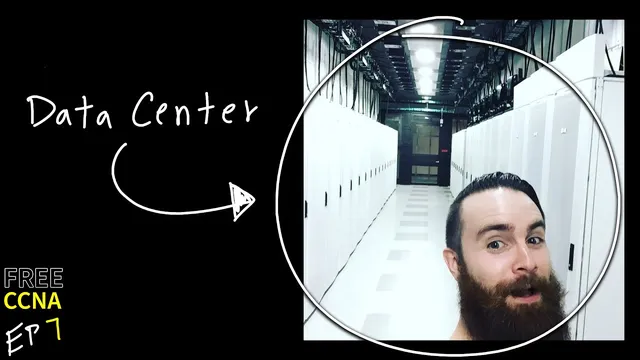
Data Center NETWORKS (what do they look like??) // FREE CCNA // EP 7
Based on NetworkChuck's video on YouTube. If you like this content, support the original creators by watching, liking and subscribing to their content.
Data center networks increasingly prioritize east-west (server-to-server) traffic because virtualization makes it the majority of workload communication.
Briefing
Data center networks have shifted from a “three-tier” design optimized for internet-bound traffic to a spine-leaf architecture built for fast, predictable server-to-server (east-west) communication. That change matters because virtualization and modern workloads turned internal traffic into the dominant share of data center load—often cited as roughly 70–80%—so network designs that were once acceptable for north-south traffic (users to servers and back) now create too many hops and bottlenecks for latency-sensitive east-west flows.
In the traditional approach, each rack typically has one or two Top-of-Rack (ToR) switches feeding a distribution/aggregation layer, which then connects to a core layer. Redundancy is added by deploying multiple switches and multiple links, but the design still routes traffic through more layers than east-west communication can tolerate. When servers in different racks need to talk—common under virtualization—traffic may traverse ToR → distribution → core → distribution → ToR, creating unpredictable hop counts and performance issues. Layer 2 redundancy also runs into spanning tree behavior, where some redundant links get blocked to prevent loops, leaving bandwidth underutilized.
The spine-leaf model removes the core layer from the critical path and replaces it with a two-tier fabric: leaf switches (the former ToR/access role) connect upward to spine switches (the backbone role). The key structural rule is a full mesh between every leaf and every spine: each leaf connects to every spine, while spines do not connect to other spines. This creates a predictable maximum of two hops for any server-to-server path—leaf → spine → leaf—regardless of where endpoints sit in the fabric. The architecture is often described as “cloth” because of the mesh-like interconnections.
The tradeoff is cabling complexity. Full-mesh connectivity increases the number of links and typically pushes designs toward fiber-heavy deployments. But the payoff is improved performance consistency for east-west traffic and the ability to keep multiple paths active.
Another important detail is how leaf-to-spine links are commonly implemented at Layer 3 rather than Layer 2. Layer 3 routing between leaf and spine avoids spanning tree’s default link-blocking behavior, enabling load balancing across links and better utilization of available bandwidth. With the underlay established by spine-leaf, large vendors then add an overlay layer for automation and policy enforcement—often associated with Cisco ACI concepts—so the fabric can be managed more programmatically.
The transcript also ties these ideas to Cisco ACI terminology using “leaf nodes” and “spine nodes.” In that model, leaf nodes connect to spine nodes, but leaf nodes do not connect directly to other leaf nodes; similarly, spine nodes do not connect to other spine nodes. The overall takeaway is that modern data center networking is less about building a hierarchical campus-like structure and more about creating a scalable, low-latency fabric that matches how workloads actually communicate today.
Cornell Notes
Data center traffic patterns changed: virtualization made server-to-server (east-west) communication dominate, often around 70–80% of traffic. The older three-tier design (ToR → distribution → core) was built for north-south traffic and can force east-west flows through too many unpredictable hops, plus spanning tree may block redundant Layer 2 links. Spine-leaf replaces the core bottleneck with leaf switches (access/ToR role) and spine switches (backbone role) connected in a full mesh between every leaf and every spine. With Layer 3 leaf-to-spine links, the fabric can keep multiple paths active and deliver predictable two-hop server-to-server communication. This underlay then supports overlay automation such as Cisco ACI.
What problem does the three-tier data center design run into once virtualization becomes common?
How does spine-leaf architecture change the path length for server-to-server traffic?
Why does using Layer 3 between leaf and spine help compared with Layer 2?
What’s the main downside of spine-leaf compared with three-tier?
In Cisco ACI terminology, which devices can connect to leaf nodes?
What role does the overlay network play after the spine-leaf underlay is built?
Review Questions
- Why does east-west traffic become the dominant concern in modern data centers, and how does that undermine the three-tier model?
- Describe the full-mesh rule in spine-leaf and explain why it yields predictable two-hop server-to-server paths.
- How does Layer 3 leaf-to-spine connectivity change the impact of spanning tree compared with a Layer 2 design?
Key Points
- 1
Data center networks increasingly prioritize east-west (server-to-server) traffic because virtualization makes it the majority of workload communication.
- 2
The classic three-tier hierarchy (ToR → distribution → core) can create too many hops and unpredictable paths for latency-sensitive east-west flows.
- 3
Spine-leaf architecture replaces the core bottleneck with leaf and spine layers connected in a full mesh between every leaf and every spine.
- 4
Spine-leaf delivers predictable server-to-server paths with a maximum of two hops: leaf → spine → leaf.
- 5
Layer 3 leaf-to-spine links help avoid spanning tree link blocking and enable load balancing across multiple paths.
- 6
Spine-leaf trades performance predictability for higher cabling complexity, often requiring extensive fiber.
- 7
Cisco ACI concepts rely on the spine-leaf underlay rules: leaf nodes connect to spine nodes, while leaf-to-leaf and spine-to-spine direct connections do not occur.