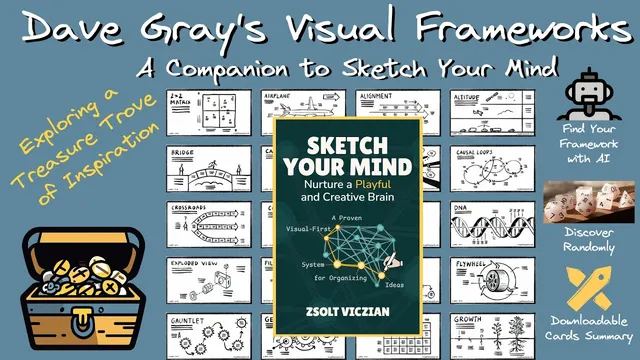
Dave Gray's Visual Frameworks: A Companion to Sketch Your Mind
Based on Zsolt's Visual Personal Knowledge Management's video on YouTube. If you like this content, support the original creators by watching, liking and subscribing to their content.
Visual frameworks use visual metaphors as anchors to structure thinking and storytelling, turning information into organized narratives.
Briefing
Visual frameworks—sketch-based metaphors that act as “anchors” for structuring thought—are presented as a practical way to turn raw ideas into clearer stories, better learning, and stronger problem-solving. The core claim is that pairing information with spatial, narrative, and organizational structure unlocks benefits that plain text often can’t: creativity gets catalyzed when ideas are “hit” by a visual prompt; spatial thinking supports memory; storyboarding improves communication; and pattern-finding helps tackle hard problems. A billiard table metaphor illustrates the approach: pockets represent outcomes like creativity, effective learning, collaboration, clarity, and big-picture thinking, while the cue and white ball represent visual thinking and the information being worked on. As the metaphor is filled with data, it also creates an “external perspective,” enabling detachment, self-reflection, and metacognition—thinking about one’s own thinking.
The discussion then pivots to a concrete resource: Dave Gray’s Visual Frameworks, hosted at visualframeworks.com/portfolio. The site organizes a set of cards (including an “impact story” billiard-table card and diagram-based options such as Venn diagrams), each paired with short descriptions of what it demonstrates and how it works. The emphasis isn’t just on having the frameworks, but on selecting the right one from a large library—described as potentially daunting when there are “over 100” options.
Two selection methods are offered to narrow the field. The first uses AI as a filtering tool. A screenshot of the framework cards is uploaded to Google’s Gemini 2.5 (in Google AI Studio), along with a scenario: a project facing a difficult situation with two very different paths forward. Based on the image, Gemini recommends specific cards—most notably the “crossroads,” “decision tree,” and “pros and cons” formats. The crossroads card is treated as especially usable for presenting a problem statement, naming alternative solution paths, and laying out steps for a team discussion. The decision tree is framed as a strong alternative when the options include multiple decision points. Pros and cons is acknowledged as plausible but less compelling in the particular example.
The second method is deliberately low-tech and playful: a “Monte Carlo approach” that uses randomness—dice or a random number generator—to pick a card. The rationale is that forcing a match can produce unexpected creative solutions, echoing creativity techniques associated with Edward de Bono, such as using random objects from a department store to build chains of inference that trigger lateral thinking. Here, the random card becomes the constraint that guides how the message is told, helping break out of habitual thinking.
Overall, the takeaway is that visual frameworks function both as communication tools and as thinking tools. They can be chosen strategically with AI when time and fit matter, or chosen randomly when creativity and surprise are the goal—either way, the method aims to turn messy information into structured, story-ready visuals.
Cornell Notes
Visual frameworks are sketch-based metaphors that help people structure thinking and storytelling. Using a spatial and narrative “anchor” (like a billiard table metaphor), ideas can be organized into creativity, learning, communication, collaboration, and big-picture insights. Filling the framework with real data also supports detachment—stepping back to gain an external view of one’s own reasoning, enabling metacognition. Dave Gray’s Visual Frameworks provides a large library of such cards, each with a short explanation of its purpose. When choosing among many options, two approaches are offered: use AI (Gemini 2.5) to recommend likely matches, or use randomness (“Monte Carlo” with dice) to force lateral thinking and uncover unexpected solutions.
How does the billiard-table metaphor map visual thinking to outcomes like learning and problem-solving?
What is the practical purpose of Dave Gray’s Visual Frameworks cards?
How can AI narrow down which visual framework to use?
Why use randomness (“Monte Carlo”) to pick a framework?
What does “detachment effect” mean in this context?
Review Questions
- If you had a problem with multiple branching decision points, which framework type would likely fit best (and why) based on the AI example?
- How does attaching knowledge to spatial objects improve learning in the memory-palace analogy, and where does that show up in the visual-framework logic?
- What creative benefit does randomness aim to produce, and how is it similar to Edward de Bono’s random-object technique?
Key Points
- 1
Visual frameworks use visual metaphors as anchors to structure thinking and storytelling, turning information into organized narratives.
- 2
Spatial thinking supports learning by linking knowledge to locations, echoing memory palace principles.
- 3
Storyboarding-style storytelling improves clarity and communication, while organizing ideas helps reveal patterns for tougher problem-solving.
- 4
Filling a framework with real data can create detachment—an external perspective that supports metacognition and self-reflection.
- 5
Dave Gray’s Visual Frameworks portfolio provides a large set of cards (including impact-story and Venn diagram formats) with brief instructions for use.
- 6
When choosing among many frameworks, AI can filter options by matching a scenario to likely diagram types (e.g., crossroads, decision tree, pros and cons).
- 7
When creativity stalls, randomness via dice or a random number generator can force lateral thinking by constraining the story to a surprising framework.