Deciphering The Vast Scale of the Universe | STELLAR
Based on PBS Space Time's video on YouTube. If you like this content, support the original creators by watching, liking and subscribing to their content.
Vesto Slipher’s measurements of rapid recession suggested some spiral nebulae were not gravitationally bound to the Milky Way.
Briefing
The universe’s scale became measurable—and therefore believable—once astronomers could turn “fuzzy blobs” in the sky into objects with real distances. That breakthrough, driven by Edwin Hubble’s work at Mt. Wilson Observatory, didn’t just move galaxies beyond the Milky Way; it also set the stage for discovering that the cosmos is expanding, implying a beginning consistent with the Big Bang.
Early telescopes showed spiral nebulae as indistinct patches of light, and many astronomers assumed they were clouds inside the Milky Way. The turning point began with clues that these nebulae were not gravitationally bound to our galaxy. In 1915, Vesto Slipher measured that some of those spiral nebulae were racing away so fast they would escape the Milky Way’s pull—an argument that they were likely separate “island universes.” The missing piece was distance. In astronomy, distance is notoriously hard because the sky’s 3-D reality collapses into a 2-D image when viewed through a telescope.
Hubble’s solution relied on Henrietta Leavitt’s discovery of Cepheid variable stars. Cepheids brighten and dim in a repeating cycle, and the length of that cycle correlates with the star’s true (absolute) brightness. Once the period is measured, astronomers can infer how luminous the star really is, then compare it to how bright it appears from Earth to calculate its distance. Hubble used this method to measure Cepheids in the Great Andromeda Nebula (later the Andromeda galaxy), finding it to be about 2 million light-years away—roughly 20 times the Milky Way’s diameter. That single distance measurement helped flip the interpretation of spiral nebulae from local gas clouds to entire galaxies.
With distances in hand, Hubble combined them with Slipher’s velocity measurements. The pattern showed galaxies generally moving away from the Milky Way, a relationship that pointed toward an expanding universe. If space itself is stretching, then the universe must have been denser and hotter in the past, aligning with the Big Bang picture.
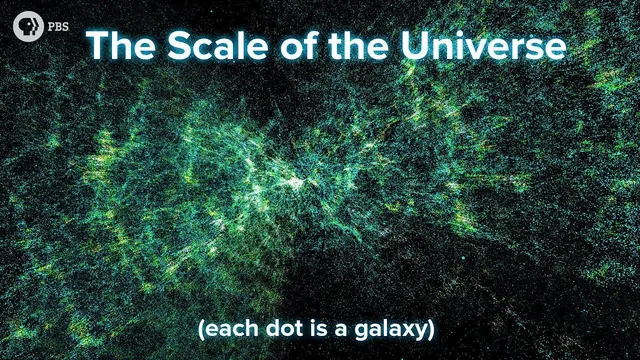
The scale that follows from those early measurements is staggering. A grain of sand held at arm’s length could contain nearly 10,000 galaxies—on the order of a quadrillion stars and as many planetary systems. And the modern view extends far beyond Hubble’s era: today’s mapping includes known galaxy positions, velocities, and even stellar content, revealing structures like the Virgo cluster, the supercluster complex called Laniakea (about 500 million light-years across), and the cosmic web of filaments shaped by dark matter. Quasars—bright cores powered by gas falling into supermassive black holes—appear as tiny points in surveys but trace some of the earliest epochs of galaxy formation.
The throughline is clear: once astronomers learned how to measure distance reliably, the universe stopped being a mystery of “clouds” and became a dynamic, expanding system with a history written across light from billions of years ago.
Cornell Notes
Hubble’s breakthrough depended on solving one problem: measuring distances to objects outside the Milky Way. Vesto Slipher had already found that some spiral nebulae were receding fast enough to escape our galaxy, but proving they were separate “island universes” required distance measurements. Henrietta Leavitt’s Cepheid variables provided the key: their pulsation period determines their true brightness, letting astronomers calculate how far away they are. Using Cepheids in the Great Andromeda Nebula, Hubble estimated Andromeda at about 2 million light-years away, showing spiral nebulae are actually galaxies. Pairing those distances with recession velocities led to the conclusion that the universe is expanding, pointing toward a Big Bang origin.
Why did astronomers struggle to determine distances to galaxies before Hubble’s work?
How did Henrietta Leavitt’s Cepheid discovery become a “standard candle” for measuring cosmic distances?
What specific measurement anchored the shift from “nebulae inside the Milky Way” to “other galaxies”?
How did combining distances with velocities lead to the idea of an expanding universe?
What does modern large-scale mapping add beyond Hubble’s original distance-and-recession framework?
Review Questions
- What observational gap had to be closed before Slipher’s recession measurements could prove that spiral nebulae were separate galaxies?
- Explain how the Cepheid period-to-luminosity relationship turns a pulsation measurement into a distance estimate.
- Why does a general recession pattern support the idea of an expanding universe rather than just random galaxy motion?
Key Points
- 1
Vesto Slipher’s measurements of rapid recession suggested some spiral nebulae were not gravitationally bound to the Milky Way.
- 2
Reliable galaxy distances required a method to infer true brightness despite telescopes producing 2-D images.
- 3
Henrietta Leavitt’s Cepheid variables acted as standard candles because their pulsation period correlates with absolute brightness.
- 4
Hubble’s Cepheid-based distance to the Great Andromeda Nebula placed Andromeda about 2 million light-years away, confirming it as a separate galaxy.
- 5
Pairing galaxy distances with recession velocities supported the conclusion that the universe is expanding.
- 6
Modern mapping extends early findings by charting galaxy motion and large-scale structure, including the cosmic web and superclusters like Laniakea.
- 7
Quasars serve as distant beacons from early cosmic epochs, powered by gas falling into supermassive black holes.