Deep RNNs | Stacked RNNs | Stacked LSTMs | Stacked GRUs | CampusX
Based on CampusX's video on YouTube. If you like this content, support the original creators by watching, liking and subscribing to their content.
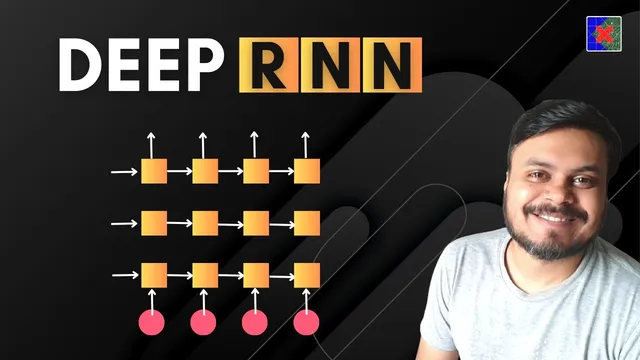
Deep RNNs (stacked RNNs) increase model capacity by stacking multiple recurrent layers and unrolling across both time and depth.
Briefing
Deep RNNs—also called stacked RNNs—aim to boost a recurrent model’s representational power by stacking multiple recurrent layers on top of each other, then unrolling the entire structure through time. The core payoff is better feature extraction at multiple levels: lower layers tend to pick up primitive patterns (word-level cues), middle layers capture sentence/phrase structure, and higher layers integrate context to form an overall decision (like document-level sentiment). That hierarchy matters because many real language tasks build meaning progressively—from words to phrases to whole reviews.
The training motivation starts with a simple neural network on a toy spiral dataset: adding neurons to a single hidden layer improves performance, and adding additional hidden layers improves it further by increasing the model’s complexity and ability to find patterns. The same “stack more layers to get more expressive power” idea is then transferred to RNNs. In a standard RNN for sentiment analysis, each time step processes one word and passes a hidden state forward via a feedback loop (the previous hidden state influences the next). When accuracy is low, stacking additional recurrent layers is presented as a direct way to increase capacity without changing the overall recurrent mechanism.
A key architectural point is that depth and time interact. For a stacked RNN, each time step contains multiple recurrent computations—one per hidden layer—and each layer receives input from the layer below at the same time step, while also receiving its own previous hidden state from the prior time step. When the model is “unfolded,” the result is a grid: one axis tracks time steps, the other tracks depth (layer index). The transcript walks through how information flows through this grid using feedback loops (recurrent connections) and feed-forward connections between layers.
The discussion then shifts from intuition to practical design choices. Deep RNNs are recommended when the task is complex (examples given include speech recognition and machine translation) and when enough data and compute are available; otherwise, overfitting risk rises and training can become slow. Another trigger is when a simpler baseline (single-layer RNN) fails to meet performance targets.
A concrete Keras example demonstrates how to build a deep recurrent model using the IMDB dataset. The pipeline includes an embedding layer to convert word indices into 32-dimensional vectors, two stacked recurrent layers with 5 units each, and a final dense layer with a sigmoid output for binary sentiment. The example emphasizes a crucial implementation detail: keeping `return_sequences=True` for intermediate recurrent layers so the next recurrent layer receives the full sequence output; only the last recurrent layer can output a single vector.
Finally, the transcript recommends using deep LSTMs or deep GRUs in practice rather than deep vanilla RNNs, citing vanishing/exploding gradient issues that become more severe with depth. It also flags two main downsides: increased architectural complexity (requiring careful regularization like dropout, learning-rate tuning, and weight initialization) and longer training time due to more parameters and more backpropagation paths. The takeaway is straightforward: if a single-layer recurrent model underperforms and resources/data are sufficient, stacking recurrent layers—preferably LSTM or GRU—can materially improve results.
Cornell Notes
Deep RNNs (stacked RNNs) improve sequence modeling by stacking multiple recurrent layers and unrolling the resulting depth-by-time grid. Lower layers learn primitive, word-level patterns; middle layers capture sentence/phrase structure; higher layers integrate context for an overall prediction such as sentiment. In a stacked setup, each layer at time t receives input from the layer below at time t and also receives its own hidden state from time t−1 via a feedback loop. A Keras IMDB example uses an embedding layer (32-dim vectors), two recurrent layers with 5 units each, and a final sigmoid dense layer, with `return_sequences=True` on intermediate recurrent layers so the next layer gets the full sequence. Deep LSTMs/GRUs are preferred over vanilla RNNs due to vanishing/exploding gradient concerns.
How does stacking layers change what an RNN can learn for tasks like sentiment analysis?
What is the information-flow difference between a single-layer RNN and a stacked (deep) RNN?
Why does Keras require `return_sequences=True` for intermediate recurrent layers in a stacked model?
What practical conditions make deep RNNs worth trying instead of staying with a simpler model?
Why are deep LSTMs/GRUs recommended over deep vanilla RNNs?
What are the two major downsides of deep RNNs mentioned, and how can they be mitigated?
Review Questions
- In a stacked RNN, what two sources determine the input to a given layer at time t?
- In the Keras IMDB example, what role does the embedding layer play, and why is `return_sequences=True` important for the first recurrent layer?
- List the conditions under which deep RNNs are recommended over single-layer RNNs, according to the transcript.
Key Points
- 1
Deep RNNs (stacked RNNs) increase model capacity by stacking multiple recurrent layers and unrolling across both time and depth.
- 2
Layer hierarchy supports multi-level feature learning: word-level cues in early layers, phrase/sentence patterns in middle layers, and overall meaning in deeper layers.
- 3
In stacked architectures, each layer at time t receives input from the layer below at time t and its own previous hidden state from time t−1.
- 4
Keras implementations must set `return_sequences=True` for intermediate recurrent layers so the next recurrent layer receives per-time-step outputs.
- 5
Deep RNNs are most useful for complex tasks, when data and compute are sufficient, and when simpler baselines underperform.
- 6
Deep LSTMs/GRUs are generally preferred over deep vanilla RNNs due to vanishing/exploding gradient issues.
- 7
Deep RNNs trade off better expressiveness against added training complexity and longer training time, requiring careful regularization and hyperparameter tuning.