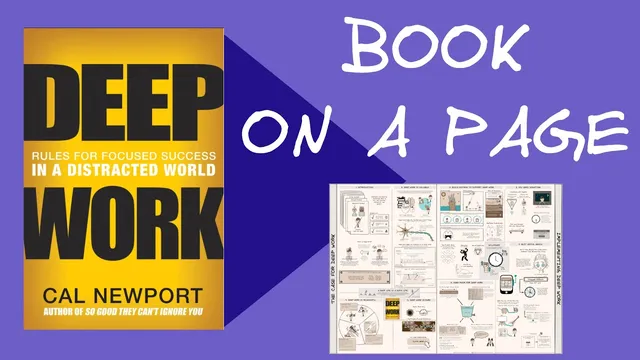
Deep Work - Book on a Page
Based on Zsolt's Visual Personal Knowledge Management's video on YouTube. If you like this content, support the original creators by watching, liking and subscribing to their content.
Deep work is defined as distraction-free concentration on tasks that push cognitive limits and produce new value, while shallow work is low-value, logistical work done while distracted.
Briefing
Deep work is framed as a competitive advantage in a world where machines and algorithms increasingly handle routine knowledge tasks—and it’s also presented as a path to better learning, higher-quality output, and a more satisfying life. Instead of chasing “fast productivity” measured in days or weeks, the approach emphasizes slow productivity: protecting distraction-free concentration long enough to produce work that “moves the needle” over years. That long arc matters because modern economies reward people who can repeatedly acquire complex skills and deliver elite performance, while constant interruption erodes the ability to focus.
The core definition draws a sharp line between deep work and shallow work. Deep work means professional tasks done in a state of distraction-free concentration that push cognitive ability to its limit, producing new value, improving skills, and remaining difficult to replicate. Shallow work is described as low-value, logistical, non-cognitively demanding tasks often performed while distracted—and it’s argued that frequent immersion in that state can permanently degrade deep-work capacity unless deliberate retraining is undertaken.
A major biological and psychological case supports the focus on concentration. Learning is likened to “myelinating” neural pathways: focused attention repeatedly activates relevant circuits, strengthening them and making future learning faster. Distraction—checking email, social media, or phone notifications—activates competing mental processes, weakening the focused practice needed for efficient learning. The transcript also highlights “attention residue,” citing an experiment where interruptions (even trivial ones) significantly reduce puzzle performance, with refocusing taking more than 20 minutes. The practical implication is blunt: constant checking keeps people stuck below peak cognitive performance, even if they feel busy.
The output argument follows a similar logic. Peak focus is described as a window—often 60 to 90 minutes—after which time fatigue reduces output, even for experienced practitioners. The takeaway is that the same hours can yield radically different results depending on whether attention stays intact.
Why workplaces don’t naturally support deep work is attributed to measurement and incentives. Knowledge work is hard to quantify, so organizations default to industrial-era productivity proxies like email throughput and meeting volume. Instant messaging and open-office norms further fracture the day, turning “easy” responsiveness into a system that prevents sustained concentration. There’s also a critique of unexamined technology adoption: new tools are treated as automatically “better,” even when they introduce new distractions and trade-offs.
Part two shifts from diagnosis to implementation. Willpower is treated as finite and depleted by everyday urges, with social media singled out as a top temptation. The transcript then lays out four deep-work philosophies—monastic, bimodal, rhythmic, and journalistic—before recommending the rhythmic approach as the most practical starting point: fixed deep-work blocks early in the day, built as a habit rather than a daily decision. It adds tactics like rituals to start sessions, “alone-and-together” workplace design (hub-and-spoke), challenging deadlines, and a management system using the “four disciplines of execution” (wildly important goals, lead measures, a visible scorecard, and accountability).
Downtime is treated as essential rather than optional, with “shutdown procedures” used to clear mental clutter and transition into rest. Social media guidance is more nuanced than a full ban: instead of quitting, the approach recommends scheduled access, deliberate tool selection, and even a “packing party” experiment that removes networked tools for 30 days to test what’s truly necessary. Finally, shallow work is drained through quantifying depth, scheduling the day minute-by-minute, negotiating a shallow-work quota with a boss, and becoming “hard to reach” via email rules and structured reply processes. The overall message ties together: protect attention, design systems around it, and treat focus as a skill that compounds.
Cornell Notes
Deep work is defined as distraction-free concentration on tasks that push cognitive limits, create new value, improve skills, and are hard to replicate. The transcript argues that constant shallow work and frequent interruptions damage learning and performance through “attention residue,” where refocusing after distraction takes over 20 minutes. Deep work is positioned as both a learning accelerator (focused repetition strengthens neural pathways) and an elite-output driver (peak focus typically lasts 60–90 minutes before time fatigue). Implementation centers on willpower management, choosing a deep-work philosophy (especially a rhythmic schedule), building rituals, using deadlines, and tracking progress with lead measures and a visible scorecard. The plan also includes downtime, deliberate social media use, and tactics to reduce shallow work via quotas, scheduling, and structured email boundaries.
What makes deep work different from shallow work, and why does that distinction matter for long-term success?
How does distraction slow learning, according to the transcript’s neuroscience framing?
What is “attention residue,” and how does it translate into real-world productivity loss?
Why do modern workplaces tend to undermine deep work, even when people want to do it?
What practical system is recommended to build deep work habits without relying on daily willpower?
How should social media be handled—quit entirely or manage it—and what’s the proposed method?
Review Questions
- Explain how attention residue changes the cost of frequent email or social media checking, and estimate the refocusing time mentioned.
- Describe the rhythmic deep-work philosophy and connect it to the idea of finite willpower.
- List four tactics used to reduce shallow work and explain how each creates more room for deep work.
Key Points
- 1
Deep work is defined as distraction-free concentration on tasks that push cognitive limits and produce new value, while shallow work is low-value, logistical work done while distracted.
- 2
Distraction harms learning by weakening focused repetition of neural pathways; focused attention is framed as strengthening myelination of relevant circuits.
- 3
Attention residue means interruptions can take more than 20 minutes to fully clear, so frequent checking prevents peak performance.
- 4
Peak focus is described as typically lasting 60–90 minutes, after which time fatigue reduces output even for experienced practitioners.
- 5
Workplaces often block deep work because knowledge-work output is hard to measure, so incentives shift toward email and meetings as easy productivity proxies.
- 6
A practical deep-work system starts with a scheduled philosophy (especially rhythmic blocks), rituals to begin sessions, challenging deadlines, and tracking via lead measures and a visible scorecard.
- 7
Social media should be managed through scheduled access and deliberate tool selection (including a 30-day removal test), not necessarily abandoned completely.