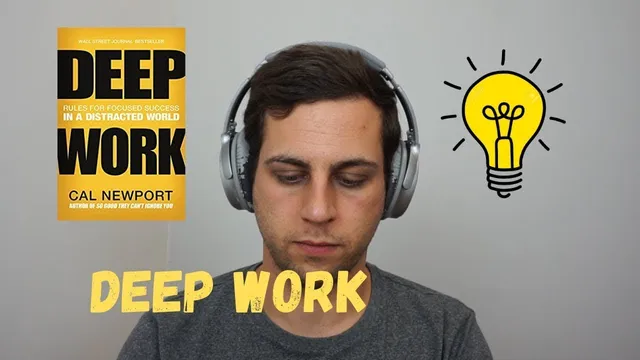
Deep Work by Cal Newport: Summary and Key Lessons
Based on Dan Silvestre's video on YouTube. If you like this content, support the original creators by watching, liking and subscribing to their content.
Deep work is distraction-free concentration on demanding tasks that push cognitive ability to its limit, and it’s framed as a route to elite performance in a knowledge economy.
Briefing
Deep work is defined as distraction-free concentration on demanding tasks—work that pushes mental ability to its limit—and it’s framed as a competitive advantage in a knowledge economy. The core claim is that people who can master hard things quickly and then deliver elite output in both speed and quality are the ones most likely to thrive, especially as automation and “intelligent machines” handle routine work. Deep work is positioned less as a personality trait and more as a skill that can be built into everyday routines.
Making it a habit requires reducing the willpower needed to enter sustained focus. That means designing systems—rather than relying on motivation—that make deep work the default state during planned blocks. The first practical lever is adopting a “deep work philosophy,” with four styles: monastic (long isolation from shallow work), bimodal (a few consecutive deep-work days followed by shallow-work time), rhythmic (regular daily deep-work hours), and journalistic (alternating deep and shallow as circumstances arise). For most knowledge workers, the rhythmic approach is presented as the most workable starting point: set aside roughly three to four hours daily for deep work, then allow the rest of the day for shallow tasks.
The second lever is time blocking—scheduling deep work blocks in advance. Planning the week ahead, then reserving specific days and hours for deep tasks (and separate time for lighter work like writing, editing, publishing, or management) removes ambiguity when it’s time to start. The argument is that pre-commitment both lowers the mental friction of switching into focus and improves control over the workday because the next action during each block is already decided.
The third lever is building rituals that trigger the transition into unbroken concentration. Small, repeatable cues—like making coffee or tea, taking a shower, dressing in a particular way, or using the same playlist for a specific type of work—serve as signals to the brain that deep work is starting. The goal is to create a reliable “entry ramp” into focus.
The final lever is a shutdown ritual at the end of the workday. This routine is described as crucial for three reasons: it creates downtime that supports insight, it helps the brain run more efficiently the next day by recharging, and it prevents low-value after-hours work from bleeding into the next morning. A shutdown ritual includes capturing “open loops” (what’s unfinished or needs follow-up), closing emails, archiving or deleting unused files, and setting a clear endpoint.
Beyond scheduling and rituals, the transcript emphasizes rewiring attention by resisting boredom and distraction. It recommends deciding in advance when distractions are allowed—such as only checking social media after work ends—and using “productive meditation,” which combines physical activity with mental focus on a single problem. It also highlights a 30-day social media test run: step away for a month without deleting accounts, then evaluate whether it was truly difficult, whether it was missed, and whether anyone cared. The strategy is paired with filling the freed time with higher-quality alternatives like documentaries, so attention is redirected rather than simply removed. The overall message is that deep work becomes a durable productivity advantage only when attention habits, work structure, and end-of-day closure are treated as a system.
Cornell Notes
Deep work is distraction-free work on demanding tasks that push cognitive ability to its limit. The transcript argues that turning it into a habit depends on systems that reduce willpower: choose a deep-work philosophy (with “rhythmic” daily blocks as the easiest starting point), schedule deep work in advance using time blocking, and use rituals to cue the brain into sustained focus. A shutdown ritual at day’s end helps create recovery, improves next-day performance, and prevents low-value after-hours work. Finally, attention is trained by embracing boredom, limiting distraction windows, practicing productive meditation, and running a 30-day social media break to measure how much it fragments focus.
Why is deep work treated as a competitive advantage rather than just a productivity tip?
What makes the “rhythmic” deep-work philosophy different from monastic, bimodal, and journalistic approaches?
How does time blocking reduce the effort required to start deep work?
What kinds of rituals are suggested to trigger “unbroken concentration”?
What is a shutdown ritual, and what purpose does it serve?
How does the transcript recommend handling distraction and boredom?
Review Questions
- What tradeoffs exist between monastic, bimodal, rhythmic, and journalistic deep-work philosophies, and which one is recommended as the easiest starting point?
- Design a shutdown ritual for your own schedule: what “open loops” would you capture, and how would you signal the end of work?
- What evidence would you look for during a 30-day social media test run to decide whether it fragments attention in your life?
Key Points
- 1
Deep work is distraction-free concentration on demanding tasks that push cognitive ability to its limit, and it’s framed as a route to elite performance in a knowledge economy.
- 2
Turning deep work into a habit requires systems that reduce willpower—especially by planning focus time in advance.
- 3
Choose a deep-work philosophy; the rhythmic approach (about three to four hours daily) is presented as the most practical starting point for many knowledge workers.
- 4
Use time blocking to schedule deep work blocks on the calendar so the next action during focus time is already decided.
- 5
Build entry rituals (coffee/tea, shower, dressing, consistent playlists) to cue the brain into sustained concentration.
- 6
End each day with a shutdown ritual that captures open loops, closes work, and creates recovery to improve next-day execution.
- 7
Train attention by setting rules for distraction windows, practicing productive meditation, and running a 30-day social media break to measure its impact on focus.