Designing Urban Places that Don't Suck (a sense of place)
Based on Not Just Bikes's video on YouTube. If you like this content, support the original creators by watching, liking and subscribing to their content.
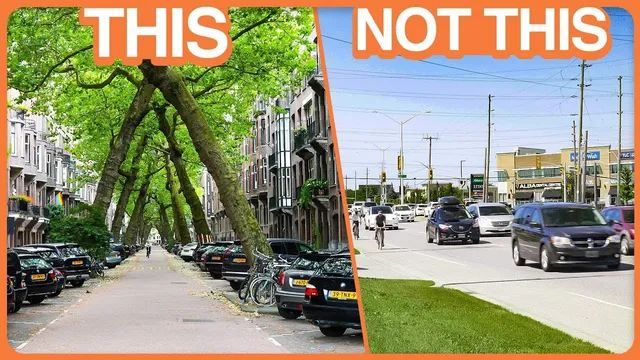
Enclosure helps urban spaces feel like distinct “public rooms,” and it often aligns with practical width-to-height ratios (about 3:1 for streets and 6:1 for squares).
Briefing
Great cities feel memorable because they deliver a strong “sense of place”—a built environment quality that makes people feel they’re somewhere specific, worth lingering in, and hard to confuse with anywhere else. When that sense of place is missing, streets and districts blur together into a lifeless sameness where nothing invites stopping, browsing, or staying.
A key ingredient is enclosure: public space should feel like a “room,” with walls made from buildings, trees, or other elements that define boundaries. Urban planning rule-of-thumb ratios—roughly no more than a 3-to-1 street width-to-building height (and about 6-to-1 for squares)—often align with streets that feel coherent and squares that feel intimate. Exceptions exist, such as Saint Peter’s Square, where the space is extremely wide but still works because an obelisk breaks up the view; the caveat is that these designs depend on keeping cars out. In car-heavy contexts, enclosure collapses—especially when wide surface parking dominates—leaving people unsure where a place begins or ends.
Enclosure can also be manufactured without tall buildings. Trees can split a wide right-of-way into multiple “rooms,” including the “kissing canopy” effect where branches nearly meet overhead to create a roof-like comfort. Other makeshift coverings—like matching umbrellas in Zagreb’s Dolat Square or a fully covered market in Rotterdam—show how physical definition can turn open areas into destinations rather than pass-through space.
The second major factor is eye-level interest: when streets function as public rooms, the “walls” matter. Shop windows, stalls, outdoor cafés, and public art create details people notice while walking—like mosaic facades in Paris or intricate concrete work in Prague. By contrast, car-oriented suburban streets often present blank, prison-like façades and low-quality materials that discourage walking and make the environment feel hostile or disposable.
Third comes entrance frequency: the number of accessible places branching off a street at regular, walkable intervals. Suburban “power centers” fail here because entrances are spaced so far apart that people default back into cars. Even well-designed enclosed plazas can lose their power if they’re surrounded by parking that forces a drive-first approach; multiple entrances that connect to nearby streets and transit preserve the sense that the place is part of everyday movement.
Underlying all of this is a planning choice about identity. A city’s sense of place reflects what it values—dining culture, preserved history, industrial reinvention, or other local priorities. In North America, ethnic enclaves such as Chinatown, Little Havana, and old Quebec City often succeed at recreating distinctive streetscapes from immigrants’ home regions, with frequent street-level businesses and enclosure that separates the enclave from the surrounding world. But uniqueness can fade when cities allow generic chain retail to replace local character; Amsterdam’s canal ring remains distinctive partly because the city has restricted what can open in the center.
The payoff is psychological as much as aesthetic. In car-dependent areas, everything looks interchangeable, so navigation becomes about major roads and directions. In a place-rich city like Amsterdam, navigation becomes about moving between meaningful destinations—turning the city into a network of distinct rooms people care about. The result is a built environment that doesn’t just function, but gives residents a reason to feel connected to where they are.
Cornell Notes
Strong “sense of place” makes urban areas feel unique, memorable, and worth lingering in—while weak sense of place turns districts into interchangeable sameness. Enclosure is central: streets and squares should feel like public rooms, often aligning with width-to-height ratios (about 3:1 for streets and 6:1 for squares) and reinforced through buildings, trees, or coverings. Eye-level interest matters because pedestrians notice façades, windows, cafés, and public art; car-oriented design tends to produce blank, prison-like walls. Entrance frequency also shapes experience by keeping destinations reachable at regular walkable intervals. Finally, sense of place depends on identity choices—what a city values—and can erode when generic chain retail replaces local character.
How does “enclosure” create a sense of place, and why does car traffic undermine it?
What is “eye-level interest,” and how does it differ between pedestrian-oriented and car-oriented streets?
Why does “entrance frequency” affect whether people walk or drive?
How do cities encode identity through design choices?
What causes a once-distinct district to become generic over time?
Review Questions
- Which design mechanisms in the transcript most directly increase enclosure, and what are the conditions under which they stop working?
- How do enclosure, eye-level interest, and entrance frequency work together to change how people navigate and decide where to stop?
- Give one example from the transcript of how identity is preserved (or lost) through retail and land-use choices. What design lever made the difference?
Key Points
- 1
Enclosure helps urban spaces feel like distinct “public rooms,” and it often aligns with practical width-to-height ratios (about 3:1 for streets and 6:1 for squares).
- 2
Trees and coverings can create enclosure even when buildings don’t, including “kissing canopies” that form a roof-like canopy.
- 3
Car-dependent design frequently destroys sense of place by replacing boundaries with wide surface parking and asphalt that makes areas feel continuous and lifeless.
- 4
Pedestrian experience depends on eye-level interest—windows, cafés, stalls, and public art—while car-first streets often present blank, low-engagement façades.
- 5
Entrance frequency determines whether people can stop and browse on foot; widely spaced entrances push behavior back toward driving.
- 6
Sense of place is an identity signal: design choices communicate what a city values, and generic chain retail can erase local distinctiveness.
- 7
Ethnic enclaves often maintain strong sense of place through frequent street-level businesses, enclosure, and distinctive details drawn from immigrants’ home environments.