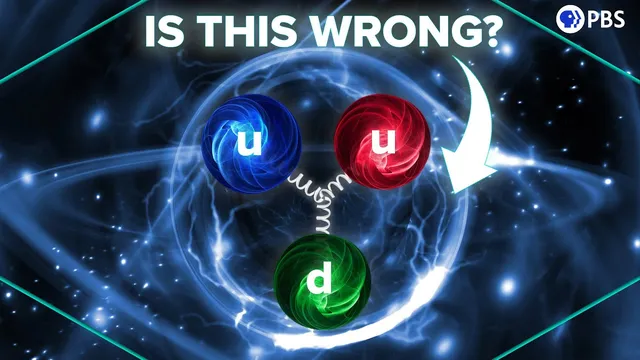
Did AI Prove Our Proton Model WRONG?
Based on PBS Space Time's video on YouTube. If you like this content, support the original creators by watching, liking and subscribing to their content.
Higher-energy electron scattering can resolve smaller proton substructures because electron wavelength decreases with energy.
Briefing
Proton “interiors” may not be limited to the familiar three-quark picture: evidence is emerging that protons sometimes behave like five-quark systems, potentially including an “intrinsic charm” component. The stakes are high because the proton is the backbone of ordinary matter, and its internal structure underpins how physicists interpret results from high-energy experiments and the theory of the strong force.
For decades, scattering experiments have been the main way to probe what’s inside a proton. The basic idea is that higher-energy probes resolve smaller structures: in electron scattering, an electron with enough energy can penetrate the proton and scatter off internal constituents rather than bouncing off the proton as a whole. Early landmark results from SLAC in the late 1960s used high-energy electrons to infer that protons contain three point-like constituents whose properties match quarks—leading to the standard “two up, one down” valence-quark model.
But increasing the electron beam energy revealed a richer interior than three quarks alone. The proton is better described as a quantum soup: a dense network of gluons constantly transforming into virtual quark–antiquark pairs and back again, often called the “quark sea.” Within this chaos, quantum rules enforce conservation laws, so the net valence content remains two up and one down. At higher energies, scattering can also pick out short-lived fluctuations in the sea, producing detailed signatures of gluons and virtual quarks.
A persistent oddity is charm. Around 1% of the time, scattering data have shown hints consistent with charm quarks inside the proton. Charm is heavy—more massive than the proton—so the simplest explanation is “extrinsic charm”: the incoming electron’s energy can create charm–anticharm pairs during the collision. That idea fits high-energy behavior, but it struggles with earlier low-energy hints where charm appeared more often than expected even when the electron lacked enough energy to reliably manufacture charm.
Theoretical work addresses this tension using the uncertainty principle. If energy can be “borrowed” briefly, a charm–anticharm pair could exist transiently inside the proton without being part of its long-term valence structure. In that picture, the proton’s internal state occasionally resembles a five-quark configuration. Yet proving intrinsic charm has been difficult because low-energy QCD is hard to calculate and many different proton-interior models can reproduce the same scattering outcomes—making it easy to fit data by chance.
Machine learning is now being used to break that stalemate. In the NNPDF collaboration, researchers trained a neural network on nearly 30 years of proton collision data, exploring a vast space of possible proton models rather than committing to a single theoretical form. The network produced a model that includes intrinsic charm and matches the scattering data better than previous approaches. The reported significance is 3-sigma, meaning there’s about a 1 in 1000 chance the improvement could arise from random fluctuations; the field’s usual threshold for discovery is 5-sigma.
More data are needed to confirm whether charm is truly an intrinsic part of the proton’s structure. Still, the approach signals a broader shift: faster model testing via AI could sharpen how physicists separate genuine internal structure from artifacts of limited theory and limited statistics.
Cornell Notes
Scattering experiments probe the proton by firing energetic electrons at it and analyzing how they deflect. Early SLAC results supported a three-quark (two up, one down) valence picture, but higher energies revealed a complicated “quark sea” driven by gluons and virtual quark–antiquark pairs. Hints of charm quarks—heavy enough that they shouldn’t be easily produced in low-energy collisions—raised the possibility of “intrinsic charm,” where a charm–anticharm pair can briefly exist inside the proton via quantum uncertainty. A new neural-network analysis by the NNPDF collaboration tested thousands of proton-interior models against nearly 30 years of data and found a better fit when intrinsic charm is included, with a tentative 3-sigma significance. Confirmation will require more experiments and higher statistical power, ideally reaching the 5-sigma standard.
Why does electron scattering reveal smaller details of a proton at higher energies?
What is the difference between “intrinsic” and “extrinsic” charm in this context?
How can quantum mechanics allow a heavy charm pair to appear inside a proton without being “part of it” in the usual sense?
Why has intrinsic charm been hard to prove using traditional modeling?
What did the NNPDF neural-network approach change about the intrinsic-charm search?
What does a 3-sigma result mean, and why isn’t it the final word?
Review Questions
- How does increasing electron energy change what parts of the proton scattering experiments are sensitive to?
- What physical reasoning distinguishes intrinsic charm from extrinsic charm, and why does low-energy evidence matter?
- What methodological advantage does a neural-network model search (as used by NNPDF) provide over testing a small number of proton-interior models?
Key Points
- 1
Higher-energy electron scattering can resolve smaller proton substructures because electron wavelength decreases with energy.
- 2
The proton’s interior is not just three quarks; gluons continually generate and annihilate virtual quark–antiquark pairs, forming a “quark sea.”
- 3
Charm-quark signals can be interpreted as either extrinsic (created in the collision) or intrinsic (part of the proton’s internal quantum state).
- 4
Intrinsic charm is motivated by the uncertainty principle, allowing brief charm–anticharm fluctuations whose contribution to proton mass is time-averaged.
- 5
Traditional intrinsic-charm searches struggled because low-energy QCD is hard to model and many different proton models can fit the same scattering data.
- 6
The NNPDF neural-network analysis trained on nearly 30 years of data tested a much larger space of proton-interior models and found a better fit including intrinsic charm.
- 7
The current evidence is tentative at 3-sigma; reaching the stronger 5-sigma threshold will require more experimental data and validation.