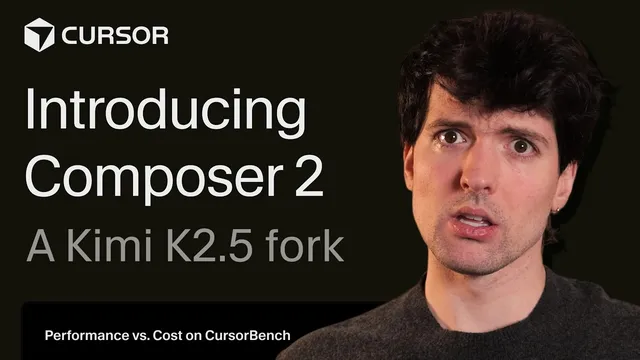
Did Cursor really steal Kimi???
Based on Theo - t3․gg's video on YouTube. If you like this content, support the original creators by watching, liking and subscribing to their content.
Composer 2 is presented as a coding-focused model with very low inference costs and strong code benchmark performance, including comparisons against Opus.
Briefing
Cursor’s newly shipped “Composer 2” model is being treated as a major leap in coding performance-per-dollar—but a wave of scrutiny suggests it may not be as brand-new as its name implies. The controversy ignited after someone noticed “Kimmy K2.5” embedded in Composer 2’s API-related naming, prompting questions about whether Cursor effectively built its coding model by heavily post-training Moonshot AI’s openweight Kimmy base rather than starting from scratch.
The core claim emerging from the discussion is that Composer 2 is a refined, RL-tuned derivative built on top of Kimmy K2.5, with Cursor using large-scale compute and reinforcement learning to push coding ability toward “frontier” levels while keeping inference costs extremely low. In reported pricing terms, Composer 2’s default throughput is described as roughly 80–100 tokens per second at about $0.50 per million tokens in and $2.50 per million out—about 10x cheaper than Opus (quoted at $5 in and $25 out). External benchmarks cited in the conversation also place Composer 2 ahead of Opus on code-focused tests like TerminalBench 2, though the model still makes “dumb mistakes” that require steering.
What makes the situation more combustible is licensing and disclosure. Moonshot AI’s modified MIT license includes a commercial-use condition requiring prominent display of “Kimmy K2.5” in products or services exceeding certain scale thresholds (100 million monthly users or $2 million monthly revenue). Critics argue Cursor’s product naming and UI did not clearly surface that requirement. Speculation then turned to how Cursor might comply indirectly: Fireworks—described as a compute platform for hosting openweight models—provides hosted inference and RL tooling, and the discussion claims Cursor accessed Kimmy K2.5 through Fireworks as part of an authorized commercial partnership. In that framing, Fireworks’ pipeline allegedly handles the license-required disclosure “through inference partner terms,” allowing Cursor to avoid showing “Kimmy K2.5” directly in its own interface.
Supporters and defenders in the thread point to the technical reality that “openweight” models are commonly used as starting points. Post-training can drastically change behavior: the conversation emphasizes that many major model releases reuse the same pre-training base and then apply refinement to unlock new capabilities. The unusual part, according to this account, is the scale and outcome—using post-training on someone else’s model to reach coding results comparable to top-tier systems.
Beyond the immediate drama, the discussion frames a broader industry risk: if licensing ambiguity and perceived “rebranding” backlash deter openweight releases, smaller labs may hesitate to publish models at all. The long-term worry is that openweight cost improvements—credited here with driving better and cheaper frontier performance—could slow if model providers feel exposed to disputes over attribution, compliance, and “spirit” of licenses. The bottom line: Composer 2 appears genuinely strong and unusually economical for coding, but the path to it—starting from Kimmy K2.5 and the way that relationship was disclosed—has become a flashpoint for how openweight ecosystems may evolve under intense compute-price pressure.
Cornell Notes
Composer 2, Cursor’s new coding model, is portrayed as a major jump in coding performance-per-dollar, with very low token pricing and strong code benchmark results. The controversy centers on whether Composer 2 is effectively built by post-training Moonshot AI’s openweight Kimmy K2.5—an inference that appears in API-related naming. Moonshot’s modified MIT license reportedly requires prominent “Kimmy K2.5” display for large commercial products, raising questions about Cursor’s disclosure. A proposed workaround is that Cursor accessed Kimmy K2.5 via Fireworks under inference-partner terms, shifting license compliance into the hosting pipeline. The dispute matters because it could reshape incentives for openweight model releases and how companies document licensing and starting points.
What evidence triggered the suspicion that Composer 2 was built on Kimmy K2.5 rather than being fully new?
Why does post-training on an existing openweight model matter for performance, according to the discussion?
How do the cited pricing and benchmark comparisons support the “performance-per-dollar” claim?
What licensing issue is at the center of the controversy?
How does Fireworks enter the story as a potential compliance mechanism?
What broader industry impact is warned about if this dispute escalates?
Review Questions
- What technical distinction between pre-training and post-training does the discussion rely on to justify how Composer 2 could become much better than the base Kimmy model?
- How do the quoted token prices for Composer 2 and Opus support the claim that Composer 2 is unusually cost-effective for coding?
- What are the two competing interpretations of licensing compliance described here (direct UI disclosure vs. disclosure handled via inference-partner terms)?
Key Points
- 1
Composer 2 is presented as a coding-focused model with very low inference costs and strong code benchmark performance, including comparisons against Opus.
- 2
The controversy began after API-related naming appeared to reference “Kimmy K2.5,” implying Composer 2 started from Moonshot AI’s openweight base.
- 3
Moonshot’s modified MIT license reportedly requires prominent “Kimmy K2.5” display for large-scale commercial use, creating a disclosure-compliance dispute.
- 4
A proposed workaround is that Cursor used Fireworks’ hosted inference/RL pipeline under authorized inference-partner terms, shifting where license obligations are satisfied.
- 5
Post-training—especially reinforcement learning—is emphasized as a mechanism that can dramatically change model behavior after a shared pre-training base.
- 6
The dispute is framed as an ecosystem-level risk: unclear licensing and perceived rebranding could discourage openweight releases, slowing cost-driven progress across frontier models.