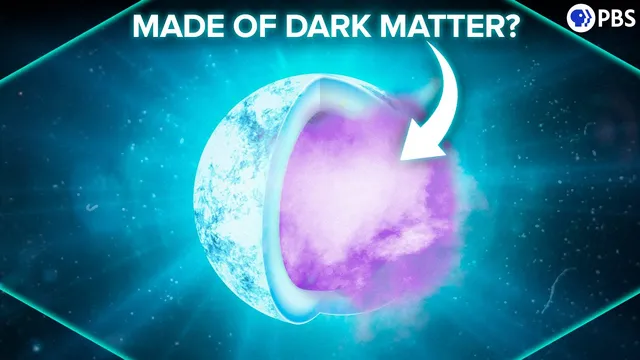
Did JWST Discover Dark Matter Stars?
Based on PBS Space Time's video on YouTube. If you like this content, support the original creators by watching, liking and subscribing to their content.
JWST’s JADES survey found four extremely distant objects (z10–z13) whose brightness implies very large masses at about 400 million years after the Big Bang.
Briefing
JWST’s deep-field observations have produced four extremely distant objects—JADES-GS-z10-0 through JADES-GS-z13-0 (z10–z13)—that look like tiny, early-universe “dots” but are among the oldest and farthest confirmed sources ever seen. Their light has been traveling for most of the universe’s age, placing them at roughly 400 million years after the Big Bang (about 3% or less of the universe’s current age). At first glance, their brightness suggests they might be enormous galaxies, yet the early timing creates a tension: models struggle to grow such massive systems so quickly.
That mismatch has fueled speculation, including a more exotic possibility proposed in a new Proceedings of the National Academy of Sciences paper: some of these objects could be “dark stars,” powered not by nuclear fusion but by dark matter annihilation. The idea traces back to work by Katherine Freese and collaborators in 2007, but the novelty here is the claim of candidate objects consistent with the dark-star scenario.
Dark stars require a particular kind of dark matter particle. It must behave like standard dark matter in one crucial way: it can’t strongly interact with itself, so it stays “puffy” and doesn’t collapse into a compact object on its own. It also must remain electromagnetically silent—unable to emit or absorb photons—so it truly stays dark. At the same time, the particle must have at least some weak self-interaction that becomes relevant only at very high densities, enabling dark matter to collapse under extreme conditions and, most importantly, to annihilate. The annihilation is assumed to occur when particles meet closely enough, either because the particle is its own antiparticle or because dark matter arrives in particle–antiparticle pairs.
In the proposed early-universe setup, dark matter forms mini-halos with masses of millions to hundreds of millions of solar masses. Dark matter alone resists collapsing, but gas falls toward the center of these halos. As the gas density rises, its gravity drags dark matter inward too, boosting dark matter concentration by orders of magnitude. Even if dark matter makes up only a tiny fraction of the gas mass inside the central region, the annihilation rate can become enormous. That energy heats the surrounding gas and halts further contraction before normal fusion-driven stellar densities are reached—meaning the object never becomes a conventional star, yet it can still shine brilliantly because annihilation supplies the power.
The paper further suggests dark stars could grow by accreting additional gas and dark matter, potentially reaching masses millions of times that of the Sun and luminosities billions of times the Sun’s—bright enough to be detectable at JWST’s distances. Eventually, annihilation depletes the dark matter fuel or the supply dwindles, and the gas cloud likely collapses quickly, possibly forming seed black holes. That mechanism is pitched as a potential contributor to the rapid appearance of massive black holes and early quasars.
Crucially, the hypothesis is testable in principle. Dark stars should produce different spectral signatures than galaxies: a galaxy spectrum typically shows emission lines from illuminated interstellar gas, while a single star-like source would show absorption lines. High-quality spectroscopy of the z10–z13 objects could therefore help distinguish a compact dark-star source from a massive early galaxy, or reveal a hybrid case such as a small galaxy hosting a dark star at its center.
Overall, galaxies remain the more conservative explanation because they are known to exist and the dark-star idea is speculative. Still, the combination of extreme distance, unexpected brightness, and a clear observational path keeps the dark-star possibility on the table—at least until spectra settle the question.
Cornell Notes
JWST has identified four extremely distant objects (JADES-GS-z10-0 to JADES-GS-z13-0, or z10–z13) seen as they were about 400 million years after the Big Bang. Their brightness and implied mass are hard to reconcile with how quickly normal galaxies should assemble, motivating a speculative alternative: some could be “dark stars” powered by dark matter annihilation rather than fusion. Dark stars require dark matter that stays electromagnetically silent and weakly self-interacting (so it doesn’t collapse by itself), yet can annihilate when concentrated enough. In the proposed scenario, gas falling into early mini-halos drags dark matter inward, triggering annihilation that heats gas and prevents normal star formation while still producing extreme luminosity. Spectroscopy—emission lines for galaxies versus absorption lines for stars—offers a way to test the idea.
Why are the z10–z13 objects considered unusual even before any dark-star claim?
What specific properties must dark matter have for dark stars to work?
How does dark matter annihilation prevent a normal star from forming in the dark-star model?
What role do mini-halos and gas play in triggering dark-star conditions?
What happens to dark stars after their fuel runs out, and why does that matter for black holes?
How can spectroscopy distinguish a dark star from a galaxy?
Review Questions
- What dark-matter interaction constraints are simultaneously required for a dark star to both stay “dark” and still annihilate efficiently?
- Describe the chain of events from mini-halo formation to dark-matter concentration to annihilation-driven heating.
- What spectral-line differences would you expect between a massive early galaxy and a single luminous star-like dark-star source?
Key Points
- 1
JWST’s JADES survey found four extremely distant objects (z10–z13) whose brightness implies very large masses at about 400 million years after the Big Bang.
- 2
The early formation timescale problem for massive galaxies motivates alternative explanations, including dark stars powered by dark matter annihilation.
- 3
Dark-star models require dark matter that is electromagnetically silent, weakly self-interacting (to stay diffuse), yet capable of annihilating when concentrated.
- 4
In the proposed scenario, gas collapse into early mini-halos drags dark matter inward, raising annihilation rates enough to heat gas and halt normal star formation.
- 5
Dark stars could reach enormous luminosities and masses, making them detectable at JWST distances despite being powered by non-fusion energy.
- 6
Spectroscopy offers a practical test: galaxies should show emission lines, while a star-like source should show absorption lines, with hybrid cases possible.