Did JWST SOLVE The Mystery of Supermassive Black Hole Origins?
Based on PBS Space Time's video on YouTube. If you like this content, support the original creators by watching, liking and subscribing to their content.
UHZ1 is an ultra-high-redshift quasar candidate at redshift z = 10.1, observed during the universe’s earliest era (light emitted when the cosmos was under 3.5% of its current age).
Briefing
JWST’s ultra-high-redshift galaxy UHZ1 appears to host an early supermassive black hole that’s already far too massive to be built from “small seeds” within the universe’s first billion years—strengthening the case for “heavy seed” formation via direct collapse. The object, gravitationally magnified by the galaxy cluster Abell 2744 (about 4 billion light-years away), shows infrared colors consistent with a redshift of 10.1, meaning the light has been traveling for roughly 13.2 billion years from when the universe was under 3.5% of its current age.
The decisive clue comes from X-ray observations with Chandra. The compact “smudge” emits a large amount of X-rays concentrated within the source region—an arrangement that strongly points to a quasar. Quasars require a supermassive black hole feeding at the center of a galaxy, where infalling gas heats up and radiates intensely, including high-energy X-rays near the black hole. Using the X-ray output and the distance implied by the redshift, astronomers estimate the black hole mass at about 40 million Suns—roughly 10 times the mass of the Milky Way’s central supermassive black hole. That makes UHZ1 the most distant quasar yet found, and therefore the earliest black hole with direct observational evidence.
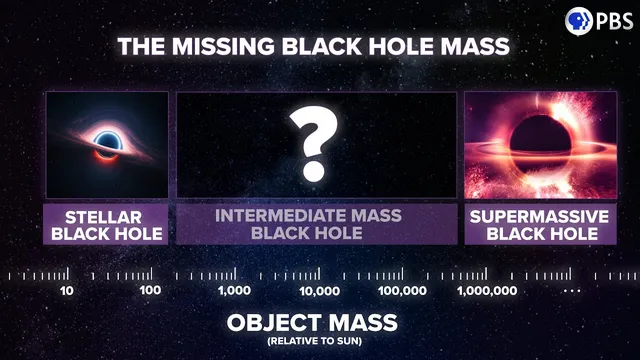
UHZ1 matters because it targets one of cosmology’s biggest puzzles: how supermassive black holes (SMBHs) reached masses of 100,000 to several billion solar masses so early. Two leading scenarios compete. In the “small seed” model, black holes begin as remnants of massive stars (around 10–100 solar masses) and then grow by accretion and mergers. But growth is constrained by the Eddington limit—radiation pressure that counteracts infalling gas—making it difficult for a small seed to reach quasar-scale masses in less than a billion years. Even though there are workarounds (super-Eddington feeding, frequent mergers, or unusually massive stellar progenitors), they require sustained, “creative” conditions.
The “heavy seed” model instead proposes that the earliest black holes formed already large—around 100,000 solar masses—through direct collapse of pristine gas in the early universe. In this picture, the relevant threshold is the Schwarzschild radius: matter doesn’t need to be “ultra-dense” in the everyday sense, but it must be compressed enough for collapse. Early hydrogen-and-helium-rich gas likely avoided fragmentation, allowing protogalactic clouds to collapse into black holes without first forming stars. Once such a seed exists, ordinary feeding rates can plausibly build up to SMBH masses within hundreds of millions of years.
UHZ1’s observed properties lean toward the heavy-seed pathway. Estimates of the galaxy’s starlight versus quasar light suggest a stellar mass of about 40 million Suns—comparable to the black hole mass—while the system’s stellar content is far smaller than the Milky Way’s. That pattern challenges the usual long-term correlation between galaxy stellar mass and central black hole mass, implying the black hole may have formed first and the stars later “caught up.” The object fits simulations of a proposed class called OBGs (overly-massive black hole galaxies), which are expected when the black hole forms via direct collapse rather than growth from stellar remnants.
Still, it’s not a definitive verdict. UHZ1 could, in principle, be an unusual case—such as forming from a rare primordial black hole or an exotic “quasistar” scenario—but the alignment with direct-collapse/OBG predictions makes those alternatives less likely. The next step is straightforward: find more objects like UHZ1. With JWST and Chandra continuing to push toward the earliest quasars, astronomers hope to determine whether heavy seeds dominate the universe’s first black hole growth or whether small seeds can still account for a substantial fraction of them.
Cornell Notes
UHZ1 is an ultra-high-redshift quasar candidate magnified by the gravitational lensing cluster Abell 2744. JWST infrared data place it at redshift z = 10.1 (about 13.2 billion years ago), when the universe was less than 3.5% of its current age. Chandra detects strong, compact X-ray emission consistent with a quasar, implying a black hole mass of about 40 million Suns. That early, already-massive black hole strains “small seed” growth models constrained by the Eddington limit, and it fits better with “heavy seed” direct-collapse scenarios that can produce ~100,000-solar-mass seeds early. The galaxy’s stellar mass appears comparable to the black hole’s, matching the proposed OBG (overly-massive black hole galaxy) class where the black hole forms first and stars later catch up.
Why does Chandra’s X-ray detection matter more than the infrared “smudge” alone?
How is the black hole mass for UHZ1 estimated, and what does it imply?
What makes the “small seed” model difficult for early quasars like UHZ1?
How does the “heavy seed” model avoid the Eddington-time problem?
What observational pattern in UHZ1 supports the heavy-seed/OBG interpretation?
Does UHZ1 conclusively rule out alternative black hole origins?
Review Questions
- What roles do gravitational lensing by Abell 2744, JWST infrared measurements, and Chandra X-ray imaging each play in identifying UHZ1?
- How do the Eddington limit and the available cosmic time jointly constrain the small seed model for early SMBH growth?
- What does the approximate equality of UHZ1’s stellar mass and black hole mass suggest about the sequence of black hole versus galaxy growth?
Key Points
- 1
UHZ1 is an ultra-high-redshift quasar candidate at redshift z = 10.1, observed during the universe’s earliest era (light emitted when the cosmos was under 3.5% of its current age).
- 2
Gravitational lensing by the galaxy cluster Abell 2744 magnifies the faint object, enabling JWST and Chandra to study it in detail.
- 3
Chandra’s concentrated X-ray emission indicates a quasar, implying a central supermassive black hole rather than ordinary star formation.
- 4
The inferred black hole mass for UHZ1 is about 40 million solar masses, making it the earliest observed quasar and an early SMBH with unexpectedly large mass.
- 5
Small seed growth models struggle because the Eddington limit limits how fast a stellar-remnant black hole can gain mass within the first billion years.
- 6
Heavy seed direct-collapse models predict ~100,000-solar-mass starting black holes that can reach quasar-scale masses within hundreds of millions of years.
- 7
UHZ1’s stellar mass appears comparable to its black hole mass, aligning with the proposed OBG (overly-massive black hole galaxy) class and favoring direct-collapse origins for at least some early SMBHs.