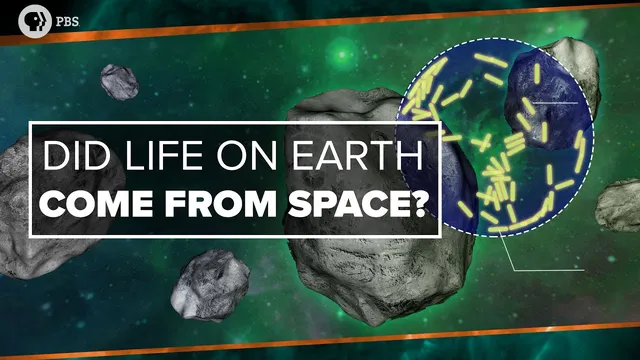
Did Life on Earth Come from Space?
Based on PBS Space Time's video on YouTube. If you like this content, support the original creators by watching, liking and subscribing to their content.
Panspermia reframes Earth’s origin-of-life question by proposing that life could have arrived from elsewhere instead of forming locally.
Briefing
Life’s first appearance on Earth may have been less a lightning-bolt chemical event and more a cosmic delivery problem. The core idea behind panspermia is that abiogenesis—life emerging from nonliving chemistry—could be so rare that it happened only once (or very few times) in the Milky Way, and that the resulting microbes arrived on Earth later rather than starting here. That shift matters because it reframes “how life began” from a single-planet chemistry puzzle into a question about whether living organisms can survive the brutal physics of space travel.
Panspermia hinges on three lethal stages: getting ejected from a source world, surviving the journey through space, and enduring entry into a new planet’s biosphere. For “litho panspermia,” impacts on planets can fling debris into space. Earth has received meteorites whose chemistry points to origins on the Moon or Mars, and Earth itself has produced ejecta during major impacts. But escape requires extreme speeds—Earth’s escape velocity is about 11.2 km/s—along with shock pressures and heating during impact and reentry. Survival tests have therefore used “microbe abuse”: high-velocity projectiles, centrifugation, extreme pressure exposure, and even dropping microbe-laden rocks from space or attaching them to reentry vehicles. Many organisms can endure parts of the ordeal, but radiation is the standout threat.
In the vacuum, cold, and dryness of space, numerous microbes can persist by entering dormant forms. Cryptobiosis lets organisms shut down metabolism and wait out hostile conditions. Spores and similar hibernation states are especially important: bacterial endospores can survive without water, air, or nutrients and are notably resistant to DNA damage. Experiments and observations show revival after months of exposure, and endospores have been reported as viable after up to six years in space conditions. Yet ultraviolet light and cosmic rays can shred DNA quickly unless microbes are shielded.
That’s why endoliths—organisms living deep inside rocks—stand out as the best candidates. Buried within rock, they can be protected from UV and cosmic radiation, and their low metabolic rates can stretch survival for decades, centuries, or even longer. Endoliths exist across major branches of life and include extremophiles, with some ocean-floor microbes dated to hundreds of millions of years. The journey between planets is plausibly survivable for such protected life, but interstellar travel is harder. A rock leaving a star system must escape not only a planet’s gravity but also the star’s influence, requiring even higher speeds and therefore harsher launch conditions. After that, the travel time to nearby stars can span tens of thousands of years, and the odds of a passing rock being captured by a planetary system are low.
Even so, panspermia remains plausible rather than proven. A key statistical tension is that if dormant life seeds are common, why haven’t many of the roughly forty billion Earth-like planets produced advanced civilizations far earlier? The transcript also floats directed panspermia—deliberate seeding by an advanced civilization—as an explanation, but it remains speculative.
The episode closes by shifting from science to media ethics, arguing that fringe ideas can be harmful when presented without caution or context. Overhyped claims can train the public to distrust science broadly, while responsible communication should keep uncertainty visible. In the panspermia debate, the “alien” question is less about spectacle and more about whether biology can survive the long, radiation-soaked trip between worlds.
Cornell Notes
Panspermia proposes that life on Earth may have arrived from elsewhere rather than forming here. The idea depends on whether microbes can survive three stages: ejection from a source world, survival during space travel, and entry into a new planet’s environment. Many organisms can endure vacuum, cold, and dryness by using dormant states such as cryptobiosis; bacterial endospores are especially resistant and have been revived after long exposures. Radiation—especially UV and cosmic rays—is the main bottleneck, making shielding in rock crucial. Endoliths (rock-dwelling microbes) are highlighted as strong candidates because they can be protected deep inside rocks, potentially surviving long interplanetary journeys, though interstellar capture odds remain low.
Why does panspermia depend on “three deadly stages,” and which stage is hardest to beat?
What evidence from survival experiments supports the idea that microbes can endure space conditions?
How do cryptobiosis and endospores help organisms survive the void?
Why are endoliths repeatedly singled out as the best panspermia candidates?
What makes interstellar panspermia harder than moving life within a solar system?
What statistical or logical objections challenge panspermia?
Review Questions
- Which physical factor most strongly limits unshielded microbial survival in space, and how does rock burial change the outcome?
- How do cryptobiosis and endospores differ from active life in terms of survivability during long interplanetary or interstellar journeys?
- Why might interstellar capture odds be a bigger problem than microbial survival itself?
Key Points
- 1
Panspermia reframes Earth’s origin-of-life question by proposing that life could have arrived from elsewhere instead of forming locally.
- 2
Survival must be possible through ejection, space transit, and planetary entry; radiation is the dominant threat across these stages.
- 3
Cryptobiosis enables many organisms to endure vacuum, cold, and dryness by entering dormant, metabolism-suppressed states.
- 4
Bacterial endospores are among the most radiation- and desiccation-resistant forms, with revival reported after years in space conditions.
- 5
Radiation protection is crucial; thick shielding inside rocks makes endoliths especially promising candidates.
- 6
Interstellar panspermia is constrained not only by survival but also by the difficulty of escaping stellar gravity and the low probability of capture by other star systems.