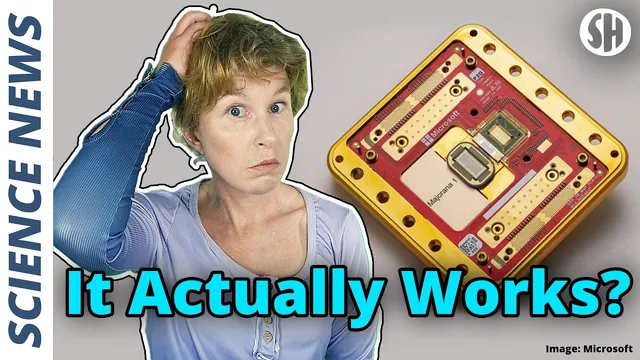
Did Microsoft Just Fix Its Quantum Problem?
Based on Sabine Hossenfelder's video on YouTube. If you like this content, support the original creators by watching, liking and subscribing to their content.
Microsoft’s newer Majorana-based results report a qubit built from four Majorana modes and reliable readout of two parity states, extending earlier single-parity demonstrations.
Briefing
Microsoft’s topological-qubit push is gaining new experimental detail, but the evidence still falls short of proving the qubits are truly “topological” or that they deliver a decisive advantage over competing quantum approaches. The latest update—an arXiv pre-print—reports creating a qubit built from four Majorana modes and reliably reading out two parity states. That moves beyond an earlier Nature-linked effort that demonstrated only a single parity state with two measured values at about 99% reliability. In other words, the work now shows a clearer proof of principle: multiple parity states can be prepared and read out.
Still, two major caveats keep the story from turning into a breakthrough headline. First, the reported error rates are high by quantum-computing standards: one parity-state readout is associated with roughly 0.5% error, while the other is around 16%. The latter figure is so large that it undermines confidence in whether the device is performing in the regime needed for scalable quantum computation. Second, the results do not yet establish that the qubit is genuinely topologically protected. Demonstrating topological protection requires showing that the system resists noise in the specific way theory predicts—typically by verifying that superpositions and operations remain stable under repeated measurement sequences that probe the parity structure.
The debate is sharpened by a near-simultaneous counterclaim from other researchers. A separate paper argues that topological qubits may be less protected than previously believed because 1/f noise—common in electronic circuits—could cause superpositions to decohere within about a nanosecond. Microsoft’s response, attributed to Chetan Nayak in an HPCwire interview, is that the issue has been “well-studied for a decade” and that both direct and indirect experimental measurements in Microsoft’s devices indicate small associated error rates. In effect, the disagreement is about whether theoretical estimates of 1/f noise impact match what experiments actually show.
Neither side’s work is peer reviewed, and Microsoft’s topological research has previously faced retractions, though the transcript characterizes earlier problems as honest mistakes rather than misconduct. Even if topological qubits eventually prove their protection claims, the transcript emphasizes that the advantage is still a gamble: topological protection may only cover certain operations, leaving other noise sources to be handled by error correction. Meanwhile, Google and IBM are portrayed as advancing error-correction protocols and hardware progress in parallel.
Taken together, the new parity-state results strengthen the case that Majorana-based devices can be built and measured, but they do not yet resolve the central question—whether topological qubits will deliver a practical, scalable edge. For now, the competitive gap remains, with Microsoft still lagging behind the leading quantum players despite aggressive marketing momentum.
Cornell Notes
Microsoft’s latest Majorana-based effort reports a qubit formed from four Majorana modes and reliable readout of two parity states, improving on earlier work that demonstrated only one parity state. The advance is meaningful as proof of principle, but the reported error rates—about 0.5% in one case and ~16% in the other—are too high to treat the results as scalable performance. The work also does not yet prove true topological protection, which would require evidence that noise resistance matches theoretical expectations under repeated parity-related measurements. A separate paper argues that 1/f noise could cause rapid decoherence, while Microsoft’s Chetan Nayak says experimental measurements indicate small error rates. With neither side peer reviewed, the dispute remains unresolved.
What experimental step did Microsoft add in the newer pre-print compared with the earlier Nature-linked work?
Why do the reported error rates prevent the results from being treated as a scalable breakthrough?
What would be required to prove that the qubits are truly topological rather than just Majorana-like?
How does the external criticism about 1/f noise challenge the topological-qubit promise?
What is Microsoft’s counter-position on the 1/f noise concern?
Even if topological protection works, why is the advantage still described as uncertain?
Review Questions
- What specific experimental evidence would distinguish “Majorana modes with parity readout” from “topologically protected qubits”?
- How do the two reported error rates (0.5% vs ~16%) affect the plausibility of scaling topological qubits?
- What does the 1/f noise critique predict about decoherence, and how does Microsoft’s response claim to address it?
Key Points
- 1
Microsoft’s newer Majorana-based results report a qubit built from four Majorana modes and reliable readout of two parity states, extending earlier single-parity demonstrations.
- 2
Reported error rates remain a bottleneck: about 0.5% in one case and roughly 16% in the other, with the latter far too high for scalable quantum computing.
- 3
The current evidence does not yet establish true topological protection; proof would require showing noise resistance and predicted behavior under iterated parity-related measurements.
- 4
An external paper argues 1/f noise could cause rapid decoherence (on the order of a nanosecond), challenging assumptions about topological robustness.
- 5
Chetan Nayak’s response claims theory has been studied for years and that experimental measurements indicate small error rates despite the 1/f noise concern.
- 6
With neither side peer reviewed and Microsoft’s past retractions mentioned, the competitive picture remains unsettled, and topological-qubit advantage is still treated as a gamble.