Did One Single Neutrino Just Prove Stephen Hawking Right?
Based on Sabine Hossenfelder's video on YouTube. If you like this content, support the original creators by watching, liking and subscribing to their content.
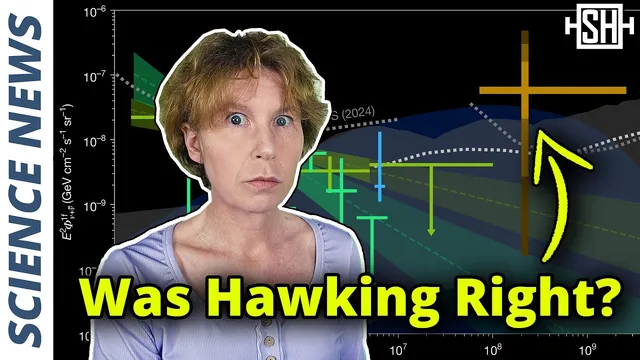
A neutrino event estimated at roughly 100 to 200 PeV is being highlighted as the most energetic neutrino ever detected, far above previous records and collider energies.
Briefing
A single ultra-high-energy neutrino detection is being floated as a potential clue to Hawking’s long-standing prediction that black holes evaporate—yet the case hinges on whether primordial black holes can produce neutrinos at energies far beyond anything made in known astrophysical accelerators. The headline rests on a new event recorded by a kilometer-scale neutrino telescope in the Mediterranean Sea: researchers estimate the neutrino’s energy at roughly 100 to 200 Peter electron volts (PeV), described as the most energetic neutrino ever detected. For context, the previous record from IceCube was about a tenth of that energy, and even that earlier value was already around a factor of 1,000 above what the Large Hadron Collider produces.
The Hawking link comes from how tiny black holes would behave. In the 1970s, Stephen Hawking predicted that black holes emit radiation—now called Hawking radiation—which causes the black hole to lose mass and eventually evaporate. Crucially, the radiation temperature scales inversely with black hole mass: stellar-mass black holes are too cold to measure, but very small black holes would be hot enough for their radiation to be detectable. Such small black holes are not expected to form from ordinary stellar collapse, but they could have formed in the early universe from over-dense regions in the primordial plasma. These hypothetical objects—primordial black holes—are also discussed as a possible dark matter component. As they evaporate, they should end in a final, extremely bright burst because the temperature rises as mass decreases.
The new neutrino event is framed as a natural byproduct of that final stage. Black hole evaporation is expected to emit all particle species, with the smaller the particle mass, the more of it the black hole produces. In that picture, photons dominate the radiation, followed by neutrinos—making neutrinos a key signature of evaporation. The neutrino’s extreme energy could be explained if it originated billions of years ago from an evaporating primordial black hole, then traveled to Earth essentially unimpeded compared with charged particles.
At the moment, alternative explanations are described as limited. The most violent astrophysical phenomena—supernovae and black hole jets—are not known to reach these energies, leaving the event as a “mystery” that would be hard to reproduce with standard sources. Still, the evidence is not treated as a slam dunk. The proposed test is a cross-check: if evaporating black holes produce neutrinos at these energies, they should also produce photons of similarly high energy. Photons interact more strongly than neutrinos, so they are less likely to reach us, but occasional detections should occur.
If the pattern holds, it would be a strong clue that at least part of dark matter could be made of primordial black holes. The overall confidence is pitched as moderate—about a six out of ten—because primordial black holes remain an understudied possibility and astrophysicists may yet find other mechanisms. The bottom line: one neutrino alone can’t “prove” Hawking’s theory, but it can motivate targeted searches for the accompanying high-energy photon signals that would make the Hawking/primordial-black-hole scenario stand up to scrutiny.
Cornell Notes
A record-setting neutrino event—estimated at 100 to 200 PeV—has revived interest in Hawking radiation as a possible source, specifically through primordial black holes evaporating today or long ago. Hawking’s prediction implies that smaller black holes are hotter, and the final evaporation stage should emit many particles, with photons most abundant and neutrinos following. Because neutrinos can traverse cosmic distances, an ultra-high-energy neutrino could plausibly be a relic of a primordial black hole’s late-time “bright bang.” The key next step is not more neutrinos alone, but cross-checking for accompanying ultra-high-energy photons, since photons should be produced too even though they interact more and reach Earth less often. The confidence is framed as tentative, with alternative astrophysical explanations still possible.
Why does Hawking radiation matter for interpreting an ultra-high-energy neutrino?
What role do primordial black holes play in the neutrino-energy argument?
Why is the detected neutrino’s energy treated as unusually significant?
What particle-production expectation links black hole evaporation to neutrinos?
What cross-check could strengthen (or weaken) the black-hole-evaporation interpretation?
Why isn’t one neutrino considered definitive proof?
Review Questions
- What physical relationship between black hole mass and Hawking radiation temperature makes small black holes the relevant targets for detection?
- How do neutrino and photon interaction strengths affect which signals should be easier to observe from distant sources?
- What specific observational cross-check would most directly test the primordial-black-hole evaporation hypothesis behind an ultra-high-energy neutrino event?
Key Points
- 1
A neutrino event estimated at roughly 100 to 200 PeV is being highlighted as the most energetic neutrino ever detected, far above previous records and collider energies.
- 2
Hawking radiation predicts black holes evaporate, with radiation temperature increasing as black hole mass decreases—making tiny black holes the only plausible measurable ones.
- 3
Primordial black holes, potentially formed in the early universe, are proposed as a source that could produce an ultra-high-energy neutrino during late-stage evaporation.
- 4
Black hole evaporation should emit many particles, with photons most abundant and neutrinos following, so neutrinos can serve as a signature of evaporation.
- 5
The strongest next test is a correlated search for ultra-high-energy photons, since photons should be produced alongside neutrinos even though they interact more and arrive less often.
- 6
Confidence remains cautious because one event cannot rule out alternative mechanisms, and astrophysical explanations may yet be developed.