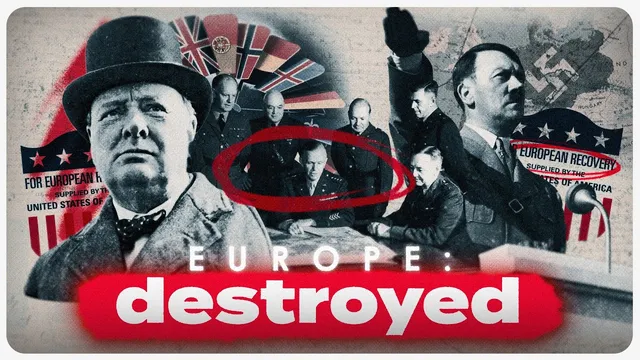
Did The US Really "Save" Europe?
Based on Second Thought's video on YouTube. If you like this content, support the original creators by watching, liking and subscribing to their content.
The Marshall Plan is framed as creating dependence on the U.S. by reshaping Europe’s energy system and weakening labor’s ability to pressure governments.
Briefing
The Marshall Plan is framed as less a benevolent “save Europe” effort and more a strategy that reshaped Europe’s economy to lock in long-term dependence on the United States—while weakening the political forces most capable of challenging that arrangement. After World War II, American leaders promised to revive Europe’s “working economy” to prevent hunger, poverty, desperation, and chaos. Yet the account here argues that the aid came with conditions that dismantled European checks on power, especially organized labor and communist influence, and redirected Europe’s energy system toward American oil.
A central thread links two early postwar trends: Western Europe’s energy mix and the political decline of the French Communist Party. In 1947, coal supplied over 90% of Western Europe’s energy; oil rose from under 10% before 1960 to more than 30% by 1960. Over the same period, the French Communist Party’s parliamentary strength is described as collapsing from more than 160 seats to about 10. The explanation offered is that coal’s political leverage—through unionized miners—helped communists and workers exert real pressure on governments. Coal’s importance also made strikes and disruptions powerful enough to force concessions on wages, hours, and safety. But the Marshall Plan’s design, the narrative says, reduced coal workers’ leverage and replaced that bargaining power with an energy system that was harder to organize.
The argument then builds a four-part “puzzle” behind the policy. First, European coal created a mass base of unionized workers, many tied to communist parties, giving ordinary people a pathway to democratic workplace power. Second, American oil companies faced a structural problem: Europe had limited dollars to buy oil during recovery, and U.S. domestic rules constrained companies from simply shifting production back home. Third, the U.S. government prioritized expanding markets for American firms while containing the spread of communism as Soviet influence grew. Fourth, European ruling classes—especially amid inflation, food shortages, and large communist-led strikes—needed a way to rebuild without empowering the communist bloc.
Marshall Plan conditions are described as the mechanism for aligning these interests. European countries were pushed to integrate through the European Steel and Coal Community (a step toward the European Union), which coordinated coal production and reduced the ability of coal workers to disrupt supply. The narrative also claims the U.S. promoted American-style productivity arguments and sought to purge communists and weaken unions via training and propaganda. Most consequentially, oil became the pivot: of $13 billion associated with the Marshall Plan, $1.2 billion is said to have been earmarked for European purchases of American oil, with large portions flowing back to U.S. pockets. Industries were converted to oil power, while Europe received comparatively little support to build its own refining capacity.
Because oil arrived via ships or pipelines—routes involving fewer workers and fewer points of disruption—the account argues that labor’s ability to control energy flows was sharply reduced. With unions “neutered,” the narrative concludes that Europe’s recovery rested on fragile political foundations, leaving the continent more vulnerable to authoritarian and fascist forces as the U.S. and its oil interests retained leverage over European politics.
Cornell Notes
The Marshall Plan is portrayed as a program that rebuilt Europe while engineering long-term dependence on the United States. The core claim links coal’s political power—through unionized miners—to the decline of communist influence, arguing that Marshall Plan conditions weakened coal unions and redirected energy toward American oil. Oil’s logistics (ships and pipelines) are described as making worker coordination and disruption harder than with coal trains and mines. The result, in this telling, is faster economic recovery but “shaky foundations”: weaker democratic checks, diminished labor leverage, and increased vulnerability to U.S. oil interests. The stakes are political as much as economic—who controls energy and therefore who can pressure governments.
Why does coal matter politically in this account of postwar Europe?
What connection is drawn between energy shifts and political outcomes in France?
How do American oil companies fit into the Marshall Plan story here?
What role does the U.S. government play in the policy logic described?
What specific Marshall Plan conditions are said to weaken labor and reshape Europe’s energy system?
Why is oil described as harder for workers to organize than coal?
Review Questions
- How does the account connect coal union power to democratic leverage in postwar Europe?
- What mechanisms are described as shifting Europe from coal-based leverage to oil-based dependence?
- Which parts of the Marshall Plan are presented as most responsible for weakening unions and political checks?
Key Points
- 1
The Marshall Plan is framed as creating dependence on the U.S. by reshaping Europe’s energy system and weakening labor’s ability to pressure governments.
- 2
Coal is presented as politically powerful because it relied on large, unionized workforces whose strikes could disrupt national life.
- 3
The narrative links coal’s decline and oil’s rise to the weakening of communist influence, using France’s parliamentary shift as an example.
- 4
American oil companies are described as needing European buyers during recovery, since Europe lacked dollars and U.S. domestic rules limited alternative options.
- 5
U.S. Cold War priorities—especially preventing communism’s spread—are portrayed as aligning with corporate market goals.
- 6
Marshall Plan conditions are described as coordinating coal production, purging communist influence, and promoting productivity narratives that supported lower labor power.
- 7
Oil’s logistics (ships and pipelines) are argued to reduce worker coordination and make disruptions harder, enabling political vulnerability to U.S. interests.