Did they just break quantum physics?
Based on Sabine Hossenfelder's video on YouTube. If you like this content, support the original creators by watching, liking and subscribing to their content.
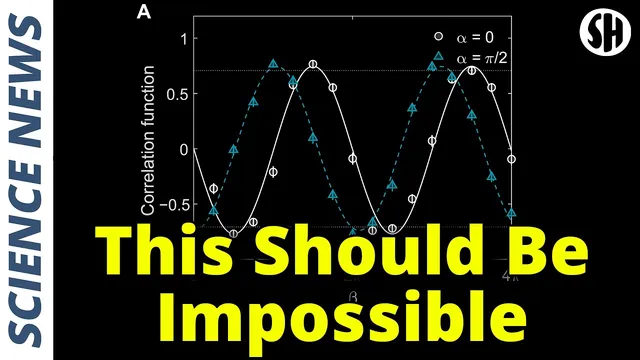
Bell tests use correlation strength to check whether results exceed limits any local classical explanation must satisfy.
Briefing
A new photonics experiment reports Bell-test correlations strong enough to indicate entanglement between two distant “sides,” even though the design should only create entanglement locally on each side. That mismatch—entanglement without the expected entanglement—would be a serious headache for quantum foundations if it survives scrutiny, because Bell tests are built to rule out ordinary correlations that could arise from classical shared randomness.
Entanglement is a special kind of correlation between particles that can persist across distance. Distance alone doesn’t make something quantum: clocks on different phones are correlated because they’re engineered to be. What makes entanglement distinctive is that measurement outcomes line up more strongly than any non-quantum explanation can allow. In practice, researchers perform a Bell test: they measure properties of particles at separated locations, compute how measurement results correlate, and check whether the correlation strength exceeds a bound that classical or “local hidden-variable” models must obey. Exceeding that bound is taken as evidence of entanglement.
The experiment uses photons generated in pairs by four photon-emitting stations. Each station can emit a pair of photons when illuminated by a laser. The key trick is indistinguishability: the setup alternates which two emitters are pumped so that, from the photons alone, it’s impossible to determine which pair of emitters produced which photons. On each side, the researchers measure interference between two photons after applying a phase shift. Those interference-based measurements feed into the Bell-test analysis.
Under the intended interpretation, entanglement should exist only within each side’s local photon pairs, not between the left and right sides. Yet the reported Bell-test results indicate that the two sides behave as if they are entangled. The authors reportedly don’t have a definitive explanation, but they speculate that the inability to trace photon origin from the measurement process may be central.
Independent experts quoted in the discussion point to several possible culprits. Stefano Paesani suggests the analysis may be affected by “post selection”: emitters don’t always fire as expected, and the researchers may only keep runs where all four photons appear. If the selection rule correlates with hidden variables, it can artificially inflate Bell-test violations. Jeff Lundeen argues that correlations resembling entanglement can arise without meaningful entanglement, though the discussion pushes back on that framing. Aephraim Steinberg maintains that some form of entanglement may still be present in the setup; one suspicion raised is that the laser itself could induce entanglement across the sides, since coherent light can create nontrivial quantum correlations.
Even with the excitement, the takeaway is restraint: the results are intriguing but not yet a verdict on quantum theory. If follow-up tests confirm the effect under tighter controls—especially around post selection and laser-induced correlations—it could force a re-think of what Bell-test violations really certify in complex experimental conditions. For now, it’s less “quantum physics is broken” and more “something unusual is happening, and the details matter.”
Cornell Notes
The experiment reports Bell-test violations that normally signal entanglement between two separated regions, even though the design should only generate entanglement locally on each side. Bell tests work by measuring correlations and checking whether they exceed bounds that any classical, local explanation must satisfy. The setup uses four photon emitters and relies on making the photons’ origins indistinguishable, then measures interference after phase shifts to feed the Bell-test calculation. Experts raise concerns that post selection (keeping only runs where all four photons are detected) could bias the statistics, while others argue that entanglement may still be present—possibly induced by the laser. If the effect holds up under improved tests, it would challenge assumptions about what “entanglement without entanglement” can mean for quantum foundations.
What makes Bell-test correlations a strong indicator of entanglement rather than ordinary distance-spanning correlation?
How does the experiment try to prevent entanglement from forming between the two sides?
Why does “indistinguishability of photon origin” matter in this setup?
What is post selection, and why could it create a misleading Bell violation?
What alternative explanations do experts suggest besides “entanglement without entanglement”?
If the result is real, why would it be considered a foundational crisis?
Review Questions
- What role do Bell-test bounds play in distinguishing quantum entanglement from classical correlations?
- How could post selection alter the statistical meaning of a Bell test?
- What experimental design feature makes it difficult to identify which emitters produced which photons, and why might that matter?
Key Points
- 1
Bell tests use correlation strength to check whether results exceed limits any local classical explanation must satisfy.
- 2
Entanglement is not just “correlation across distance”; it produces correlations stronger than classical bounds allow.
- 3
The experiment uses four photon emitters and alternates pumping so photon origin is indistinguishable from the measurement outcomes.
- 4
Reported Bell-test violations suggest cross-side entanglement even though the setup should only generate local entanglement.
- 5
Post selection—keeping only runs with all four photons—could bias results if it correlates with hidden variables.
- 6
Other explanations include residual entanglement or laser-induced correlations across the two sides.
- 7
Follow-up tests are needed before concluding that quantum foundations are actually breaking down.