Difference between Mediator and Moderator
Based on Research and Analysis's video on YouTube. If you like this content, support the original creators by watching, liking and subscribing to their content.
A mediator explains the mechanism by which an independent variable affects a dependent variable through an intermediate pathway.
Briefing
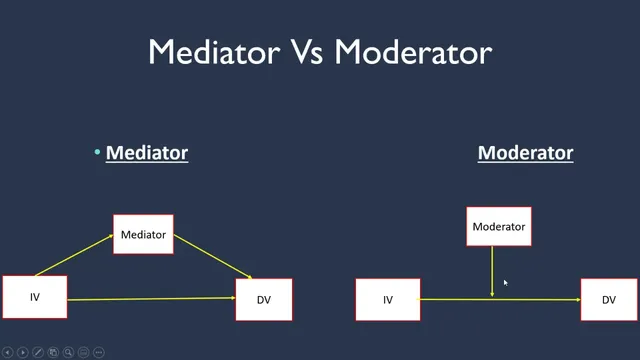
Mediator and moderator variables both sit in quantitative research models, but they play fundamentally different roles in how independent variables relate to dependent variables. A mediator acts as a bridge: the effect of the independent variable (IV) on the dependent variable (DV) runs through the mediating variable. In plain terms, the IV influences the mediator, and the mediator then influences the DV—so the IV–DV relationship is explained by that intermediate pathway.
A moderator works differently. The IV and DV are already connected, and the moderating variable changes that existing relationship. Depending on the theory, a moderator can strengthen or weaken the effect of the IV on the DV, and in some cases it can even alter the direction of the relationship. Rather than explaining “why” the IV affects the DV (as mediation does), moderation explains “when” or “under what conditions” the IV’s effect on the DV is stronger or weaker.
The transcript uses the same example to make the distinction concrete. For mediation, smartphone usage (IV) affects health (DV) through smartphone addiction (mediator). The logic is sequential: smartphone usage leads to addiction, and addiction leads to health outcomes. If smartphone addiction is the mechanism, then removing it should eliminate the IV’s direct impact on health.
For moderation, smartphone usage (IV) still targets health (DV), but exercise (moderator) changes the strength of that relationship. Under higher levels of exercise, the negative (or otherwise described) impact of smartphone usage on health becomes smaller—meaning the IV–DV link is present, but its magnitude depends on the moderator.
The transcript also distinguishes full mediation from partial mediation. Full mediation occurs when, after accounting for (or removing) the mediator, the direct effect of the IV on the DV drops to zero. Partial mediation occurs when a direct effect remains even after the mediator is removed, indicating that the mediator explains only part of the IV’s influence.
Finally, deciding whether a variable should be treated as a mediator or a moderator comes down to theory. If the variable fits a causal chain—an IV relates to the mediator, and the mediator relates to the DV—it belongs in a mediation framework. If the variable is proposed to alter an already-existing IV–DV relationship—by affecting its strength or direction—it belongs in a moderation framework. Understanding this distinction matters because mediation and moderation require different analytic steps in quantitative research.
Cornell Notes
Mediator and moderator variables differ in how they connect an independent variable (IV) to a dependent variable (DV). A mediator explains the mechanism: the IV affects the mediator, and the mediator affects the DV, so the IV–DV relationship runs through the mediating variable. A moderator changes the relationship itself: the IV and DV are already linked, and the moderator alters the strength (and sometimes direction) of that link depending on conditions. The transcript also distinguishes full mediation (IV’s direct effect becomes 0 after accounting for the mediator) from partial mediation (a direct effect remains). Choosing mediator vs. moderator should follow theory about whether the variable provides a causal pathway or modifies an existing effect.
How does a mediator differ from a moderator in a causal model?
What would full mediation look like after removing the mediator?
What would partial mediation look like?
Using the smartphone example, why is addiction a mediator?
Using the smartphone example, why is exercise a moderator?
How should theory guide whether a variable is treated as mediator or moderator?
Review Questions
- In your own words, what distinguishes a mediating variable from a moderating variable in terms of the IV–DV relationship?
- Give an example of a full mediation scenario and explain what happens to the direct IV → DV effect.
- What theoretical criteria would make you classify a variable as a moderator rather than a mediator?
Key Points
- 1
A mediator explains the mechanism by which an independent variable affects a dependent variable through an intermediate pathway.
- 2
A moderator changes the strength or direction of an existing independent-variable-to-dependent-variable relationship.
- 3
Full mediation occurs when the direct effect of the IV on the DV becomes zero after accounting for the mediator.
- 4
Partial mediation occurs when a direct IV-to-DV effect remains even after accounting for the mediator.
- 5
Whether a variable is a mediator or moderator should be determined by theory: causal chain supports mediation; conditional influence supports moderation.
- 6
Mediation and moderation require different analytic approaches because they represent different kinds of relationships.