Divergence and curl: The language of Maxwell's equations, fluid flow, and more
Based on 3Blue1Brown's video on YouTube. If you like this content, support the original creators by watching, liking and subscribing to their content.
Divergence measures net outward versus inward behavior of a vector field in an infinitesimal neighborhood, with positive values acting like sources and negative values acting like sinks.
Briefing
Divergence and curl turn messy vector fields into two crisp “local” diagnostics: divergence measures whether nearby flow behaves like a source or sink, while curl measures whether it tends to rotate. Framed through the intuition of fluid motion, divergence becomes a single-number test of how much a tiny neighborhood sends fluid outward versus pulls it inward, and curl becomes a single-number test of whether the same neighborhood produces a net clockwise or counterclockwise swirl.
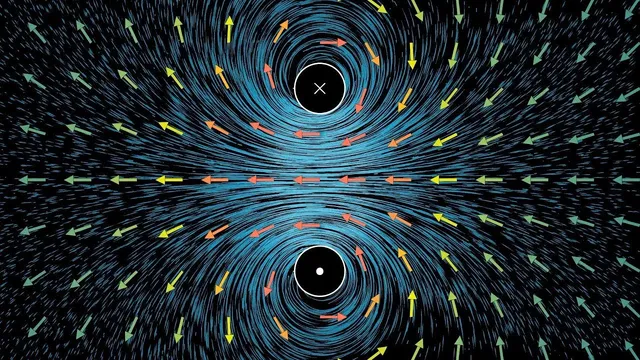
The discussion starts by defining a vector field as a rule that assigns a vector (magnitude and direction) to every point in space—often used to represent velocities in fluid flow, forces like gravity, or field strengths like electricity and magnetism. To build intuition, the field is treated as if it were a static 2D flow: some points act like sources where “fluid” appears to spring into existence, while others act like sinks where it disappears. Divergence at a point quantifies this behavior. Positive divergence corresponds to net outward flow from small regions around that point, including cases where flow doesn’t simply move away in every direction but still suggests “spontaneous generation” because inflow and outflow rates don’t balance. Negative divergence corresponds to net inward behavior—more fluid entering a neighborhood than leaving. Mathematically, divergence produces a new function: it takes a point and outputs one number determined by the field’s behavior in an infinitesimal neighborhood, making it analogous to a derivative.
Curl is introduced by shifting the question from “outward or inward?” to “rotating or not?” Imagine dropping a twig at a point and asking whether the local flow would spin it. Regions that drive clockwise rotation have positive curl; counterclockwise rotation gives negative curl. Importantly, curl doesn’t require every surrounding arrow to point the same way—what matters is the net rotational tendency created by variations across the neighborhood (for instance, slow motion on one side and faster motion on another can still yield a nonzero curl). While full curl is inherently three-dimensional, the 2D version used here assigns each point a single number describing rotation.
These two ideas then get connected to Maxwell’s equations, where divergence and curl appear as the language of electromagnetism. Gauss’s law links the divergence of the electric field to charge density, letting positive charge act like sources and negative charge like sinks; in regions with no charge, the “electric fluid” behaves incompressibly, matching the divergence-free intuition. Another equation states that the divergence of the magnetic field is zero everywhere, interpreted as the absence of magnetic monopoles—no isolated north or south ends. The remaining Maxwell equations relate how each field changes to the curl of the other, and that back-and-forth is tied to the emergence of light waves.
Finally, divergence and curl are extended beyond physical space into abstract dynamical systems. In predator–prey models, each pair of population sizes defines a point in a 2D “phase space,” and the differential equations assign a vector showing how both populations change. The resulting phase flow can exhibit convergence, divergence, or cycles, and divergence/curl provide geometric clues about these behaviors—though a complete analysis often needs additional tools. The closing takeaway is that divergence and curl are not just physics tricks: they’re general ways to read local structure in any vector field, with dot-product and cross-product notation reflecting deeper connections to how small steps change a field.
Cornell Notes
Divergence and curl are two local measurements that convert a vector field into actionable information. Divergence quantifies whether a tiny neighborhood of the field acts like a source (positive) or a sink (negative), producing a single number at each point. Curl quantifies whether the local flow tends to rotate, with positive and negative values corresponding to clockwise versus counterclockwise rotation in the 2D setting. These ideas appear directly in Maxwell’s equations: electric charge relates to divergence of the electric field, magnetic fields have zero divergence (no monopoles), and changes in fields relate to each other’s curl. The same geometric mindset also applies to dynamical systems like predator–prey models via phase space and phase flow.
How does divergence translate into a “source vs. sink” test for a vector field?
Why is curl best understood as a rotation tendency rather than a direction of flow?
How do Maxwell’s equations use divergence and curl to describe electromagnetism?
What does it mean to apply divergence and curl to predator–prey dynamics instead of physical space?
Why do dot product and cross product show up in divergence and curl notation?
Review Questions
- In a 2D vector field interpreted as incompressible fluid velocity, what must divergence equal everywhere, and why?
- Give an example of how curl can be nonzero even if the arrows around a point don’t all point clockwise (or all point counterclockwise).
- How do divergence and curl appear in Maxwell’s equations, and what physical interpretations are attached to those specific divergence/curl statements?
Key Points
- 1
Divergence measures net outward versus inward behavior of a vector field in an infinitesimal neighborhood, with positive values acting like sources and negative values acting like sinks.
- 2
Curl measures net local rotation tendency; in 2D, positive curl corresponds to clockwise rotation and negative curl to counterclockwise rotation.
- 3
Divergence and curl produce new functions from a vector field: divergence outputs a single number per point, and the 2D curl version also outputs a single number per point.
- 4
Maxwell’s equations translate electromagnetism into divergence and curl: electric charge density relates to divergence of the electric field, magnetic fields have zero divergence, and field changes relate to the other field’s curl.
- 5
The same geometric intuition applies to abstract dynamical systems by treating state variables as coordinates in phase space and the differential equations as a vector field.
- 6
Dot-product and cross-product notation reflects a deeper relationship between how small steps change a vector field and whether that change aligns with the step (divergence) or is perpendicular/rotational (curl).