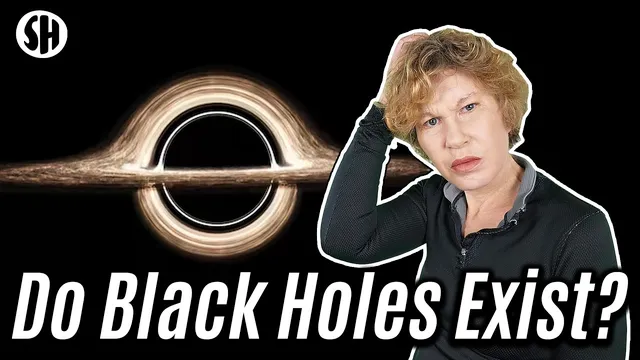
Do Black Holes Exist? Some Physicists Don’t Think So
Based on Sabine Hossenfelder's video on YouTube. If you like this content, support the original creators by watching, liking and subscribing to their content.
A black hole’s defining feature in general relativity is the event horizon, not the ability to see it directly.
Briefing
The strongest takeaway is that “black holes don’t exist” claims mostly hinge on misunderstandings of what black holes mean in general relativity—and on edge-case interpretations of horizons and evaporation. In practice, physicists treat black holes as real insofar as Einstein’s equations produce a spacetime geometry with an event horizon that matches a wide set of astronomical observations, even if some technical definitions would restrict the term to perfectly eternal horizons.
A black hole, in the standard relativistic sense, is a spacetime geometry solving Einstein’s field equations whose defining feature is an event horizon: a closed boundary from which nothing can escape, not even light. Such horizons are expected to form when matter is compressed enough—famously during stellar collapse after a supernova—because the required escape velocity rises until it exceeds the speed of light. Inside, classical general relativity predicts a singularity where curvature becomes effectively infinite and “time ends,” a sign that something is missing or mis-modeled, likely involving quantum gravity.
Several arguments against black holes are addressed directly. One claims black holes never form because, from outside, the collapse takes an infinite time. That’s true only for the outside observer’s notion of time: signals from the infalling matter get increasingly redshifted, and the horizon never appears to form to distant observers. But an infalling observer crosses the horizon in finite proper time and reaches the singularity in finite time, so the “infinite formation time” argument doesn’t eliminate horizons—it changes which time coordinate is being used.
Another claim says Hawking radiation prevents a horizon from forming by causing the collapsing star to lose mass before the event horizon can appear. The response is that the mass/energy loss from Hawking radiation has been computed repeatedly and is vanishingly small for large astrophysical objects, far too weak to stop horizon formation.
Hawking’s own provocative remarks are reframed: “black holes don’t exist” can be interpreted as “black holes aren’t eternal.” If evaporation eventually destroys the horizon, then a truly eternal event horizon never exists; instead, there can be an apparent horizon that mimics an event horizon for a long time. Under a strict definition requiring eternal horizons, Hawking’s wording is technically defensible. Under the way astronomers and relativists use the term—calling objects “black holes” when they behave like them—the concept remains useful.
The case for black holes is described as indirect but consistent: astronomers infer masses and effective sizes from how stars orbit unseen compact objects, track radiation signatures from infalling gas, and observe gravitational lensing. None of this proves the event horizon’s interior is directly observable, but it does support that the black-hole solutions of Einstein’s theory fit the data without needing deviations.
Finally, alternative ideas—such as “black hole mimickers” with hard surfaces (“gravastars,” in the transcript’s shorthand)—face observational and theoretical pressure: a hard surface should produce distinctive emissions when matter impacts it, and maintaining such objects across all masses would require implausible behavior at extremely low densities. The conclusion is pragmatic: black holes are treated as real because their mathematics matches observations, while questions about whether the “inside” and singularity are physically meaningful are more philosophical than experimentally settled.
Cornell Notes
Black holes are defined in general relativity by an event horizon: a boundary from which nothing escapes. Claims that black holes “never form” confuse different notions of time—outside observers see collapse asymptotically slow, while infalling observers cross the horizon in finite proper time. Hawking radiation does not stop horizon formation for large astrophysical black holes because the predicted mass loss is extraordinarily small. Hawking’s “black holes don’t exist” can be read as “not eternal”: evaporation means a strictly eternal event horizon may not exist, though long-lived apparent horizons look like event horizons. Overall, black holes remain the best-fit interpretation because Einstein’s black-hole solutions match multiple indirect observations, even if the interior’s physical reality is harder to pin down.
Why does “black holes take an infinite time to form” not rule them out?
How does Hawking radiation factor into the idea that horizons can’t form?
What does Hawking’s “black holes don’t exist” mean in a technically precise sense?
What counts as evidence that black holes exist if they can’t be seen directly?
Why are “hard-surface” alternatives (gravastar-like ideas) considered problematic?
Review Questions
- What role do different time notions (outside coordinate time vs infalling proper time) play in the “infinite formation time” argument?
- Why is Hawking radiation too weak to stop horizon formation for large astrophysical black holes, according to the transcript?
- How does evaporation change the strict definition of an event horizon, and why does that matter for interpreting Hawking’s remarks?
Key Points
- 1
A black hole’s defining feature in general relativity is the event horizon, not the ability to see it directly.
- 2
The claim that horizons never form from the outside is a statement about outside observers’ time perception, not about whether a horizon forms in spacetime.
- 3
Hawking radiation does not prevent horizon formation for large astrophysical black holes because the predicted evaporation rate is extremely small.
- 4
Evaporation implies horizons may not be eternal; apparent horizons can mimic event horizons for long periods.
- 5
Astronomers treat black holes as real because Einstein’s black-hole solutions consistently match indirect observations like orbital dynamics, infall heating, and gravitational lensing.
- 6
Hard-surface “black hole mimicker” models face observational tension (missing impact emissions) and theoretical tension (requiring implausible density behavior across masses).