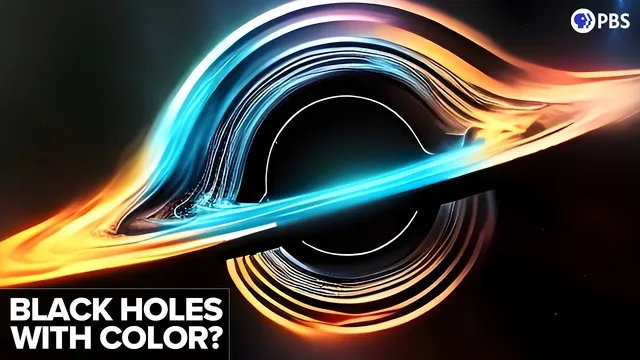
Do Black Holes Have to Be Black?
Based on PBS Space Time's video on YouTube. If you like this content, support the original creators by watching, liking and subscribing to their content.
The no-hair theorem permits black holes to carry charge for any fundamental force, including strong-force colour charge, not just mass and spin.
Briefing
Black holes may not have to be “black” in the everyday sense—some could carry the strong force’s “colour charge,” potentially leaving detectable fingerprints from the universe’s first moments. The key idea is that the no-hair theorem allows black holes to possess more than just mass and spin; it also permits charge under any fundamental force. For ordinary electric charge, black holes quickly neutralize by attracting opposite charge from their surroundings. But colour charge (the strong-force charge tied to quarks and gluons) behaves differently because of colour confinement: in most of today’s universe, isolated colour charge can’t exist, since quarks bind into colour-neutral hadrons (like protons and neutrons).
The conditions that could generate colour-charged black holes likely existed only in the early universe. Before about 10^-5 seconds after the Big Bang, the cosmos was hotter than roughly 10^13 Kelvin, dissolving quark bound states into a quark-gluon plasma where quarks and gluons roam freely. Even if the plasma’s net colour charge is zero, random local fluctuations could produce patches with an excess of one colour (or anti-colour). If a primordial black hole (PBH) formed from such a dense patch, it could inherit a nonzero net colour charge—creating a “coloured” black hole.
A new study by Elba Alonso Monsalve (PhD student) and David I. Kaiser (MIT) estimates whether these objects could form in meaningful numbers and whether any could survive to the present. The timing of PBH formation matters because it sets the PBH mass, and mass determines whether a PBH is small enough to capture a significant colour fluctuation. If PBHs are invoked as dark matter, their masses must fall in a narrow window of about 10^14–10^19 kg, corresponding to formation times roughly 10^-21 to 10^-16 seconds after the Big Bang. At the early end of that range, most PBHs would be too massive to accumulate much net colour charge, remaining effectively colour neutral. The researchers’ hope lies in PBH formation scenarios that produce a dominant peak mass plus a long tail of smaller PBHs; the smaller members of that tail could be light enough—below about 20 tons—to capture substantial colour charge.
Those small PBHs would be extremely short-lived under Hawking radiation. A ~20-ton black hole would evaporate in about 10^-4 seconds, but that interval is still long compared with the rapidly changing early-universe conditions. Crucially, it could outlast the quark-gluon plasma epoch and enter the later era when colour confinement forces quarks into hadrons. Once surrounded by colour-neutral hadrons, the black hole’s colour charge could be screened by quantum vacuum effects, reducing the tendency to lose charge—potentially allowing the most colour-rich, near-extremal black holes (where internal colour charge nearly cancels the gravitational field at the horizon) to persist longer.
Survival to later cosmic milestones could leave indirect evidence. The study points to possible impacts on big bang nucleosynthesis, where altered hadron distributions might shift the predicted ratios of light elements. Another speculative route involves “Planck relics,” in which black holes stop evaporating at the Planck length; if enough primordial PBHs became relics, colour charge might remain in some of them, enabling interactions with atomic nuclei and offering a path to detection. Direct observation of the first fraction of a second remains out of reach, but the theoretical mechanism—colour-charged PBHs formed in a quark-gluon plasma and potentially surviving via screening and near-extremality—could translate early-universe physics into measurable cosmological or particle-physics signatures.
Cornell Notes
The no-hair theorem allows black holes to carry charge from any fundamental force, not just mass and spin. While electric charge is quickly neutralized, strong-force “colour charge” could persist if a black hole forms in a quark-gluon plasma where colour confinement is temporarily lifted. In the first ~10^-5 seconds after the Big Bang, the universe’s temperature exceeded ~10^13 K, letting quarks and gluons move freely and creating random local colour fluctuations. If primordial black holes formed from sufficiently dense patches, they could inherit net colour charge—especially for the small end of the PBH mass spectrum. The main challenge is Hawking evaporation: a ~20-ton coloured PBH would evaporate in ~10^-4 seconds, but screening by surrounding hadrons and near-extremal conditions might let some colour-rich objects survive long enough to affect big bang nucleosynthesis or, in speculative cases, remain as Planck relics.
Why does “colour charge” behave differently from electric charge for black holes?
What early-universe conditions could allow colour-charged primordial black holes to form?
How do PBH formation time and mass determine whether a black hole can capture colour charge?
Why might some coloured black holes survive long enough to matter cosmologically?
What observable consequences are proposed if colour-charged PBHs existed?
Review Questions
- What physical mechanism prevents black holes from accumulating electric charge in the long run, and why doesn’t the same argument automatically apply to strong-force colour charge?
- How do the quark-gluon plasma temperature threshold and the PBH formation time jointly determine whether a primordial black hole could inherit net colour charge?
- Why do near-extremal coloured black holes have a better chance of surviving than more typical small black holes?
Key Points
- 1
The no-hair theorem permits black holes to carry charge for any fundamental force, including strong-force colour charge, not just mass and spin.
- 2
Colour confinement in the modern universe makes isolated colour charge effectively unobservable, so black holes formed from ordinary matter tend to remain colour neutral.
- 3
In the first ~10^-5 seconds, the universe’s temperature exceeded ~10^13 Kelvin, creating a quark-gluon plasma where local colour fluctuations could seed colour-charged primordial black holes.
- 4
Whether a PBH can capture significant net colour depends on its mass (set by formation time); the study highlights a small-mass tail below ~20 tons as the most promising range.
- 5
Hawking evaporation is severe for small PBHs, but screening after the plasma era and near-extremal conditions could allow some colour-rich black holes to persist longer.
- 6
Potential evidence includes altered big bang nucleosynthesis light-element ratios and, in speculative scenarios, detectable interactions from colour-charged Planck relics.