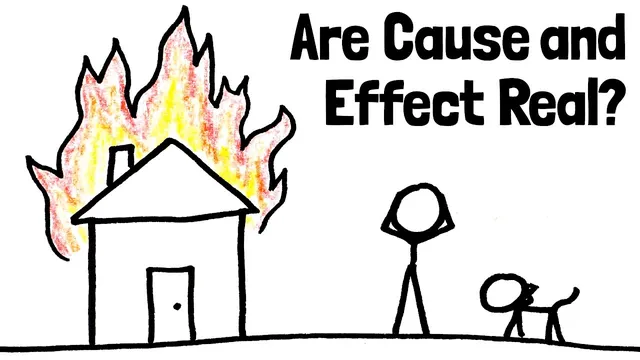
Do Cause and Effect Really Exist? (Big Picture Ep. 2/5)
Based on minutephysics's video on YouTube. If you like this content, support the original creators by watching, liking and subscribing to their content.
Microscopic physics is time-symmetric: the same information determines both past and future motion, so “cause” and “effect” aren’t fundamental categories there.
Briefing
Cause and effect feel natural in everyday life, but at the microscopic level physics treats them as a matter of pattern, not direction. The core claim is that the fundamental laws governing particles and forces don’t privilege “before” over “after.” Given a particle’s position and momentum, its motion in the next second is fixed—and the same information also determines how it was moving in the previous second. In that sense, neither the past nor the future plays the role of a true “cause” preceding an “effect.” What exists is a single, time-symmetric trajectory through state space: like the integers around 42, where 41 and 43 don’t get “caused” by 42; they just sit in a consistent sequence.
That picture changes when moving from the microscopic to the macroscopic scale. Human-scale systems—collections of enormous numbers of particles—display an effective arrow of time, making one-directional narratives possible. At that level, it becomes meaningful to say a spark “causes” oxygen and hydrogen to become water, or that an explosion follows from ignition. The asymmetry shows up in everyday experience: reverse processes don’t occur in the way a simple causal story would require. Water doesn’t spontaneously split into oxygen and hydrogen gas and then, at the end, emit a spark that “restarts” the reaction.
The transcript reframes causation using the idea of “leverage.” A tiny event can have outsized influence on what follows, so the small trigger earns the label “cause.” If a spark never happens, the later explosion never occurs. But the leverage logic doesn’t automatically run backward. Altering a small part of the explosion doesn’t tell you whether a spark happened earlier; the same present-day observation can be consistent with many prior micro-histories.
The same leverage concept also works in the opposite direction, producing a different kind of interpretation: “records” rather than causes. A pencil contains trace carbon-14 produced by nuclear bomb testing. The presence of that small amount of radioactive carbon implies that bomb detonations occurred in the relevant historical window, because without those tests the carbon-14 wouldn’t be there. Yet removing a pencil-sized portion of a bomb’s material wouldn’t noticeably change the pencil’s composition. Here, the small present detail has leverage over the past, so it’s treated not as a cause of the detonations but as a record of them.
Overall, the distinctions people rely on—cause versus effect, prediction versus memory—aren’t fundamental features of the underlying physics. They emerge from large-scale conditions, especially the effective direction of time, which turns symmetric microscopic dynamics into one-way stories that feel intuitive.
Cornell Notes
At the microscopic level, physics treats time symmetrically: knowing a particle’s position and momentum determines both its past and its future. That means “cause” and “effect” aren’t fundamental categories in the laws of motion; they’re descriptions of patterns. On macroscopic, human-scale systems, an effective arrow of time appears, letting one-directional causal stories make sense—like a spark leading to water formation and not the reverse. Causation can be understood as “leverage” from a small present event to a large future outcome. The same leverage can point backward too, but then the small present detail functions as a “record” (like carbon-14 in a pencil) rather than a cause.
Why doesn’t microscopic physics support a strict “cause before effect” idea?
What analogy helps explain the difference between fundamental patterns and causal language?
Why do causal stories become meaningful at the macroscopic scale?
How does “leverage” define when something counts as a cause?
How can the same leverage idea lead to “records” instead of causes?
Review Questions
- How does knowing a particle’s position and momentum undermine the idea of a fundamental “cause preceding effect”?
- Explain the difference between a “cause” and a “record” using the leverage concept and the spark vs. carbon-14 examples.
- Why does an arrow of time matter for when causal language becomes useful?
Key Points
- 1
Microscopic physics is time-symmetric: the same information determines both past and future motion, so “cause” and “effect” aren’t fundamental categories there.
- 2
Particles follow consistent patterns rather than one event generating another in a strict temporal direction.
- 3
Macroscopic systems exhibit an effective arrow of time, making one-way causal narratives like spark → reaction meaningful.
- 4
Causation can be framed as leverage: a small event can strongly determine a large future outcome.
- 5
Leverage doesn’t automatically run backward; changing the present doesn’t uniquely reveal the earlier trigger.
- 6
When a small present detail strongly constrains the past, it functions as a record (e.g., carbon-14 in a pencil) rather than a cause.