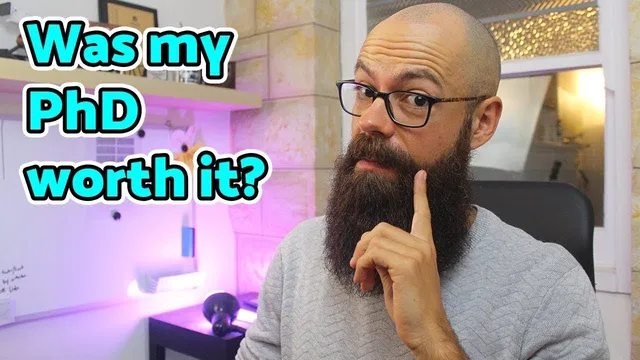
Do I regret my PhD? Truth Bombs!
Based on Andy Stapleton's video on YouTube. If you like this content, support the original creators by watching, liking and subscribing to their content.
A PhD can be a powerful credential for getting interviews and roles, but it doesn’t guarantee job satisfaction or a linear career payoff.
Briefing
A PhD can be “worth it” in the long run—but not because it reliably delivers a dream job. Over 10 years after submitting his thesis, Andy Stapleton frames the core tradeoff as access versus fit: a PhD opened doors for him in industry and academia, yet the specific career paths it enabled didn’t match what he actually enjoyed. That mismatch forced him to break away from the “PhD train,” even mid-contract, and rebuild his work life around science communication and content creation.
From a purely career perspective, he lands on a blunt conclusion: a PhD wasn’t worth it for him. It did help him get an explosives-chemist role at a mining company, where the organization valued PhD-trained scientists and where his topic and credentials made hiring possible. It also helped him secure a postdoc in solar cell technology and organic photovoltaics—an opportunity he says he found almost by accident because both he and the lab spelled “post-doctorial” incorrectly. But once those doors opened, he found himself stuck in jobs he didn’t like. Industry meant “big dirty holes,” government work meant bureaucracy and red tape, and the academic track came with paperwork and a sense of being trapped by identity and momentum. He describes a Stockholm-syndrome-like pressure to make the career work because he had already invested so much.
The turning point came when he left research roles and started building a different path: science communication. He tried traditional routes, including an internship at Cosmos magazine, but concluded that the market in Australia didn’t value science communicators enough—he likened the work to being treated like a “science clown” for school audiences. Still, the science thread persisted. His later startup and his current YouTube and blog work rely on scientific grounding: writing articles from primary sources, using research and evidence as a differentiator, and turning expertise into public-facing communication. In that sense, the PhD kept paying off, just not in the way a conventional career ladder would promise.
Identity and learning are the two other major pillars in his assessment. He argues that a PhD becomes deeply ingrained as part of how someone sees themselves—“Dr” and “scientist” can be hard to shed even when day-to-day work changes. That pride is both a strength (a continuing thread of confidence and scientific thinking) and a burden (difficulty moving into a non-scientist life without that label). At the same time, he credits the PhD with an “invaluable” skill: learning how to learn. The long-term structure taught him to build foundations, tackle new topics at a high level, and keep learning as long as there’s purpose and interest—whether that’s science, sewing, knitting, or urban sketching.
Finally, he calls out lifestyle and life-location outcomes as the most concrete “worth it” payoff. The PhD gave him a reason to travel and study abroad, which he says enabled him to move to Australia, build international friendships, and ultimately become an Australian citizen. He sums it up as a full-life shift—from a small life in Britain to an international one—where the PhD’s value showed up indirectly through skills, identity, and opportunities rather than a straight line to happiness in academia or industry.
Cornell Notes
Andy Stapleton’s long-term verdict is nuanced: a PhD can open doors, but it doesn’t guarantee a career that feels right. He says a PhD helped him land industry and postdoc roles (including explosives chemistry and organic photovoltaics), yet he disliked the jobs those credentials led to and eventually left mid-contract to pursue science communication. The payoff came later through transferable skills—especially learning how to learn—and through a persistent “science thread” in writing, public speaking, and online content. He also credits the PhD with lifestyle benefits: international connections, travel, and moving to Australia, where he became a citizen.
Why does he say a PhD wasn’t worth it from a purely career perspective?
What specific examples show the PhD opening doors for him?
How did he turn away from traditional science communication—and what kept the PhD relevant?
What role does identity play in his assessment of whether to regret a PhD?
What skill does he call “invaluable” from the PhD, and how does he apply it outside research?
How does he connect the PhD to lifestyle outcomes, including moving countries?
Review Questions
- If a PhD helps you get interviews but you dislike the resulting roles, what decision points does he describe for breaking out of that path?
- Which two “non-career” benefits does he emphasize as long-term payoffs (skills/identity/lifestyle), and what concrete examples support each?
- How does he reconcile pride in the “Dr/scientist” identity with the desire to live a life that doesn’t revolve around it?
Key Points
- 1
A PhD can be a powerful credential for getting interviews and roles, but it doesn’t guarantee job satisfaction or a linear career payoff.
- 2
Credentials opened doors for him in industry and a postdoc, yet he ultimately left because the work didn’t match what he enjoyed.
- 3
Science communication in Australia didn’t offer strong market demand, pushing him toward online content and writing as a more sustainable outlet.
- 4
The PhD’s biggest long-term value for him is transferable learning skill—how to learn and keep learning with purpose.
- 5
A PhD becomes part of personal identity, making it hard to fully move on from the “scientist/Dr” label even after changing careers.
- 6
Lifestyle outcomes—travel, international friendships, and relocating to Australia—were among the most tangible reasons he considers the PhD worth it.