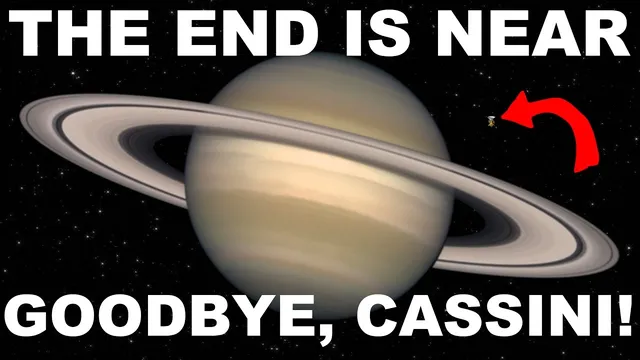
Do Not Go Gentle...Cassini's Final Mission
Based on Second Thought's video on YouTube. If you like this content, support the original creators by watching, liking and subscribing to their content.
Cassini reached Saturn in July 2004 and was the first spacecraft built to stay in orbit long-term rather than just fly by.
Briefing
Cassini’s legacy rests on two moons—Titan and Enceladus—where Saturn’s system looks increasingly like a place that could host life. Titan’s atmosphere, methane-rich surface, and evidence of past liquid hydrocarbons reshaped scientists’ expectations for what an outer-solar-system world can be. Enceladus, meanwhile, erupted with water-rich plumes that point to a heated, salty subsurface ocean—an environment that, by Earth’s standards, could supply the ingredients for biology.
Launched October 15, 1997, Cassini reached Saturn after using gravitational assists from Venus (twice via two flybys) and Jupiter to conserve propellant. During a six-month Jupiter flyby, it captured roughly 26,000 images, including a highly detailed global color portrait. Cassini arrived at Saturn in July 2004 and became the first spacecraft designed to remain in orbit long-term to study both the planet and its moons. That staying power mattered: it carried specialized equipment, including the Huygens probe, built to be dropped onto Titan.
On January 14, 2005, Huygens became the first human-made object to land on a world in the outer solar system—the farthest landing any craft had achieved at the time. As it descended through Titan’s thick haze, the view cleared to reveal dark drainage channels, suggesting Titan once had flowing rivers of liquid methane. Cassini’s broader Titan observations reinforced the picture of an active world: it mapped locations of liquid hydrocarbon bodies, detected ongoing weather patterns, and found that much of Titan’s surface is made of frozen water. The result was a compelling target for future exploration—an environment with abundant methane and the possibility of liquid water in the right places, potentially supporting life forms unlike those on Earth.
Cassini’s findings on Enceladus were equally consequential. The moon’s spectacular plumes feed most of Saturn’s E-ring, ejecting water and other volatiles from “cryo volcanoes” rather than silicate rock. Cassini identified more than 100 geysers, collectively blasting about 200 kg of water ice and other material into space every second. Some of that material falls back as snow, while much becomes part of the E-ring. The combination of plume activity and Enceladus’s proximity to Saturn and other moons indicates ongoing internal heating—strong evidence for a subsurface ocean, with a suspected depth around 10 km.
That ocean matters because it could be salty and warmed by geological activity, echoing the logic behind Earth’s deep-sea thermal vents, where hardy microbes thrive. Cassini’s data helped turn Enceladus from an intriguing ice moon into a prime candidate in the search for extraterrestrial life.
With fuel running low, Cassini’s mission ends in a controlled “Grand Finale.” Beginning April 22, 2017, it performed 22 dives between Saturn and its rings. On the final dive, scheduled for September 15, 2017, it entered Saturn’s atmosphere, burned up, and transmitted data until it went offline. The end was also a planetary-protection measure: avoiding a crash into Enceladus or Titan helps prevent contaminating potentially habitable environments with Earth microbes. Cassini’s final act closes the loop on a mission that helped identify life’s potential “backyard” targets—and sets up future returns with landers, drills, buoyant probes, and even submarines for Titan’s hydrocarbon lakes and Enceladus’s hidden oceans.
Cornell Notes
Cassini’s long Saturn orbit transformed Titan and Enceladus into top candidates for astrobiology. Huygens’ landing on Titan revealed dark drainage channels consistent with past methane rivers, while Cassini mapped liquid hydrocarbon bodies, detected active weather, and found extensive frozen water. On Enceladus, Cassini observed over 100 geysers whose water-rich plumes feed Saturn’s E-ring, pointing to a heated subsurface ocean roughly 10 km deep. Together, the data suggest environments where water, energy, and chemical ingredients could support life unlike Earth’s. Cassini then ended with 22 ring-and-atmosphere dives in 2017, burning up to avoid contaminating these moons with Earth microbes.
Why did Cassini’s route to Saturn matter for the mission’s scientific payoff?
What did Huygens’ descent on Titan reveal, and how did it change expectations?
How did Cassini connect Enceladus’s plumes to a subsurface ocean?
What ingredients for life did the transcript highlight on Titan and Enceladus?
Why was Cassini’s final dive sequence designed to end in Saturn’s atmosphere?
Review Questions
- What specific observations on Titan supported the idea of past methane rivers, and what did Cassini add to that picture afterward?
- How do Enceladus’s cryo-volcano plumes and their relationship to Saturn’s E-ring lead to the subsurface-ocean conclusion?
- What planetary-protection concern shaped Cassini’s “Grand Finale,” and how did the mission’s final trajectory address it?
Key Points
- 1
Cassini reached Saturn in July 2004 and was the first spacecraft built to stay in orbit long-term rather than just fly by.
- 2
Gravitational assists from Venus and Jupiter helped Cassini conserve propellant for sustained Saturn system science.
- 3
Huygens’ Titan landing on January 14, 2005 revealed dark drainage channels interpreted as evidence of past liquid methane rivers.
- 4
Cassini found Titan has active weather patterns and liquid hydrocarbon bodies, with much of its surface made of frozen water.
- 5
Cassini detected Enceladus cryo-volcano plumes—over 100 geysers releasing about 200 kg of water ice and volatiles per second.
- 6
Enceladus plume activity implies internal heating and a subsurface ocean roughly 10 km deep, potentially salty and habitable by Earth-based logic.
- 7
Cassini ended with 22 dives in 2017 and burned up in Saturn’s atmosphere to avoid contaminating Enceladus or Titan with Earth microbes.