Do Salt Lamps Work?
Based on Veritasium's video on YouTube. If you like this content, support the original creators by watching, liking and subscribing to their content.
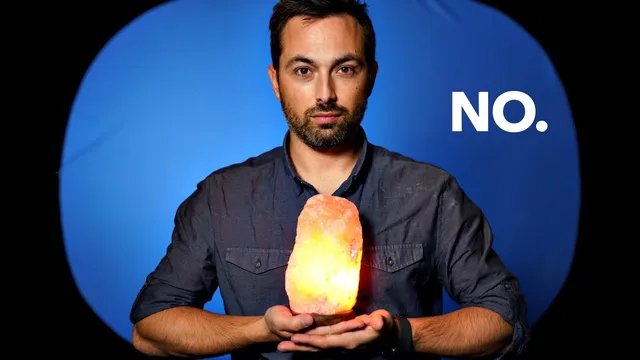
Himalayan salt lamps did not produce detectable negative ions under test conditions using atmospheric-pressure mass spectrometry.
Briefing
Salt lamps are marketed as mood and health boosters because heat supposedly releases “negative ions” into the air. The core claim is that negative ions improve how people feel—often tied to serotonin—and that the effect is strong enough to matter indoors. But lab testing and the broader scientific record point in the opposite direction: the specific mechanism behind salt lamps doesn’t work as advertised, and human studies on air ions are inconsistent at best.
Atmospheric ions do exist, and they’re generated constantly by natural processes. Cosmic rays create ions as they slam into the atmosphere, while natural radioactivity from uranium and thorium decay products adds more ionization. Thunderstorms and lightning produce large ion bursts, and waterfalls and ocean surf can generate electrified sprays that raise ion counts to tens of thousands per cubic centimeter near the source. Indoors, the story changes: buildings shield people from cosmic rays and radioactivity, and pollutants and aerosols can cause ions to cling and disappear faster—so typical indoor concentrations can be around 100–200 ions per cubic centimeter.
That context helps explain why scientists have studied ion effects for decades. Some experiments report benefits from high concentrations of negative ions, including antidepressant-like effects in seasonal affective disorder when paired with bright light therapy, faster reaction times and higher reported energy, and EEG changes consistent with altered brain activity. Workplace trials using an ionizer in an office building also reported fewer headaches and improved alertness when negative ions were produced. Positive ions, in contrast, have been linked to increased anxiety and excitement in at least one study, alongside higher serum serotonin.
Still, the strongest reality check comes from direct measurement. Using a mass spectrometer designed to detect negative ions at atmospheric pressure, researchers tested Himalayan salt lamps and found no detectable negative-ion signal—no peaks above background. The proposed explanation for salt lamps is that water landing on salt liberates chloride ions from the crystal lattice, but chemists argue the energy required is far too high for the reaction to occur under normal conditions. Salt’s crystal structure doesn’t support the ion-producing behavior that some other materials can.
Tourmaline, for example, can generate ions when heated because its crystal structure allows charge buildup on crystal faces and air breakdown between them. That’s why tourmaline “ion” devices exist—though they’re expensive.
Even when negative ions are generated effectively, the trade-off can be worse than the benefit. An ionic air purifier produced a measurable negative-ion breeze, but it also emitted ozone: ozone levels rose from about 17 parts per billion to over 80, approaching smog-alert territory. Beyond practical risks, the overall health evidence remains shaky. Reviews and meta-analyses have found no consistent influence of positive or negative air ionization on anxiety, mood, relaxation, sleep, or comfort, with study limitations like poor blinding, tiny sample sizes, and uncontrolled ion exposure.
The takeaway is blunt: salt lamps don’t reliably generate negative ions, and the broader case for health gains from indoor ionization is not strong enough to outweigh uncertainty and potential harms. For mood and physical health, the most dependable “proven” boost remains straightforward—getting outside and exercising, with fresh air as a bonus.
Cornell Notes
Salt lamps are sold as negative-ion generators, but direct mass-spectrometry testing found no detectable negative ions coming from Himalayan salt lamps when heated. Atmospheric ions do form naturally from cosmic rays, radioactivity, lightning, and especially waterfalls and ocean surf, which helps explain why researchers studied ion effects on mood and performance. Some small studies report improvements with high negative-ion exposure and worse outcomes with positive ions, yet the overall evidence is inconsistent and often methodologically weak. When negative ions are produced by other devices, ozone can be a dangerous by-product, undermining the “healthier air” promise. Overall, the strongest support for better mood and health remains exercise and time outdoors rather than indoor ion gadgets.
Why do atmospheric ions exist at all, given that opposite charges should neutralize quickly?
What indoor factors tend to reduce ion concentrations compared with outdoors?
What did researchers find when they tested a Himalayan salt lamp for negative ions?
How do tourmaline-based ion devices differ from salt lamps?
If a device does generate negative ions, what major safety issue can appear?
Why doesn’t the health evidence for air ions settle the question?
Review Questions
- What natural processes generate atmospheric ions, and how do they differ from indoor sources?
- Why did mass spectrometry fail to detect negative ions from Himalayan salt lamps?
- What trade-off can occur with ionic air purifiers, and how does it affect the overall case for negative-ion devices?
Key Points
- 1
Himalayan salt lamps did not produce detectable negative ions under test conditions using atmospheric-pressure mass spectrometry.
- 2
Salt-lamp ion claims rely on a water-on-salt mechanism that chemists argue is energetically implausible and inconsistent with salt’s crystal structure.
- 3
Atmospheric ions are continuously generated by cosmic rays, natural radioactivity, lightning, and can be especially abundant near waterfalls and ocean surf.
- 4
Indoor ion concentrations are typically lower due to shielding from ionizing sources and faster ion removal by pollutants and aerosols.
- 5
Some studies report mood and performance benefits from high negative-ion exposure, but results are inconsistent and often weakened by small samples and imperfect blinding.
- 6
Devices that reliably generate negative ions can also emit ozone, raising potential health and air-quality concerns.
- 7
Given the weak and inconsistent evidence, exercise and time outdoors remain the most reliable ways to improve mood and physical well-being.