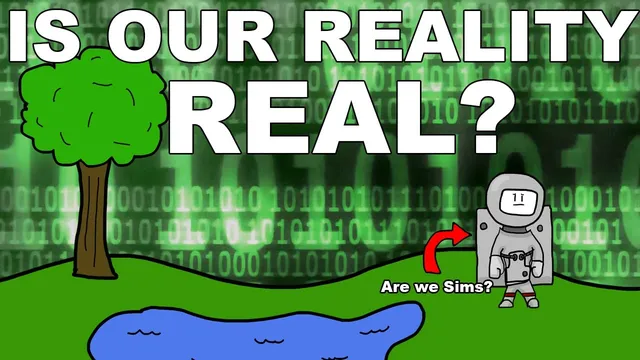
Do We Live in a Simulation?
Based on Second Thought's video on YouTube. If you like this content, support the original creators by watching, liking and subscribing to their content.
The simulation argument claims that if ancestor simulations are feasible for posthuman civilizations, then most human-like observers may be living in one.
Briefing
The core claim behind the “simulation” idea is that advanced civilizations with enough computing power could run extremely detailed “ancestor simulations” of human life—and if that’s feasible, then it becomes statistically more likely that today’s experience is one of those simulations rather than the base reality. The argument hinges on a simple but unsettling logic: once civilizations reach technological maturity, either they don’t run such simulations, they can’t survive long enough to do so, or most civilizations like ours end up living inside them. That structure matters because it turns a philosophical question into a probability claim about what kind of reality is most common.
The case starts with computing growth. From early games like Pong in 1972 to modern titles such as Battlefield 1, the trajectory of hardware performance is described as roughly exponential—often summarized by Moore’s law, with performance doubling about every two years. As photorealism and virtual reality improve, the thought follows that sufficiently advanced computers could simulate not just visuals, but the full molecular-level environment and the internal experiences of simulated beings. In that scenario, “Sims” could generate sensory data, emotions, and even false memories while remaining unaware that their world is engineered.
That leads to the simulation argument, associated with philosopher Nick Bostrom. Bostrom’s framework presents three mutually exclusive possibilities. First, civilizations capable of running ancestor simulations might go extinct before they reach that stage—through disasters like asteroid impacts, nuclear fallout, or future technological catastrophes such as self-replicating nanobots. Second, mature civilizations might choose not to run ancestor simulations, with ethics as the likely reason: if simulated minds can feel pain and suffering, running them could be morally problematic. Third, if neither extinction nor refusal applies, then almost all civilizations with human-level experience would be living in simulations.
The transcript then tightens the probability intuition. If one advanced civilization runs even a single simulation, it could run many—possibly hundreds or thousands. If multiple civilizations do so, the number of simulated realities could dwarf the number of “original” worlds, making it more likely that any given observer is inside a simulation. The discussion also cites prominent figures who treat the hypothesis as plausible: Nick Bostrom assigns a 20–50% chance, while Elon Musk is described as being “almost certain” that humans are programs.
From there, the argument shifts from probability to “what would it look like?” Plato’s allegory of the cave is used as an analogy: if people grow up inside a constructed environment, they have no direct way to verify whether it’s real. Even if a simulated person realized the truth, the transcript suggests the simulation could respond like a game—loading a prior save to prevent the realization from recurring. It also speculates about resource management: a simulated universe might mix high-fidelity and low-fidelity regions to save memory, and the physics of extreme gravity and time dilation is framed as potentially analogous to computational constraints.
Finally, the transcript links the hypothesis to the computational theory of mind: if consciousness is information processing, then it should be simulatable by computers or AI. If consciousness depends on something non-computable, then simulation might never fully reproduce it. The closing takeaway is that with today’s technology, there’s no definitive test—so the best anyone can do is treat the idea as a serious possibility and live accordingly, “just in case.”
Cornell Notes
The simulation argument claims that if posthuman civilizations can run high-fidelity ancestor simulations, then most human-like observers may be living inside one. Philosopher Nick Bostrom frames three options: advanced civilizations either go extinct before reaching that capability, refuse to run simulations for ethical reasons (because simulated minds could suffer), or run them so widely that simulated lives vastly outnumber original ones. The transcript supports feasibility by pointing to rapid, roughly exponential computing progress (Moore’s law) and the increasing realism of games and virtual reality. It then adds thought experiments: a simulated person who “notices” could be reset like a game save, and the universe might use low-fidelity regions to conserve computational resources. The conclusion depends on whether consciousness is computational information processing.
What are the three options in the simulation argument, and how do they narrow down the possibilities?
Why does the transcript emphasize computing growth and Moore’s law?
How does the “numbers game” make simulation seem more likely than a base reality?
What does Plato’s cave add to the argument?
What “game-like” mechanism is suggested if a simulated person realizes the truth?
How does the transcript connect simulation feasibility to the computational theory of mind?
Review Questions
- Which of Bostrom’s three options becomes less plausible if at least one civilization reaches technological maturity, and why?
- What role does the “ethical” objection play in option two of the simulation argument?
- How does the computational theory of mind determine whether ancestor simulations could reproduce consciousness?
Key Points
- 1
The simulation argument claims that if ancestor simulations are feasible for posthuman civilizations, then most human-like observers may be living in one.
- 2
Nick Bostrom’s three options are extinction before maturity, ethical refusal to run simulations, or widespread simulation such that simulated realities dominate.
- 3
Exponential computing progress (summarized by Moore’s law) and advances in game/VR realism are used to argue that high-fidelity simulations could eventually be possible.
- 4
If one civilization can run many simulations, and multiple civilizations do so, the sheer number of simulated worlds could make simulation more probable than base reality.
- 5
Plato’s cave is used to highlight why direct verification of “realness” may be impossible from inside a constructed environment.
- 6
A “game save/load” analogy suggests that if a simulated person realizes the truth, the system could reset or correct the anomaly.
- 7
Whether consciousness can be simulated depends on whether it is computational information processing or something non-computable.