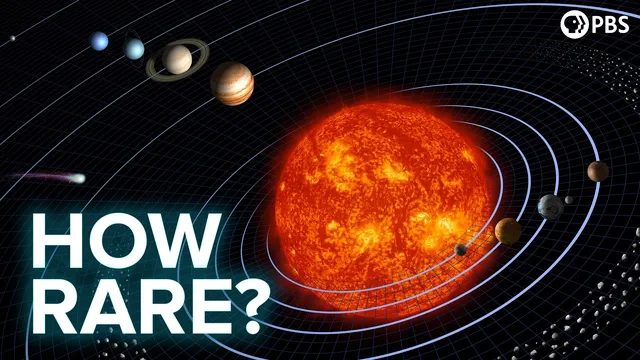
Do We Live in the Rarest Solar System In The Universe? We're about to find out!
Based on PBS Space Time's video on YouTube. If you like this content, support the original creators by watching, liking and subscribing to their content.
Gaia’s astrometry targets long-period, Jupiter-like planets by measuring tiny sky-position wobbles caused by the star’s orbit around the barycenter.
Briefing
The next major Gaia data releases could finally answer whether our solar system’s architecture is common—or unusually rare—by using a new, complementary planet-hunting technique called astrometry. That matters because the frequency of “solar system twins” directly affects how likely Earth-like life is to arise and survive in the wider galaxy.
For years, astronomers have found plenty of potentially habitable worlds: Earth-mass planets in the right orbital zones around their stars. Yet identifying the full “recipe” for habitability is harder than finding a single Earth analog. Jupiter-like planets may play a protective role—shielding inner worlds from heavy bombardment—but confirmed systems that combine both an Earth-like inner planet and a Jupiter-like outer companion around Sun-like stars are effectively nonexistent in current catalogs. The gap isn’t necessarily about nature; it’s about detection limits.
Most existing surveys have been biased toward planets that are easy to detect quickly. The radial velocity (Doppler) method is sensitive to short-period, close-in giants because stellar wobbles happen faster and are easier to measure. Transit surveys like Kepler can monitor many stars at once, but they need repeated dips—typically at least three—to flag a candidate, and Kepler’s mission lifetime made long-period “exo-Jupiters” difficult to confirm. Meanwhile, the “peas in a pod” pattern seen in many systems—where planets in a given system tend to have similar sizes and often form compact chains of super-Earths or mini-Neptunes—raises questions about why our own system looks different. One prominent hypothesis, the Grant Tack scenario, suggests Jupiter migrated inward, disrupted early planet formation, and then moved back out; if that kind of dynamical upheaval is unusual, then our solar system could be rare.
Gaia’s astrometry approach is designed to break that stalemate. Instead of relying on a planet crossing in front of its star (transits) or on Doppler shifts from stellar motion along our line of sight, astrometry measures tiny changes in a star’s position on the sky caused by the gravitational pull of orbiting planets. Wide-orbit planets create larger astrometric signals because the star’s wobble on the sky grows with orbital separation, and Gaia can observe those motions over time rather than waiting for a full orbit.
Gaia has already demonstrated the method by identifying super-Jupiters—Gaia-4b and Gaia-5b—with 12 and 21 times Jupiter’s mass, orbiting nearby low-mass stars. Those detections required careful filtering of Gaia’s “wobble” signals and confirmation with radial velocity follow-up, but they proved that Gaia can find gas giants far from their stars. The upcoming shift is even more consequential: Gaia Data Release 4, due in December 2026, will include time-series position measurements spanning 5.5 years (about twice the duration of Data Release 3). That longer baseline should enable detection of planets with longer orbital periods.
Astrophysicists Caleb Lammers and Josh Winn estimate that Gaia DR4 will yield about 7,500 exoplanet detections (with uncertainty of a couple thousand), more than doubling the current confirmed total of roughly 6,000. The full dataset, DR5, expected in the early 2030s, could raise the count dramatically—around 120,000 detections—because the longer observing window increases sensitivity to long-period planets and larger stellar wobbles.
Crucially, Gaia should be able to detect Jupiter analogs at orbital distances of roughly 1–5 astronomical units, while TESS can help fill in the inner systems. Together, the combined census could reveal whether systems like ours—an Earth-like world plus a Jupiter-like companion—are common or scarce. If such configurations are rare, it would support the idea that our solar system’s ability to host a uniquely habitable planet may be the exception rather than the rule.
Cornell Notes
Gaia’s astrometry method is poised to test whether our solar system’s layout is unusual by detecting long-period, Jupiter-like planets that earlier surveys struggled to confirm. Unlike transits or Doppler measurements, astrometry tracks tiny changes in a star’s position caused by the gravitational pull of orbiting planets, making wide orbits easier to detect. Gaia has already found super-Jupiters such as Gaia-4b and Gaia-5b, proving the technique works for distant gas giants. Gaia Data Release 4 (December 2026) will add time-series position measurements over 5.5 years, enabling detections of planets with longer orbital periods; DR5 in the early 2030s should expand the yield even further. Pairing Gaia’s outer-planet detections with TESS’s inner-system transits could produce a near-complete census of planetary system architectures and clarify how rare “solar system twins” might be.
Why are Earth-like planets easier to find than Jupiter-like companions in the same system around Sun-like stars?
What does astrometry measure, and why does it favor wide-orbit planets?
How did Gaia’s early astrometric planet detections work in practice?
What changes with Gaia Data Release 4 that make Jupiter analogs more detectable?
How do Gaia and TESS complement each other for finding solar system-like architectures?
What do Lammers and Winn predict Gaia will deliver, and why does the number rise so sharply by DR5?
Review Questions
- What observational limitations of transit and Doppler surveys make long-period Jupiter analogs difficult to confirm, even when they’re massive?
- Explain how the barycenter offset relates to planet mass and orbital separation, and why that improves astrometric sensitivity to wide orbits.
- What combination of Gaia and TESS results would most directly test whether solar system-like architectures are common or rare?
Key Points
- 1
Gaia’s astrometry targets long-period, Jupiter-like planets by measuring tiny sky-position wobbles caused by the star’s orbit around the barycenter.
- 2
Current planet catalogs lack confirmed Sun-like systems that include both habitable-zone Earth-like planets and Jupiter-like outer companions, largely due to detection biases and long orbital timescales.
- 3
Transit surveys need multiple repeated dips and limited mission lifetimes make exo-Jupiters hard to confirm; Doppler surveys are less efficient at scanning huge numbers of stars for candidates.
- 4
Gaia has already demonstrated astrometric planet detection with super-Jupiters Gaia-4b and Gaia-5b, later confirmed using radial velocity follow-up.
- 5
Gaia Data Release 4 (December 2026) will add time-series astrometric measurements over 5.5 years, improving sensitivity to planets with longer orbital periods.
- 6
Astrophysicists Caleb Lammers and Josh Winn estimate ~7,500 exoplanet detections in DR4 and ~120,000 in DR5, driven by longer baselines and larger stellar wobbles for wide orbits.
- 7
Combining Gaia’s outer-planet detections with TESS’s inner-system transits could produce a near-comprehensive census of system architectures and test whether solar system twins are rare.