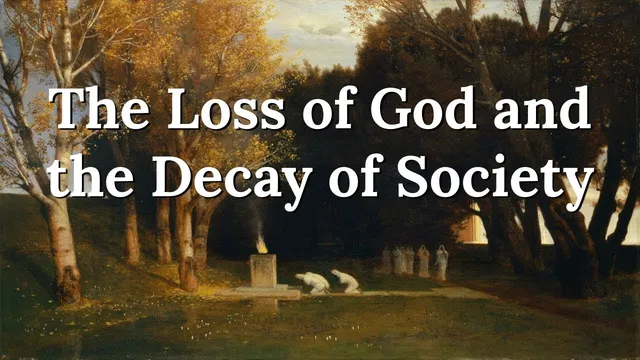
Do we Need God? - The Loss of God and the Decay of Society
Based on Academy of Ideas's video on YouTube. If you like this content, support the original creators by watching, liking and subscribing to their content.
Religion is defined as a disciplined attempt to connect human life with the divine, not merely acceptance of doctrines.
Briefing
A decline in belief is framed as more than a private loss: it’s presented as a cultural opening for “man-made gods,” utilitarian moral thinking, and ultimately political domination—problems that an authentic religious revival is said to counter. The core claim is that religion’s social value depends less on doctrinal agreement than on cultivating a lived “religious disposition” that reconnects people to the “ground of Being,” producing humility, compassion, meaning, and psychological resilience.
The argument begins by defining religion as an attempt to connect human life with the divine. Across major traditions—Hinduism, Judaism, Buddhism, Christianity, Islam, and others—religion is described as enduring far longer than states or empires, even as its popularity rises and falls. That shared durability is used to challenge the idea that secularization equals progress. Instead, the discussion distinguishes two meanings of “god.” A lower-case “god” is treated as a supernatural being that rules the universe, a concept that raises evidential and philosophical problems and can push people toward atheism. The alternative, capital-G God, is portrayed as the transcendent source or “ground of Being”—not a discrete creature among others, but the continuous source of existence.
To explain this upper-case conception, the transcript leans on Iain McGilchrist’s question of why anything exists at all, rather than what physical processes caused the universe. The “ground of Being” is described as beyond rational capture, so traditions rely on symbols, myths, and ritual practices to communicate and orient the self toward the mystery. Different cultures use different names—Brahman, Logos, Tao, YHWH, Ri, Allah, and “God” in the West—but the underlying idea is presented as similar: an infinite source that is both transcendent and immanent.
From there, religion’s purpose is argued to be experiential. Drawing on William James and Karen Armstrong, the transcript emphasizes that religious truth is “intimately encountered” through spiritual exercises—prayer, meditation, solitude, sacred texts, worship, and disciplined practice—rather than absorbed passively like information. While organized religion can be corrupted by literalism and social trends, the transcript argues that most people benefit from established traditions because they preserve effective practices for sustaining awe and wonder. A “religion between you and your God” approach is offered as a way to use rituals without surrendering personal growth to rigid institutions.
The social consequences of losing this connection are then laid out. As Christianity declined in the late 19th century, Nietzsche’s “God is dead” is invoked alongside the rise of nihilism—though the transcript claims nihilism didn’t fully take hold because people still seek meaning. Instead, society allegedly filled the vacuum with substitutes: ideologies, nationalism, celebrities, consumer goods, drugs, sex, and even technology or science treated as savior forces. These substitutes are described as religious in structure and claims, yet vulnerable to corruption because they are human-made.
Finally, the transcript links religious experience to moral and psychological effects. It argues that religious practice counters utilitarianism’s tendency to treat individuals as resources and to tolerate coercion for the “greater good.” By contrast, religious experience is said to generate harmony, compassion, reverence for life, and a humility that reduces entitlement and dishonesty. Religion is also framed as a “mental pharmacy” that supplies meaning and helps people resist despair and addiction. The prescription is not merely more belief, but good people anchored in the divine who can stand up to corrupt authority and resist the false idols—especially the State—when society loses its sacred center.
Cornell Notes
The transcript argues that religion matters socially because it is a disciplined way of connecting to the “ground of Being,” not just a set of doctrines. It distinguishes a problematic lower-case “god” (a supernatural being) from a capital-G God understood as the source of existence itself. Religious practice—prayer, meditation, worship, sacred texts, and other exercises—is presented as what enables a direct religious experience, which then produces humility, compassion, meaning, and psychological resilience. Without that connection, the discussion claims societies replace God with man-made idols (ideologies, nationalism, consumerism, technology), and moral reasoning shifts toward utilitarian calculation that can justify harming minorities. An authentic religious revival is offered as a remedy that strengthens people’s capacity to resist corrupt authority and false gods.
Why does the transcript treat “God” as more than a supernatural being?
What role do rituals and spiritual exercises play in the proposed definition of religion?
How does the transcript handle the tension between organized religion and personal spiritual growth?
What social mechanism is claimed to drive moral and political decline when belief in God fades?
How does religious experience connect to morality in the transcript’s framework?
Why does the transcript insist religion must be more than “good ideas” to be effective?
Review Questions
- How does the transcript’s capital-G concept of God differ from the lower-case “god” idea, and why does that distinction matter for the argument about atheism?
- What kinds of practices are listed as ways to cultivate a religious disposition, and what outcomes are claimed to follow from successful practice?
- According to the transcript, what replaces God when belief declines, and how is that replacement linked to political and moral problems?
Key Points
- 1
Religion is defined as a disciplined attempt to connect human life with the divine, not merely acceptance of doctrines.
- 2
Capital-G God is framed as the “ground of Being”—the source of existence—rather than a discrete supernatural being among other objects.
- 3
Religious truth is presented as experiential: prayer, meditation, worship, and sacred practices are meant to produce a direct religious experience.
- 4
Organized religion can be corrupted, but established traditions are still argued to be useful because they preserve effective practices for sustaining awe and wonder.
- 5
When the sacred center fades, the transcript claims societies replace God with man-made idols such as ideologies, nationalism, consumerism, and technology.
- 6
Religious experience is said to generate humility, compassion, and reverence, countering utilitarian moral reasoning that can justify harming minorities.
- 7
A religious revival is portrayed as necessary not only for personal healing but also for resisting corrupt authority, including the State.