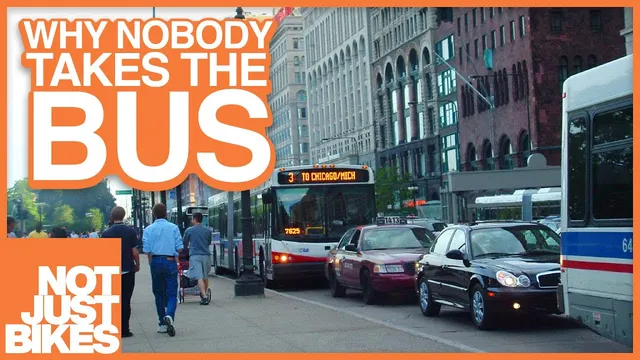
Do Your Buses Get Stuck in Traffic? Traffic solutions & the Downs-Thomson Paradox
Based on Not Just Bikes's video on YouTube. If you like this content, support the original creators by watching, liking and subscribing to their content.
The Downs–Thomson paradox links car congestion to how fast comparable trips are by public transport, not just to how many roads exist.
Briefing
A city’s traffic performance often hinges less on how many roads it builds and more on whether alternatives to driving—buses, streetcars, trams, cycling, and even walking—can move reliably. That insight comes from the Downs–Thomson paradox: the equilibrium speed of car traffic is shaped by the average door-to-door speed of comparable public-transport trips. In plain terms, if buses and trams get stuck in the same congestion as cars, then transit never becomes meaningfully faster, and car traffic keeps worsening until driving is no longer the “best” option for many people.
The paradox isn’t treated as a quirky theory. It’s framed as a predictable outcome of how most people choose transportation: the majority simply want to get from point A to point B as quickly and conveniently as possible. When public transport is slow and unreliable, it tends to attract only those with few alternatives—often described as people who are “poor” or “desperate”—which then weakens political support for improving service. In that environment, car-focused priorities can harden: wealthy residents with influence may view transit as an inconvenience, even complaining that streetcars or other transit infrastructure gets in the way of driving.
As a result, cities can end up in a feedback loop. If transit can’t compete on speed, car traffic expands almost indefinitely. North American cities are cited as examples where governments take on growing debt to build roads they can’t afford, trying to manage congestion that keeps returning. Instead of a sharp “rush hour” window, congestion can stretch into several hours as drivers adjust by leaving earlier and earlier—illustrated with Toronto traffic that remains heavy even at 2 p.m. during summer holidays.
The practical takeaway is that improving transit speed can reduce car traffic, even if only part of the population switches modes. Several cities are highlighted for taking steps that give transit priority by removing or restricting cars on key corridors: New York’s near-removal of cars from 14th Street to speed buses, San Francisco’s similar move on Market Street, and Toronto’s reduction of cars on King Street, which increased streetcar ridership. The same logic is extended beyond transit: if cycling becomes more convenient, some drivers switch to bikes; if walking becomes safer or faster, people walk instead. Downtown Toronto is cited with an especially striking figure—40% of residents walking to work—attributed to unsafe cycling conditions and traffic so bad that walking can become quicker than driving.
The message to drivers is framed as a trade-off. Yes, transit priority can force detours or delays for cars, such as circuitous routes or waiting while bicycles and transit have priority. But the alternative is worse: if driving becomes quick and convenient, more people will choose cars, making direct car routes slower over time and worsening the broader harms of congestion. The Downs–Thomson paradox, in this telling, turns traffic management into a mode-choice problem: make alternatives faster for even a segment of travelers, and car congestion can ease rather than spiral.
Cornell Notes
The Downs–Thomson paradox links car congestion to how fast alternatives to driving are. If buses, trams, or other non-car options get stuck in traffic, they never become competitive, so more people keep driving and car traffic worsens toward an equilibrium where driving remains “best” for too many trips. The transcript argues this happens because most people choose the quickest, most convenient option available, and weak transit performance can lead to weak political support. Case examples include corridor car restrictions in New York, San Francisco, and Toronto that improved transit speeds and ridership. The same mechanism applies to cycling and walking: when those options become faster or safer, some drivers switch modes, reducing car volumes and congestion.
What is the Downs–Thomson paradox, and how does it connect transit speed to car congestion?
Why does weak public transportation often persist in cities that rely on cars?
How do road-building efforts typically fail under the paradox?
What corridor changes are cited as practical fixes, and what outcomes followed?
How does the paradox extend beyond buses and trams?
Why might drivers dislike transit priority, and why does the transcript argue that’s still better?
Review Questions
- How does the transcript connect door-to-door travel time by transit to the long-run speed of car traffic?
- What political and social dynamics are described as making transit improvements harder in car-dominant cities?
- Give two examples of how making alternatives faster (not necessarily universal mode switching) can reduce car congestion.
Key Points
- 1
The Downs–Thomson paradox links car congestion to how fast comparable trips are by public transport, not just to how many roads exist.
- 2
If buses and trams are slowed by traffic, they never become competitive, so more trips remain in cars and congestion worsens.
- 3
Car-first planning can persist when transit is stigmatized and political support for service improvements stays weak.
- 4
Road expansion can fail financially and operationally when transit speed isn’t improved, leading to persistent or lengthening congestion windows.
- 5
Restricting cars on key corridors to prioritize buses and streetcars can increase ridership and reduce car volumes.
- 6
Mode shifts don’t require everyone to abandon cars; making alternatives faster for a segment can still produce meaningful congestion relief.
- 7
Transit and cycling priority may inconvenience drivers in the short term, but the transcript argues that it prevents a longer-term spiral of worsening car traffic.