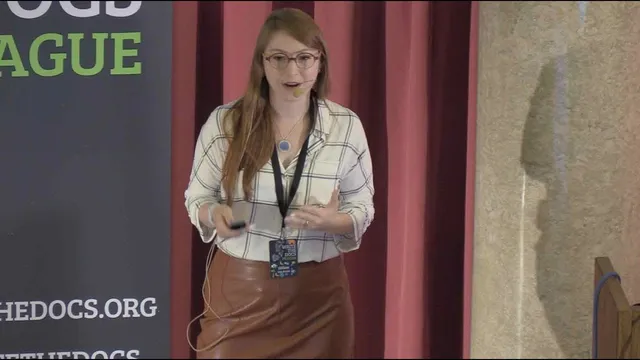
Document What Matters: Lean Best Practice for Process Documentation - Gillian von Runte
Based on Write the Docs's video on YouTube. If you like this content, support the original creators by watching, liking and subscribing to their content.
Treat documentation as value delivery: remove documentation for unused features or steps to avoid waste.
Briefing
Lean best practice for process documentation starts with a blunt premise: document only what creates customer value, and keep it current by making documentation part of everyday work. Continuous improvement teams often treat documentation as a burden—especially when there’s no dedicated technical writing staff, tight delivery timelines, or early-stage buy-in. The result is predictable: either documentation never gets started, or it’s produced in bulk and becomes unusable because it goes out of date.
The core fix is to apply lean thinking to documentation decisions the same way lean applies to product and process work. First, eliminate the need: if a feature, step, or service capability isn’t used or doesn’t solve a real customer problem, documenting it is waste. Instead of adding an extra layer of instructions around something customers don’t want, teams should simplify the underlying experience where possible and focus on what users actually need. That includes designing for intuitive use—when the interface or service flow is self-evident, documentation shrinks naturally—and reducing risk so users can recover when something goes wrong. Repetition also matters: tasks people perform consistently tend to require less explanation, so documentation can concentrate on the moments where errors are most likely.
Second, use “show, don’t tell” through on-the-ground instructions placed near the point of action. Visuals, diagrams, and short videos often communicate faster than text and can embed the “why” behind the rule, not just the command. The talk illustrates this with multiple real-world signage examples: a wall of text at a monkey park that people ignore versus a prioritized, visual set of key do-not-do rules; empathetic illustrations in Japan that discourage feeding pigeons by showing the impact on the animal; and diagrams in restrooms that turn compliance into something immediately understandable and even humorous. The message is that visuals reduce cognitive load and increase attention, especially when people are rushed.
Third, target value by prioritizing documentation around the interactions that matter most. Lean Six Sigma customer experience thinking pushes teams to focus on high-impact customer touchpoints and risk areas—where customers repeatedly make mistakes, where pain points recur, or where failures carry meaningful consequences. A key framework borrowed from Scandinavian Airlines’ “moments of truth” approach breaks the problem into three steps: identify the customer surface (where interaction happens), select the critical areas (not every interaction is equal), and improve those moments—often by changing how instructions are described so users avoid errors.
A detailed example comes from problematic elevator signage. Instructions told riders to “select the destination floor,” “move,” and followed confusing wording and excessive text—leading to queues, frustration, and repeated wrong actions. Reframing the signage around moments of truth produced a clearer, error-tolerant flow: use precise verbs like “enter,” provide a pathway when lifts are full (advise reception), and shorten steps so riders can act immediately rather than interpret long instructions.
Finally, documentation must become normal—or be removed. If it sits unused, it will drift out of date and lose trust. In agile environments without technical writers, the talk argues for shared ownership: everyone involved updates documents with every change, aligns internal process with what users see, and uses lightweight visual management (including “measles charts”) to track where customers struggle. The result is documentation that stays relevant, reduces errors, and supports continuous improvement instead of becoming shelfware.
Cornell Notes
Lean documentation work should be treated like value delivery: remove what isn’t needed, make what remains easy to use, and keep it current. The approach emphasizes eliminating wasteful features from the documentation scope, using “show, don’t tell” with on-the-ground visuals and videos near the point of action, and targeting the highest-value interactions first—especially risk points and recurring customer mistakes. A “moments of truth” lens helps teams identify where customers actually interact and which touchpoints deserve the clearest instructions. Finally, documentation must be “normal or not at all”: if it isn’t used daily, it will go out of date, so teams need shared ownership to update it with every change.
Why does “eliminate the need” matter more than producing more documentation?
What does “show, don’t tell” look like in practice for process documentation?
How do teams decide what to document first using a value lens?
What are “moments of truth,” and how do they change documentation decisions?
Why is “normal or not at all” a documentation rule, not just a slogan?
How can teams track where documentation or processes fail without heavy bureaucracy?
Review Questions
- Which documentation decisions would you classify as “waste,” and what evidence would you use to justify eliminating them?
- How would you redesign a confusing sign or instruction using on-the-ground visuals and a moments-of-truth approach?
- What mechanisms would you put in place so documentation stays updated in an agile team without technical writers?
Key Points
- 1
Treat documentation as value delivery: remove documentation for unused features or steps to avoid waste.
- 2
Make the experience more intuitive and reduce error risk so documentation doesn’t have to compensate for poor design.
- 3
Use on-the-ground instructions near the point of action, relying on visuals, diagrams, and short videos to communicate quickly and clearly.
- 4
Prioritize documentation around high-value customer interactions—risk points, frequent touchpoints, and recurring user mistakes.
- 5
Apply the “moments of truth” lens to identify where customers interact and which touchpoints need the clearest, most error-tolerant guidance.
- 6
Adopt “normal or not at all”: if documentation isn’t used daily, it will go out of date, so either integrate it into daily work or remove it.
- 7
Create shared ownership for updates in agile environments, and use visual tracking (e.g., measles charts) to spot and fix recurring failure points.