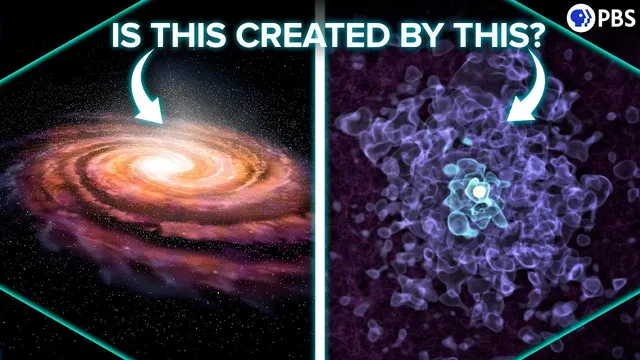
Does Axionic Dark Matter Bind Galaxies Together?
Based on PBS Space Time's video on YouTube. If you like this content, support the original creators by watching, liking and subscribing to their content.
Dark matter could be an axion field that behaves like a superfluid when axions are light enough for their de Broglie wavelengths to overlap and become coherent.
Briefing
Dark matter may not be a new kind of particle at all—it could be an axion field behaving like a galaxy-scale quantum superfluid, and that wave nature could both bind galaxies and potentially fix tensions in the standard “cold dark matter” picture. The core idea is that if dark matter consists of extremely light bosons (axions), their de Broglie wavelengths become so large that individual particles lose their identity and merge into a coherently oscillating field. In that regime, the dark matter halo forms not from particles bouncing onto random orbits, but from gravitationally bound interference patterns—yet the large-scale mass distribution can still mimic the familiar halos produced by WIMPs.
The standard cosmology, often summarized as Lambda-CDM, treats dark matter as “cold” and effectively collisionless: it clumps under gravity, creating halos that seed galaxy formation. WIMPs—weakly interacting massive particles—are the leading particle candidate in this framework. In the WIMP picture, a collapsing cloud virializes: particles fall toward the center, pass through, and end up on chaotic orbits whose random motions act like pressure, keeping the halo “puffy.” Simulations using this approach reproduce many large-scale features of the universe, from the cosmic web down to galaxy and cluster scales. But WIMPs remain undetected despite decades of searches, and small-scale structure predictions have long been a weak spot—especially around the abundance of small satellite galaxies and the steepness of dark-matter density “cusps” in galaxy centers.
Axions offer an alternative route to the same gravitational outcomes, with a different microscopic story. As axion mass decreases, the quantum wavelength grows. Once the wavelength becomes comparable to the spacing between particles, bosonic wavefunctions overlap and can blend into a single coherent oscillation. For axions with masses around 10^-5 eV (a value associated with the QCD axion), the resulting “superfluid” behavior would have a characteristic structure scale on the order of the de Broglie wavelength—hundreds of meters or less—so on solar-system and larger scales the gravitational field would look smooth. That matters because it means axion dark matter can reproduce the same average, large-scale halo density profiles and thus remain consistent with the successes of cold, collisionless-fluid modeling.
Where axions may pull ahead is in the smallest structures. If the axion mass is tuned far lower—around 10^-20 eV—its de Broglie wavelength could stretch to thousands of light-years. That wave nature would suppress the formation of very small clumps and reduce how sharply dark matter concentrates in galaxy centers, aligning better with observations that show fewer satellites and flatter central density profiles than many CDM simulations predict. This ultralight scenario is often called “Fuzzy Dark Matter,” and it could be detectable: interference patterns on galactic scales would produce a grainy gravitational signal, with gravitational lensing proposed as a way to search for it. The transcript also notes a semi-reasonable motivation for such ultralight axions from string theory, though that still leaves the big question of whether the standard Lambda-CDM model truly needs replacing.
In short: axionic dark matter could bind galaxies through quantum coherence, look nearly identical to WIMPs on large scales, and—if the axion is ultralight—change the small-scale structure enough to address longstanding discrepancies, potentially offering new observational handles like lensing.
Cornell Notes
The standard Lambda-CDM model treats dark matter as cold and collisionless, often motivated by WIMPs that virialize into puffy halos. Axionic dark matter changes the microscopic picture: for sufficiently light axions, bosonic wavefunctions overlap and merge into a coherently oscillating field, behaving like a superfluid. Even though the halo forms from interference patterns rather than particle orbits, the large-scale density distribution can match WIMP-like halos, especially for “standard” QCD axion masses around 10^-5 eV. The biggest potential payoff comes if axion mass is far smaller (about 10^-20 eV), producing “Fuzzy Dark Matter” whose huge de Broglie wavelength suppresses small clumps and flattens central cusps. That wave-driven structure could leave observable signatures, such as graininess in gravitational lensing.
Why does lowering axion mass eventually turn particle-like behavior into a galaxy-scale wave?
How can axion dark matter form a halo if it doesn’t virialize like WIMPs?
What makes axion halos potentially indistinguishable from WIMP halos on large scales?
What specific small-scale problems in CDM motivate considering ultralight axions?
How does an axion mass near 10^-20 eV lead to “Fuzzy Dark Matter” effects?
What observational strategy is proposed to detect fuzzy dark matter?
Review Questions
- What conditions on axion mass and particle spacing make wavefunction overlap unavoidable?
- Compare how WIMP virialization and axion superfluid interference produce halo support and density profiles.
- Why would ultralight axions suppress small galaxies and flatten central cusps compared with standard CDM?
Key Points
- 1
Dark matter could be an axion field that behaves like a superfluid when axions are light enough for their de Broglie wavelengths to overlap and become coherent.
- 2
WIMP halos form through virialization into random orbits, while axion halos arise from gravitationally bound interference patterns of overlapping waves.
- 3
For QCD-axion-like masses around 10^-5 eV, axion dark matter’s fine structure is so small (hundreds of meters or less) that its gravity averages to a WIMP-like smooth halo on large scales.
- 4
Axion dark matter can still match the large-scale successes of cold, collisionless-fluid modeling even if the microscopic mechanism differs.
- 5
Standard CDM tensions include too many small substructures and overly steep central density cusps compared with observations.
- 6
If axion mass is pushed to ultralight values near 10^-20 eV, the huge de Broglie wavelength suppresses small-scale clumping and produces “Fuzzy Dark Matter.”
- 7
Gravitational lensing is a proposed way to detect fuzzy dark matter via grainy interference-driven structure, though evidence is not yet conclusive.