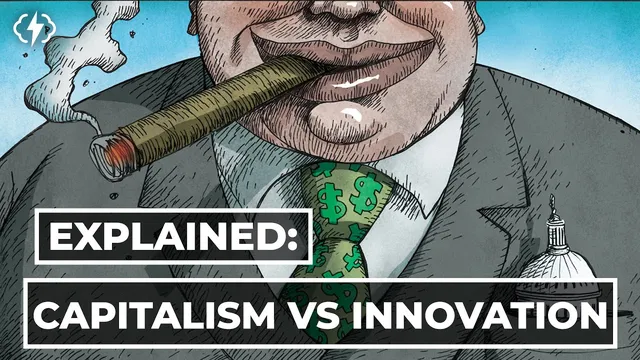
Does Capitalism Really Drive Innovation?
Based on Second Thought's video on YouTube. If you like this content, support the original creators by watching, liking and subscribing to their content.
Innovation is presented as possible without profit incentives, illustrated by Jonas Salk’s refusal to patent the polio vaccine and the resulting rapid global adoption.
Briefing
The central claim is that capitalism is often credited as the engine of innovation, but innovation actually comes from motives and institutions that don’t depend on profit—and in many cases profit incentives actively distort what gets funded. The argument matters because it challenges a common justification for inequality: if capitalism is the only path to progress, then declining living standards for most people can be dismissed as the price of “innovation.” The case here flips that logic, saying the profit motive is better at producing profitable variations than breakthroughs that improve lives.
A key example is Jonas Salk’s polio vaccine. After polio devastated children—most severely in the 1952 U.S. outbreak, with tens of thousands infected and thousands dead—Salk spent years developing a vaccine. When the breakthrough became public, he could have monetized it, yet he refused to patent it. The result was rapid, widespread manufacturing: by 1959, about 90 countries were using the vaccine, and by 1994 polio had been eradicated in North America. The point isn’t that money never matters; it’s that innovation can be driven by duty, public health priorities, and a desire to maximize availability rather than capture monopoly profits.
The argument then targets a second, broader claim: that the private sector is the primary driver of innovation. Instead, it argues that many foundational technologies in everyday life were built with public funding. The iPhone is used as a shorthand example: microchips, GPS, accelerometers, image sensors, and touch screens are described as products of government or military research. More broadly, the piece lists public-sector contributions—satellites, the internet, public schools, national parks, waste management, and water infrastructure—as the infrastructure people rely on daily. Even Elon Musk’s projects are framed as dependent on billions in government support.
From there, the profit motive is portrayed as a mechanism that steers resources toward what can be sold and patented rather than what is most beneficial. In pharmaceuticals, the incentive structure is described as encouraging “slight variations” to extend patent life instead of prioritizing critically needed new medicines. The same logic is extended to consumer goods, where profitability can mean producing many near-identical products rather than meaningful improvements.
To contrast profit-driven systems with non-profit or state-run approaches, Cuba’s healthcare is cited. Despite a lower GDP than the U.S. and decades of U.S. sanctions, Cuban doctors are described as making major medical advances and responding during the pandemic by managing their own outbreak and sending doctors and supplies abroad without profit expectations.
Finally, the discussion connects innovation to labor bargaining power. When low-wage workers quit or refuse jobs—partly because unemployment benefits can pay more—managers respond with signs blaming workers for “not wanting to work.” The argument rejects that framing, saying people don’t want degrading labor for starvation wages; they want productive work that matches their skills and time. Instead of improving jobs, the piece claims capitalists push for government enforcement that limits workers’ leverage, reinforcing the idea that capitalism doesn’t innovate where it would matter most.
Overall, the conclusion is blunt: the claim that there would be no innovation without capitalism is presented as false, contradicted by historical cases like Salk’s vaccine, by public-sector technology development, and by international examples where profit is not the organizing principle for healthcare and crisis response.
Cornell Notes
The transcript argues that capitalism is frequently credited as the driver of innovation, but innovation often comes from non-profit motives and public institutions—and profit incentives can even block progress. Jonas Salk’s polio vaccine is used to show that a breakthrough can spread rapidly when patents are refused, enabling global manufacturing and eventual eradication in North America. The discussion also claims many core technologies behind modern devices and infrastructure were funded by governments or militaries rather than private firms. It further argues that profit structures steer funding toward patentable variations and profitable products instead of the most socially valuable outcomes. Cuba’s healthcare is offered as a contrasting case where medical advances occur without reliance on profit incentives, even under sanctions.
Why does Jonas Salk’s decision not to patent the polio vaccine matter for the argument about innovation?
What technologies does the transcript claim were built with public funding rather than private-sector innovation?
How does the profit motive get portrayed as a barrier to innovation in pharmaceuticals?
What role does Cuba’s healthcare system play in the transcript’s comparison?
How does the transcript connect labor shortages in low-wage jobs to the innovation debate?
Review Questions
- What specific evidence is used to argue that innovation can occur without patents or profit incentives?
- Which public-sector technologies are cited as foundational to modern consumer devices, and how does that support the broader claim about innovation?
- How does the transcript describe the way pharmaceutical patent incentives shape what gets funded and developed?
Key Points
- 1
Innovation is presented as possible without profit incentives, illustrated by Jonas Salk’s refusal to patent the polio vaccine and the resulting rapid global adoption.
- 2
Public funding and military research are credited with developing many technologies that underpin modern consumer life, including components tied to smartphones.
- 3
Profit incentives are portrayed as steering investment toward what can be sold and patented, which can reduce incentives for genuinely high-impact innovation.
- 4
In pharmaceuticals, the incentive structure is described as encouraging incremental drug variations to extend patents rather than prioritizing critical new treatments.
- 5
Cuba is offered as an example of medical progress occurring without reliance on profit motives, even under severe U.S. sanctions.
- 6
Labor-market dynamics are used to argue that workers resist low-wage, degrading work, and that employers often seek government enforcement rather than improving conditions.