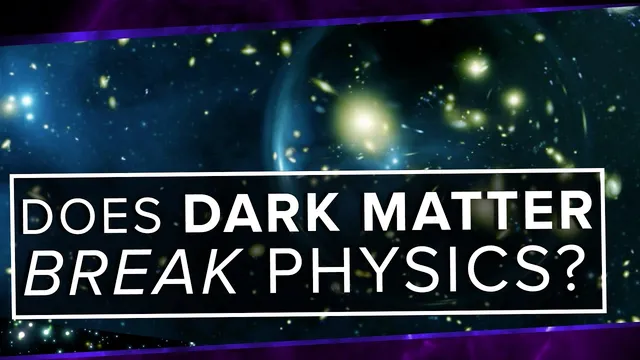
Does Dark Matter BREAK Physics?
Based on PBS Space Time's video on YouTube. If you like this content, support the original creators by watching, liking and subscribing to their content.
The Milky Way’s rotation requires about 80–90% more mass than visible matter provides, creating the dark matter problem.
Briefing
Dark matter is real, and the strongest evidence points to it behaving like an unseen form of matter rather than a flaw in gravity—yet its identity remains unknown. The Milky Way’s stars orbit too quickly for the gravity produced by visible matter alone, leaving a gap of roughly 80–90% of the mass needed to hold galaxies together. That mismatch forces a choice: either most matter has not been detected, or gravity (as currently described) fails on galactic and cluster scales.
Gravitational lensing provides independent confirmation that something extra is present. In general relativity, massive objects bend spacetime, so light follows curved paths. When galaxy clusters sit along the line of sight to more distant galaxies, their gravity acts like a lens, stretching and duplicating background light into “funhouse mirror” images. By measuring how much the light is warped, astronomers infer the total mass required to produce the lensing. In cluster after cluster, the inferred mass exceeds what stars and gas alone can account for—again implying missing mass.
From there, the possibilities narrow to three broad categories. One is “dark matter” made of known particles but in an extremely hard-to-detect form—baryonic objects like compact, dead stars or black holes. These are often grouped under MACHOs (massive compact halo objects). They can, in principle, reveal themselves through gravitational microlensing: when a compact object passes between Earth and a background star, the star briefly brightens. Surveys have found microlensing events, but not enough to supply all the dark matter, ruling out this best-case scenario.
That leaves two uncomfortable alternatives. Either particle physics is incomplete—meaning dark matter is a new particle—or Einstein’s gravity is incomplete on large scales. Modified gravity ideas try to change how gravitational strength falls off with distance, for example shifting from an inverse-square law to something closer to an inverse-distance behavior at galactic scales. Some such models can reproduce certain orbital patterns, but they struggle to match the full range of observations without heavy fine-tuning.
The Bullet Cluster delivers a decisive stress test. Two galaxy clusters collide and pass through each other. The hot gas is stripped away and ends up between the clusters, while the gravitational mass inferred from lensing maps to the locations of the stars rather than the gas. If gravity itself were behaving differently, the lensing signal should track the gas that dominates the collision’s ordinary matter. Instead, the mass behaves like collisionless matter that “passes through,” consistent with an unseen particle component. The lensing alignment therefore favors dark matter as real matter rather than a breakdown of gravity.
What dark matter seems to be, at least in broad physical terms, is “cold” and “heavy,” moving slowly enough to clump under gravity. The early universe’s smooth plasma—described through the cosmic microwave background—needed an additional gravitational ingredient to grow into today’s web of galaxies and clusters. That requirement points toward weakly interacting massive particles (WIMPs), a popular candidate often tied to supersymmetry, which predicts heavier partner particles to known ones. Detecting dark matter remains an open race: experiments on Earth search for rare collisions between dark matter particles and atomic nuclei, while telescopes look for gamma rays that could arise from dark matter annihilations in space. Until a particle is detected directly, the universe keeps its main binder—dark matter—largely hidden, even as its gravitational fingerprints keep getting clearer.
Cornell Notes
Galaxies rotate too fast for the gravity produced by visible matter, implying 80–90% of the mass is missing. Gravitational lensing—light bending in warped spacetime—independently confirms that galaxy clusters contain far more mass than stars and gas alone can explain. Compact baryonic candidates (MACHOs) can be searched via microlensing, but observed events fall short of the required amount. Modified gravity can mimic some galactic behavior, yet the Bullet Cluster shows lensing mass aligns with stars rather than collision-stripped gas, favoring unseen matter that passes through like particles. The leading picture is cold, heavy, weakly interacting dark matter, with WIMPs (often linked to supersymmetry) as a prominent candidate, still awaiting direct detection.
Why does the Milky Way’s rotation imply missing mass?
How does gravitational lensing provide evidence for dark matter independent of galaxy dynamics?
Why are MACHOs (massive compact halo objects) considered but ultimately insufficient?
What is the core logic behind modified gravity models, and what problem do they face?
How does the Bullet Cluster distinguish between “modified gravity” and “dark matter particles”?
What physical properties does cosmology suggest for dark matter, and why do WIMPs enter the picture?
Review Questions
- What two independent lines of evidence point to missing mass in galaxies and clusters?
- Why does the Bullet Cluster’s mass distribution matter for deciding between modified gravity and dark matter particles?
- What observational strategy distinguishes microlensing searches for MACHOs from direct detection experiments for WIMPs?
Key Points
- 1
The Milky Way’s rotation requires about 80–90% more mass than visible matter provides, creating the dark matter problem.
- 2
Gravitational lensing measures total mass via spacetime curvature and repeatedly finds more mass than stars and gas can explain.
- 3
Microlensing searches for MACHOs detect some compact objects but not in sufficient numbers to account for all dark matter.
- 4
Modified gravity can reproduce some galactic behavior, but it struggles to match the full range of observations without major complications.
- 5
The Bullet Cluster shows lensing mass aligns with stars rather than collision-stripped gas, supporting dark matter as real matter that passes through.
- 6
Cosmology favors dark matter that is cold and heavy, enabling gravitational clumping from an initially smooth early universe.
- 7
WIMPs remain a prominent candidate class, with ongoing searches for rare particle interactions and possible gamma-ray signatures from annihilation.