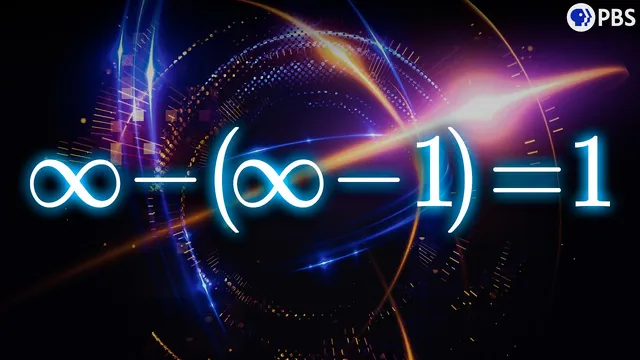
Does Infinity - Infinity = an Electron?
Based on PBS Space Time's video on YouTube. If you like this content, support the original creators by watching, liking and subscribing to their content.
The electron’s measured mass is a dressed quantity: bare mass plus the mass-equivalent energy of electromagnetic field fluctuations.
Briefing
The mass of an electron looks “small” only because huge, often divergent contributions from quantum fields cancel out in a controlled way—an arrangement that feels unnatural until quantum mechanics supplies a symmetry-based mechanism. In the simplest accounting, the measured electron mass (511 eV) is a “dressed” mass: the sum of a bare mass and the mass-equivalent energy of the electron’s surrounding electromagnetic field fluctuations. Quantum electrodynamics (QED) predicts that the field’s self-energy contributions can be enormous or even infinite if one naïvely sums over all virtual processes at arbitrarily short distances. Renormalization then redefines the bare parameters so the combined result matches the observed mass, turning mathematical infinities into finite predictions.
That still leaves a deeper worry: why do the bare and self-energy pieces have to match so precisely that their difference yields the tiny measured value? For a classical estimate, the electron’s electromagnetic field energy would correspond to a mass about 20,000 times larger than the observed electron mass if the electron is no bigger than roughly 10^-17 m; if treated as point-like, the field energy diverges. Quantum field theory reproduces the same problem: Feynman diagram calculations include loop processes where intermediate virtual particles can carry arbitrarily high energies, so the self-energy sum diverges. The fix is “hokey” in appearance—splitting divergent diagrams into a regular infinite part and a counter-term that cancels it—but the payoff is that QED’s predictions for electron behavior are extraordinarily precise. The theory’s success doesn’t come from predicting the electron’s mass from scratch; it comes from calibrating the renormalization procedure to measured quantities.
The hierarchy problem is the naturalness version of this calibration puzzle. If the electron’s self-energy is driven up toward extreme scales, why doesn’t the observed mass blow up as well? The discussion frames quantum field theory as an effective theory that must break down at very high energies (near the Planck scale, around 10^-35 m or 10^28 eV). If one imposed such a cutoff, the remaining uncanceled self-energy would still be about 10^22 times larger than the electron’s mass—so the required cancellation would be even more finely tuned than in the classical picture.
For the electron, though, a specific quantum mechanism prevents that worst-case scenario without delicate coincidence. When the electron’s surrounding energy becomes comparable to its rest mass, virtual positrons can annihilate with the real electron, effectively replacing it with a virtual electron. This interaction contributes a negative piece to the electron’s self-energy that cancels the leading positive term, leaving only smaller, second-order contributions. The cancellation is protected by an underlying symmetry tied to matter–antimatter structure: chiral symmetry associated with the electron’s particle content. The result is that the remaining self-energy scales in a way that tracks the bare mass, avoiding the need for extreme fine-tuning.
The hierarchy problem for the Higgs boson remains unsolved in this narrative. Unlike the electron, the Higgs’s small mass requires protection mechanisms that are not yet understood, and that gap motivates the search for physics beyond the Standard Model. Along the way, renormalization and regularization are positioned not just as technical tricks, but as clues about how effective theories emerge from deeper layers of reality and how physics at different energy scales can reshape what counts as “mass.”
Cornell Notes
Electron mass is treated as a “dressed” quantity: the measured 511 eV mass equals a bare mass plus the mass-equivalent energy of electromagnetic field fluctuations around the electron. In QED, summing virtual processes in Feynman diagrams produces divergent (even infinite) self-energy, so renormalization cancels infinities by redefining bare parameters and matching to measured values. The naturalness or hierarchy problem asks why the cancellation between huge positive self-energy and negative bare contributions must be so precise. If one pushes QFT up to the Planck scale, the required cancellation becomes vastly more extreme, making the problem worse. For the electron specifically, a symmetry-protected mechanism involving virtual positron annihilation cancels the leading positive self-energy term, leaving only smaller second-order contributions and avoiding extreme fine-tuning.
What does “dressed mass” mean for an electron, and how does it relate to what experiments measure?
Why do self-energy calculations in QED produce infinities?
How does renormalization turn divergent self-energy into finite predictions?
What makes the hierarchy problem a “naturalness” problem rather than just a technical one?
Why would imposing a Planck-scale cutoff make the hierarchy problem far worse?
What specific mechanism protects the electron’s mass from blowing up?
Review Questions
- How do bare mass and self-energy combine to produce the measured electron mass in QED?
- What role do loop diagrams play in generating divergent self-energy, and why does that lead to a hierarchy/naturalness concern?
- What symmetry-protected process prevents the electron’s mass from requiring Planck-scale-level fine tuning?
Key Points
- 1
The electron’s measured mass is a dressed quantity: bare mass plus the mass-equivalent energy of electromagnetic field fluctuations.
- 2
QED self-energy calculations include loop diagrams whose intermediate virtual energies are not bounded by the electron’s external energy, producing divergences.
- 3
Renormalization cancels infinities by adding counter-terms and redefining bare parameters so the dressed mass matches the observed 511 eV value.
- 4
The hierarchy problem is the naturalness puzzle of why huge contributions cancel to leave a tiny physical mass without implausible fine-tuning.
- 5
If QFT is treated as valid up to the Planck scale, the required cancellation to keep the electron light becomes dramatically more extreme (about one part in 10^22).
- 6
For the electron, virtual positron annihilation and chiral symmetry provide a mechanism that cancels the leading self-energy contribution, leaving only smaller second-order terms.
- 7
The Higgs boson’s small mass lacks an analogous understood protection mechanism, motivating searches for physics beyond the Standard Model.