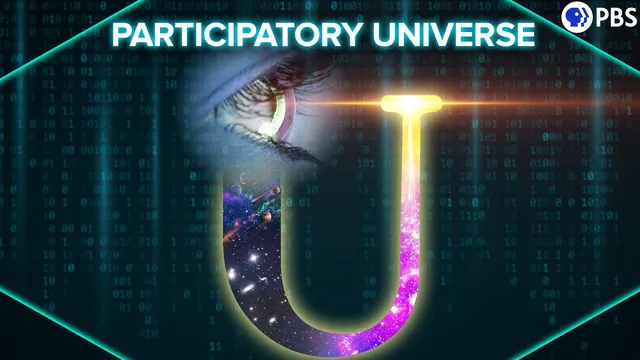
Does the Universe Create Itself?
Based on PBS Space Time's video on YouTube. If you like this content, support the original creators by watching, liking and subscribing to their content.
Wheeler’s “it from bit” view treats particles, fields, and even spacetime as deriving their meaning and existence from binary outcomes produced by measurement interactions.
Briefing
Quantum mechanics forces a choice between two uncomfortable pictures of reality: either the world is fully “out there” independent of observation, or reality is defined through the interaction between what is measured and how it is measured. A particularly radical line of thought—associated with John Archibald Wheeler—pushes the second option further, arguing that the universe’s basic existence is informational and emerges from the answers to yes-or-no questions posed by physical interactions.
The case starts with the observer problem. In the Copenhagen-style view, measurement doesn’t just reveal a pre-existing state; it helps determine what counts as a real phenomenon at all. That stance becomes vivid through thought experiments. Schrodinger’s cat places a system in a superposition—alive and dead—until the box is opened. Wigner’s friend extends the puzzle: if a second observer treats the first observer and the cat as part of a larger quantum system, the “measurement” doesn’t end the uncertainty; it relocates it. The core difficulty then becomes how separate observers can end up agreeing on a single, consistent reality when observation seems to play a constitutive role.
Wheeler’s contribution reframes the question. Rather than making consciousness the magic ingredient, he emphasizes the “distinction between the probe and the probed”—interaction itself. His slogan “it from bit” claims that particles, fields, and even spacetime’s structure derive their meaning and existence from apparatus-elicited binary answers. In this picture, the universe is not primarily a collection of objects with fixed properties; it is a self-consistent network of outcomes produced by measurement choices.
Delayed-choice experiments illustrate the tension. In a photon setup with beam splitters, quantum theory predicts that the photon behaves as if it takes multiple paths until detection. When a second beam splitter is arranged so that the path information is effectively erased, interference can force the photon’s detection to appear only at one detector—an outcome that depends on the measurement arrangement even if that arrangement is decided after the photon passes the first beam splitter. The implication is not that the past is rewritten by a conscious mind, but that the realized history must be consistent with the measurement context.
Entanglement reinforces the same theme: measuring one particle’s spin along a chosen direction correlates with its distant partner’s outcomes, making the “answers” depend on the “questions” asked. Wheeler turns this into a metaphorical framework with “negative 20 questions,” where the interrogator’s sequence of yes/no questions constrains what the answer must be, even though no object was predetermined. The universe becomes a “participatory” system: reality is the only one compatible with the totality of measurement interactions.
The discussion closes by noting that Wheeler’s ideas can be taken in less mystical directions. “Participatory realism” approaches—such as quantum Bayesianism and relational quantum mechanics—aim to keep an underlying substrate while still treating information and observer–system relations as fundamental. Either way, the central takeaway is that quantum theory makes measurement choices inseparable from what reality ends up looking like, and Wheeler’s “it from bit” makes that dependence the organizing principle.
Cornell Notes
Quantum mechanics makes measurement part of what reality is, not just a way to read it out. Wheeler’s “it from bit” view argues that particles, fields, and even spacetime derive their meaning and existence from binary (yes/no) answers produced by measurement interactions. Delayed-choice and interference experiments suggest that the realized outcome depends on measurement choices that can be set after a system has already entered the apparatus. Entanglement adds that the correlations between distant systems depend on which spin directions are measured. Wheeler’s “participatory universe” emphasizes interaction (the probe–probed distinction) rather than claiming conscious minds directly control physics.
Why do Schrodinger’s cat and Wigner’s friend create trouble for a simple “observer-independent” reality?
What does Wheeler mean by “it from bit,” and what does he treat as fundamental?
How does the delayed-choice experiment illustrate measurement-context dependence?
What role does entanglement play in the “questions determine answers” theme?
What is “negative 20 questions,” and why is it meant to mirror reality-making?
How do “participatory realism” approaches differ from a purely observer-dependent or mystical reading?
Review Questions
- Which quantum paradoxes (cat, Wigner’s friend) motivate the need to rethink how observers share a consistent reality?
- Explain how delayed-choice interference supports the idea that measurement context can determine which outcomes become definite.
- What does “it from bit” claim about particles, fields, and spacetime, and how does that relate to Wheeler’s “participatory universe” metaphor?
Key Points
- 1
Wheeler’s “it from bit” view treats particles, fields, and even spacetime as deriving their meaning and existence from binary outcomes produced by measurement interactions.
- 2
Quantum superposition and observer-dependent measurement become vivid in Schrodinger’s cat and Wigner’s friend, where “definiteness” appears to depend on how observers model the system.
- 3
Delayed-choice interference suggests that the realized detection outcomes depend on measurement configurations that can be chosen after the system has already passed earlier apparatus.
- 4
Entanglement reinforces the theme that measurement choices (e.g., spin directions) shape the correlated outcomes, making “questions” inseparable from “answers.”
- 5
Wheeler’s “negative 20 questions” metaphor frames reality as the only consistent set of answers compatible with the sequence of yes/no interactions.
- 6
Wheeler’s emphasis is on interaction (probe–probed distinction), not on granting conscious minds direct causal power over physics.
- 7
Participatory realism approaches like quantum Bayesianism and relational quantum mechanics aim to keep an underlying substrate while still making information and relations fundamental.